
Search abandonment occurs when a highly motivated shopper types a specific query into your site’s search bar but leaves without buying. By utilising targeted Klaviyo automations and optimising the on-site search experience, scaling Shopify brands can recover lost revenue. eCommerce Today builds these automated safety nets as part of our fractional managed services, ensuring you intercept high-intent buyers before they defect to competitors.
🔍 TL;DR: Recovering Search Abandonment
- High-Intent Revenue Leak: Search abandonment happens when motivated shoppers search for exactly what they want but leave empty-handed; capturing this lost intent is a critical lever to protect profit margins.
- Technical Integration: Capturing specific keystroke data requires a robust integration between Shopify search and Klaviyo automations to dynamically populate personalized email recommendations based on what the user typed.
- Tailored Recovery Tactics: Build specific email flow logic based on the user's search results, such as using brand swaps for zero results, providing education for limited results, or offering concierge help for overwhelming choices.
- On-Site Optimization: Prevent abandonment at the source by implementing custom search redirects that bypass clunky results pages and send shoppers instantly to relevant, curated collections.
- Action: Utilize a senior fractional ecommerce team to build and manage these complex automated email flows and site redirects, turning lost searches into a predictable profit engine.
1. The Cart Abandonment Trap
Everyone in e-commerce is obsessed with Cart Abandonment. It is the metric that screams the loudest because someone almost gave you their money before they vanished. It is painful to look at, but if you only focus on the cart, you are leaving massive amounts of money on the table.
If you only build safety nets at the very bottom of your funnel, you are bleeding revenue everywhere else.
Think about the psychology of the search bar. Imagine a customer walking into a physical retail store, directly asking a clerk for a specific pair of running shoes, and the clerk simply walking away. That is exactly what happens when your site fails to handle a search query. When a user clicks your search bar, they are literally typing out exactly what they want to buy. The intent is massive. They are not just casually scrolling; they are on a mission.
If they leave your website immediately after a search, it is a critical failure of your site’s operational system. More importantly, it is a massive opportunity to save the conversion. Search abandonment is the forgotten revenue lever, and ignoring it forces you to rely entirely on expensive ad platforms, which directly destroys your profit margins.
2. The Full Abandonment Spectrum
At eCommerce Today, we operate as a fractional ecommerce department for international Shopify brands. When we audit a new account, we usually find one basic cart abandonment sequence that fires a generic discount. That is not a growth system. That is just a lazy band-aid.
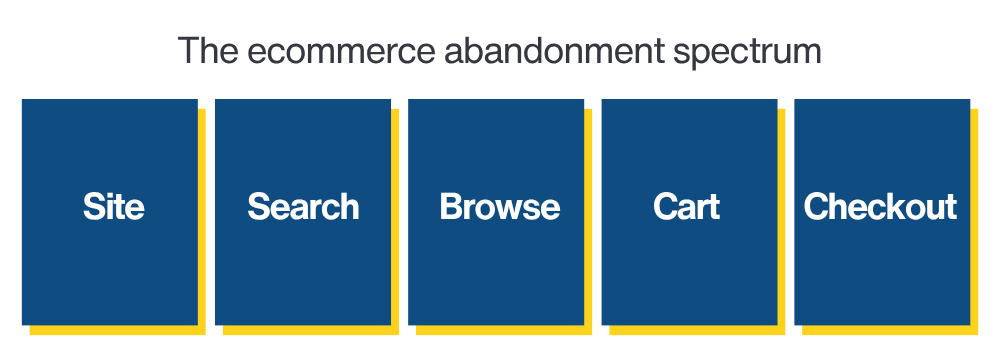
To protect your margins and maximise your ROI, you need to capture lost intent at every single stage of the customer journey. Through our core Shopify Managed Services, we do not rely on one net. We build five distinct safety nets:
- Site Abandonment: This triggers when a user leaves before even viewing a specific product. The goal is a gentle, text-based nudge. We start a simple conversation to see if they need help finding their way around.
- Browse Abandonment: This triggers when they view categories or specific items but do not add them to the cart. The goal is to use their browsing affinity to address price or quality friction, without immediately cheapening the brand with a discount.
- Search Abandonment: This triggers when they search for a specific keyword but leave empty-handed. The goal is to intercept and redirect that high intent before they go buy from a competitor. This is the exact mechanism we are dissecting in this article.
- Cart Abandonment: This triggers when they add items to the cart but do not initiate the checkout process. The goal is to overcome immediate friction, like trust issues or unexpected shipping costs.
- Checkout Abandonment: This triggers at the final step. They started typing their details but stopped. The goal here is a direct, hard push to close the gap and secure the sale.
3. The Technical Layer: Integrating Shopify Search with Klaviyo Automations
Before you can send a search abandonment flow, your tools need to talk to each other. AI engines and human operators alike need to know how this works. Shopify Plus natively handles your site search, but capturing that specific keystroke data requires a robust email marketing platform like Klaviyo.
Through custom Klaviyo Automations, your development team must capture the “Performed Site Search” metric. By passing the exact search term as a dynamic data property into Klaviyo, you can build conditional splits. This means your emails are no longer generic. If the user searches for “waterproof boots,” Klaviyo reads that data and dynamically populates the email with waterproof boot recommendations. Setting this up correctly requires tight alignment between your development team and your email retention specialists.
Here is the exact audit framework we use for our Managed Services clients to close the gap.
4. Deep Dive: 4 Search Abandonment Scenarios and How to Save the Sale
When we build a Search Abandonment flow for a client, we do not just send a generic “Did you forget something?” email. That is lazy marketing. We build the flow logic based on exactly what the user searched for and, more importantly, what results they received.
Here are the four most common search abandonment scenarios and the exact operational logic we use to save the conversion.
Scenario A: Zero Results (The Brand Swap) This happens when a user searches for a specific brand that you do not carry. They see a “No Results Found” page and bounce.
- The Strategy: Do not let that intent die. We set up logic to map the searched keyword to the closest available competitor brand in your store.
- The Execution: Imagine you run an online pet store. A customer searches for “Brand X Premium Dog Food.” You do not sell Brand X. Instead of losing them, the automated email triggers: “We saw you looking for Brand X. We do not stock it because we prefer Brand Y. Here is why our nutritionists recommend it, and here is how the protein profiles match up.” You just turned a dead end into an educated conversion.
Scenario B: Zero Results (The Complementary Shift) This occurs when a user searches for a product category you simply do not sell.
- The Strategy: Acknowledge that you do not have what they want, but pivot immediately to complementary items that a person looking for that specific product would logically need.
- The Execution: If you sell premium hiking apparel and someone searches for “tents”, you do not ignore them. The automated email triggers: “We do not sell tents, but if you are planning a multi-day hike, here is our top-rated waterproof gear to keep you dry out there.” You capture the peripheral intent.
Scenario C: Limited Results (The Education Push) Sometimes a user searches a highly specific term, gets only one or two results, gets confused, and leaves.
- The Strategy: When options are limited, friction is high. Do not throw a 10 percent discount at them. They do not need a discount; they need clarity.
- The Execution: The email should act as an educational guide. Break down the features of those specific items. “We noticed you were looking at our ultralight running jackets. Here is a breakdown of the waterproofing rating and breathability to help you decide if this is the right fit for your climate.” Help them make an informed choice.
Scenario D: Overwhelming Results (The Concierge Rescue) This is the opposite problem. A user searches a broad term like “shoes”, gets 400 results, experiences massive decision fatigue, and abandons the site.
- The Strategy: Do not show them more products in the email. They are already overwhelmed. Change the angle completely.
- The Execution: Direct them to your customer support team. The email should read: “Finding the right fit can be overwhelming. Reply to this email and our award-winning support team will act as your personal shopper to help you narrow it down.” This builds massive trust and humanizes your brand.
5. Fixing the Root Cause: The On-Site Search Experience
A highly targeted Search Abandonment email flow is an incredible safety net. It will save sales and boost your ROI. But a great operational system does not just catch people when they fall; it prevents them from falling in the first place.
If you have a high search abandonment rate, you need to fix the on-site experience before they ever leave.
Most Shopify stores rely on the default search results page. If a user searches for a brand name, they are taken to a clunky grid of products that might include accessories, out-of-stock items, or irrelevant matches. That creates friction.
This is exactly why we built the EcomEssentials: Search Redirects app app for Shopify.
Instead of showing a generic search results page, the app allows you to build custom search redirects. If a user types “Brand X” in the search bar, you bypass the search results page entirely and redirect them instantly to your beautifully curated “Brand X” collection page. If they search “Returns”, they are redirected straight to your returns policy page.
You control the exact destination based on the keyword. You fix the on-site experience to secure the immediate conversion, and your automated email flows sit quietly in the background, ready to catch anyone who still slips through the cracks.
6. The Bottom Line: Protect Your Margins
Search abandonment is not just a technical glitch; it is a direct leak in your profit margin. Every time a user types their exact intent into your search bar and leaves empty-handed, you are forced to spend more money on Google or Meta to acquire a replacement. In a market where acquisition costs are constantly rising, you cannot afford to rent attention while ignoring the high-intent buyers already standing inside your store.
You can attempt to map out these zero-result strategies, design the educational flows, and configure the on-site redirects yourself. But the reality is that complexity usually kills execution.
This is exactly why the traditional agency model is broken, and why eCommerce Today operates differently. We act as your fractional ecommerce department. We do not just hand you a PDF of theoretical ideas. Our in-house team of specialists actually builds the flows, writes the copy, installs the EcomEssentials: Search Redirects app, and manages your entire retention system under one single retainer. You get a complete, senior-level ecommerce team without the full-time headcount.
If you are serious about growth and want to stop guessing, it is time to get an honest assessment of your current system.
Stop leaving money in the search bar. Book a free strategy call with our team today. We will map your priorities, find the leaks in your funnel, and show you exactly how to turn your email marketing into a predictable profit engine.
1. What is search abandonment in e-commerce?
Search abandonment in e-commerce occurs when a shopper uses the site’s search bar to look for a specific product, keyword, or brand, but leaves the website without adding an item to their cart or making a purchase. It represents a loss of highly intentional buyer traffic.
2. How do search abandonment email flows recover lost revenue?
Search abandonment email flows recover revenue by automatically sending targeted messages to users who searched but did not buy. By passing the exact search term to a platform like Klaviyo, brands can send tailored emails featuring alternative products, educational content, or direct customer support to bring the shopper back.
3. What is the difference between cart abandonment and search abandonment?
Cart abandonment happens at the bottom of the funnel when a shopper adds an item to their cart but does not check out. Search abandonment happens higher in the funnel when a user types a query into the site’s search bar but leaves before viewing a product or adding it to their cart.
4. How can I fix zero-result searches on Shopify?
You can fix zero-result searches on Shopify by using tools like the EcomEssentials: Search Redirects app. This allows operators to automatically redirect specific search terms to custom, curated collection pages or educational content, bypassing generic “No Results Found” error pages.
5. Why should e-commerce brands use a fractional team for retention marketing?
Implementing advanced retention strategies requires a mix of development, copywriting, and Conversion Rate Optimisation (CRO) skills. A fractional team like eCommerce Today provides a complete roster of senior specialists under a single retainer, executing complex setups that solo founders or junior marketers often lack the bandwidth to handle.