
For twenty years, e-commerce has run on one basic assumption: the customer eventually has to come to you. They see an ad, they click, they land on your website, they browse, and somewhere in that sequence of pages, they either buy or they don’t. Every metric we obsess over, click-through rate, bounce rate, cart abandonment, checkout conversion, exists because that journey has so many places to fall apart. The funnel is really a description of all the ways a customer can leave before they pay.
That assumption is now breaking, and not because of a new marketing channel. It’s breaking because the checkout itself is moving. A new generation of commerce infrastructure, loosely organized around what’s being called the Universal Commerce Protocol (UCP), is letting customers discover, decide, and pay without ever loading a storefront. The purchase happens inside the feed, inside the ad, inside the chat window, wherever the customer already is.
This isn’t a distant forecast. Microsoft has been building purchasable actions directly into Copilot, Meta has spent several years turning its ad units into checkout-capable surfaces, and Shopify’s own Shop Pay infrastructure was built precisely so that ‘buy’ could happen anywhere a merchant’s product data could travel. The pieces have existed separately for a while. What’s new is that they’re being wired together under a common protocol, which is what turns a handful of isolated experiments into something merchants actually need a strategy for.
What Is the Universal Commerce Protocol?
UCP is best understood as a shared language between merchants and the platforms people already spend their time on: Microsoft Copilot, Meta’s ad network, TikTok, and the growing set of AI shopping agents that compare products and place orders on a person’s behalf. Instead of every platform scraping a website or requiring a custom integration, UCP standardizes how a product catalog, live inventory, pricing, and fulfillment rules are exposed so any compliant surface can read them and transact against them directly.
In practice, that means a merchant’s Shopify catalog stops being something only their own website can render. It becomes a feed that Copilot can reason over when a shopper asks for a gift recommendation, that Meta can turn into a purchasable ad unit, and that an autonomous shopping agent can query and check out against without a human clicking through five pages first.
The protocol itself is less interesting than what it forces merchants to get right upstream: clean titles, accurate variant data, live stock counts, and return policies that a machine can parse without ambiguity. A product listing written for a human browsing a page, full of tone, personality, and assumed context, doesn’t necessarily translate into something an AI agent can confidently transact against. Universal commerce rewards catalogs that are structured, not just well-written.
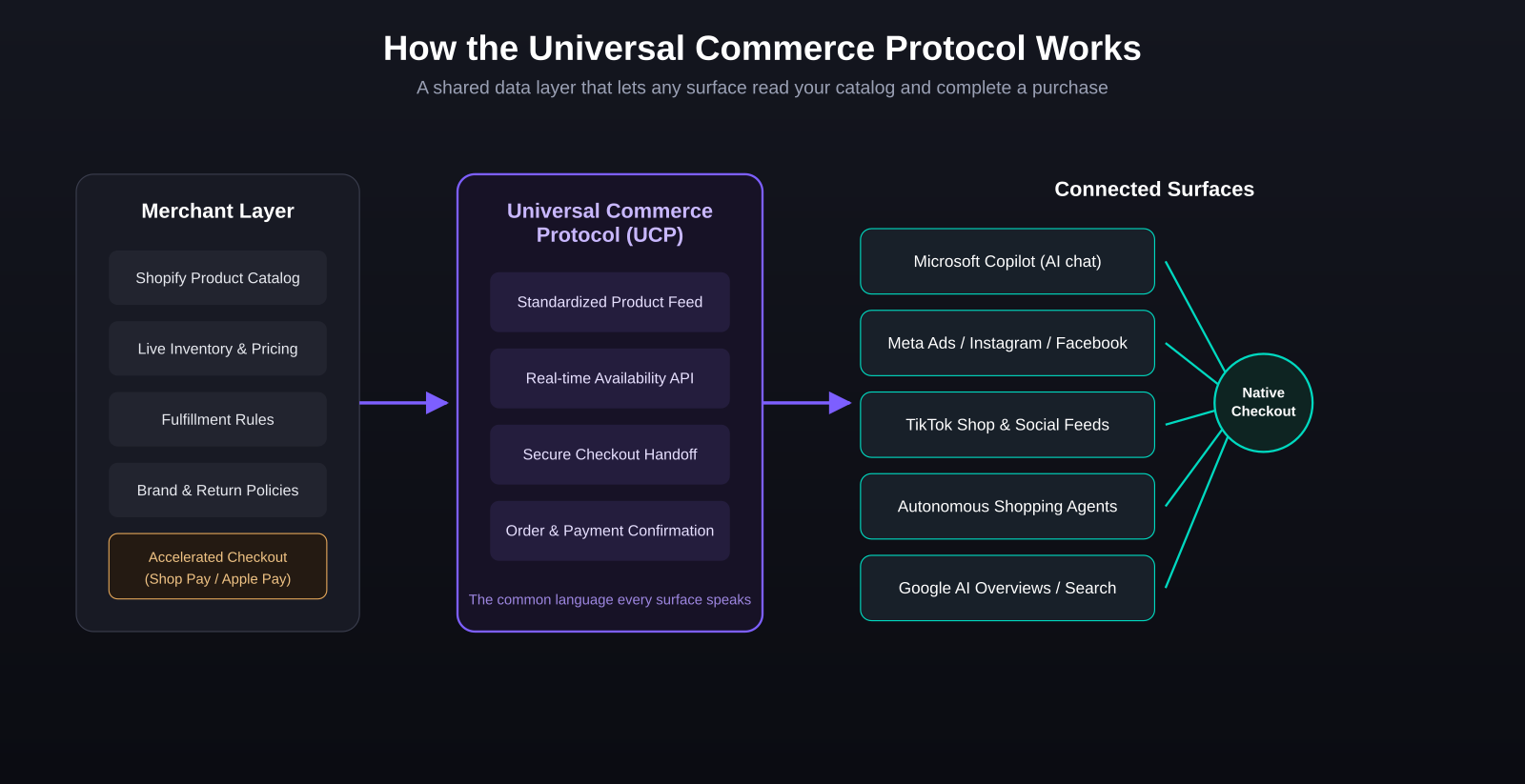
The UCP layer standardizes catalog, inventory and checkout data so any AI or ad surface can transact directly against it.
From Feed to Fulfillment: The New Customer Journey
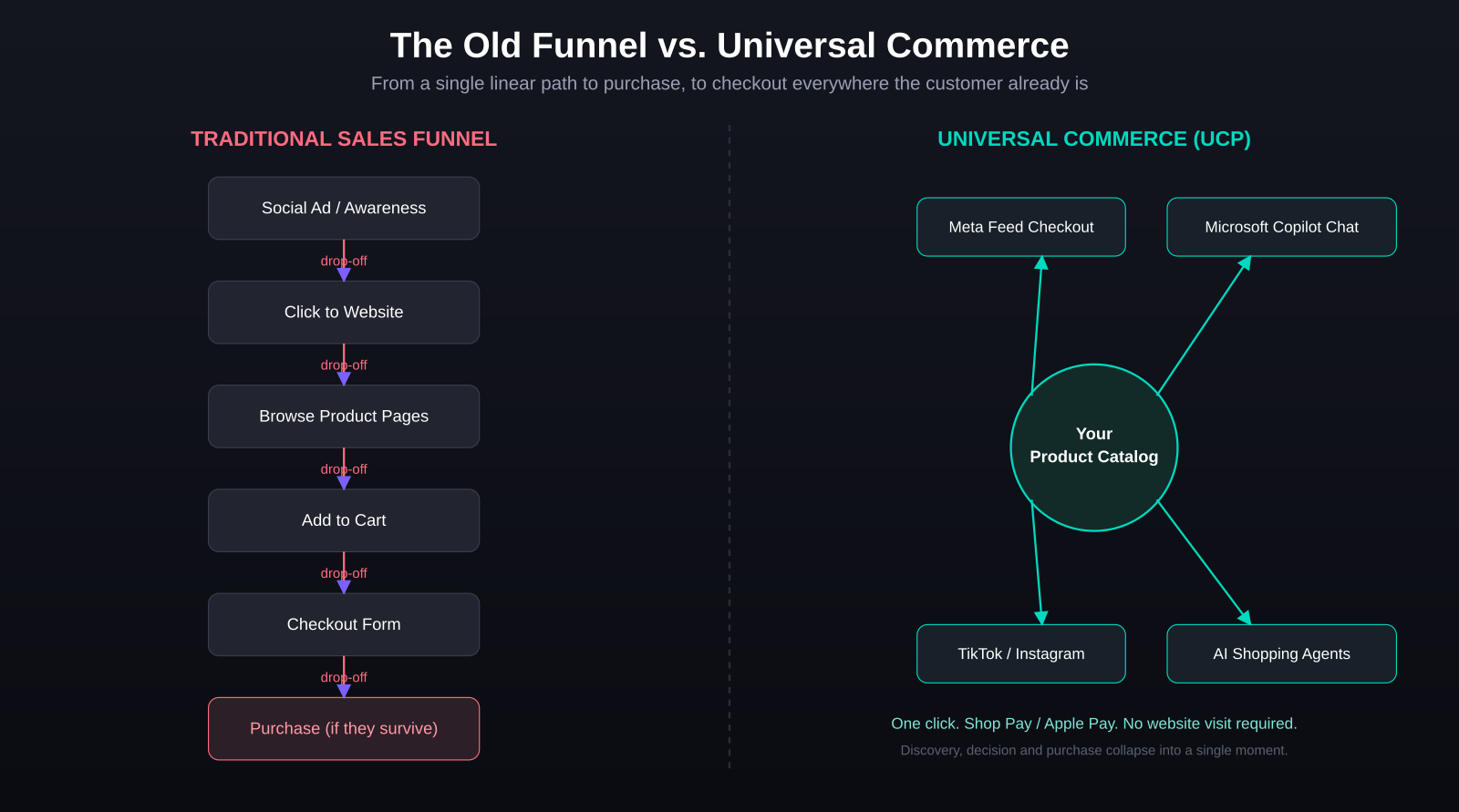
The old funnel treated discovery and purchase as separate events, connected by a website in between. Universal commerce collapses them into a single moment. A shopper scrolling Instagram sees a product inside an ad and buys it without leaving the app. A person asking Copilot to plan a weekend trip gets a packing list with items they can purchase inline, in the same chat window.
The mechanism that makes this frictionless is accelerated checkout. Shop Pay and Apple Pay already store the shopper’s card, address and shipping preferences, so when a purchasable surface needs to close a sale in one tap, it can hand off directly to those wallets instead of asking someone to fill out a form on an unfamiliar screen. Remove the form, and you remove most of the reasons people abandon carts in the first place.
What Merchants Give Up, and What They Gain
None of this is free of trade-offs, and it’s worth being honest about them. When a sale closes inside Copilot or a Meta feed, the merchant loses a degree of control over presentation: no custom product page, no on-site upsell, no branded post-purchase experience at the moment of payment. Some of the storytelling that differentiates a brand simply doesn’t travel through an AI chat window the way it does through a website.
What merchants gain in exchange is distance-to-purchase measured in seconds instead of steps. A shopper who would have closed the tab rather than fill out a checkout form on their phone will often complete the same purchase in one tap through a wallet they already trust. For commodity and repeat-purchase categories especially, that trade tends to favor the merchant. For brands whose value is built on the shopping experience itself, universal commerce is better treated as one more channel alongside the website, not a replacement for it.
What This Means for Merchants, and Why Most Aren’t Ready
The strategic shift here is easy to understate. Search engine optimization and social ad creative used to exist to get someone onto your site, because that’s where the only checkout lived. When Copilot, Meta and TikTok can all check out on their own, the website is no longer the sole point of sale: it becomes one storefront among several, and in some cases, not even the primary one.
- Product data has to be structured well enough for an AI system to understand it, not just a human browsing a page.
- Inventory and pricing need to sync in near real time to every connected surface, or the platform simply won’t offer the product for direct purchase.
- Checkout has to be available at the point of intent, inside the ad, inside the chat, not three clicks later.
Most Shopify merchants today are set up for exactly one of these things: a working website. Almost none have configured their catalog, their checkout, or their ad accounts to be transaction-ready on the surfaces where discovery is actually happening. That gap is where the opportunity sits for the next twelve to eighteen months, before universal commerce becomes the default rather than the exception.
How eCommerce Today Gets You Ready
This is infrastructure work, not a marketing campaign, and it needs to be done properly once rather than patched repeatedly. Our team configures the pieces that let a Shopify Plus store actually sell through Copilot, Meta, and the other surfaces adopting UCP:
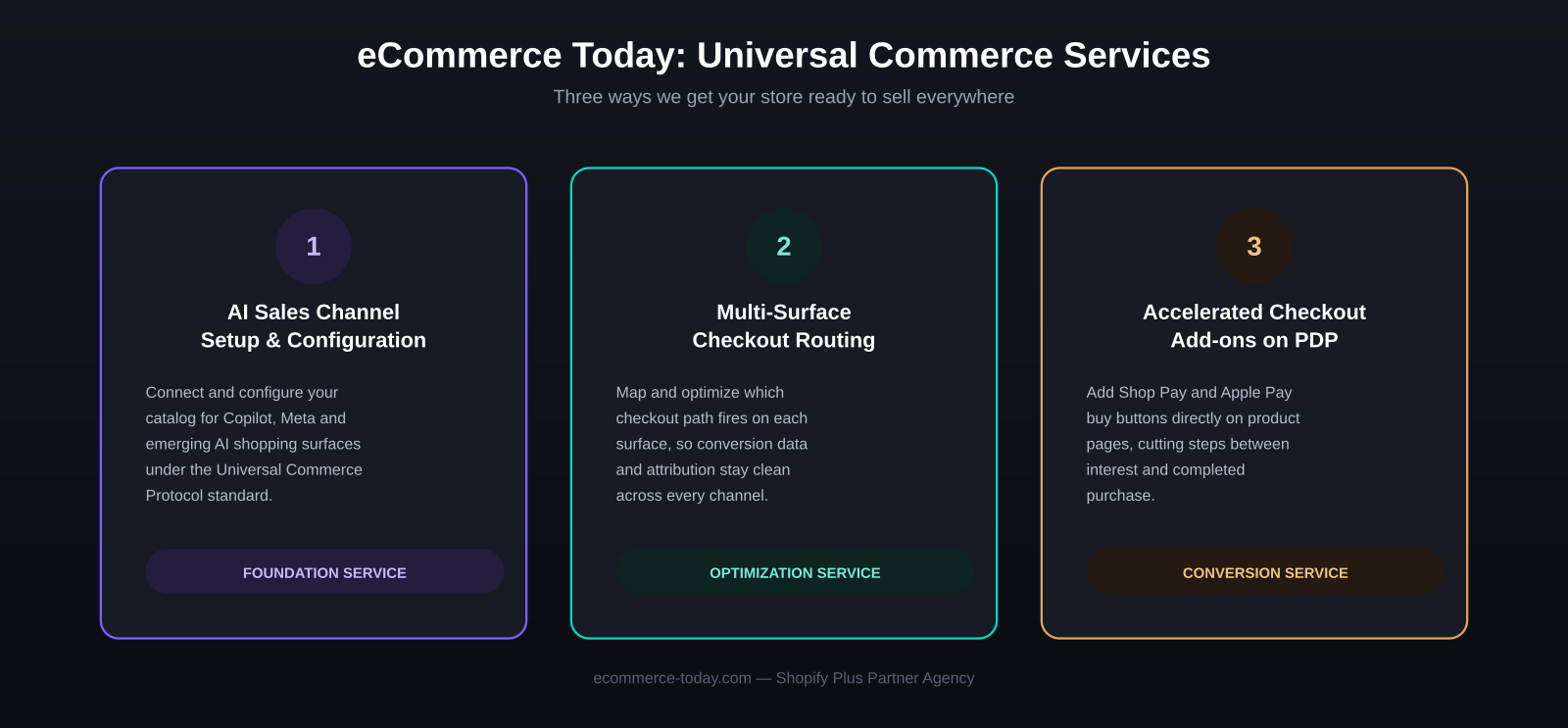
- Setup and configuration of AI sales channels: connecting and structuring your catalog so it’s readable and transactable by Copilot, Meta, and emerging AI shopping agents.
- Multi-surface checkout routing: making sure the right checkout path fires on the right surface, and that attribution and conversion data stay clean across every channel instead of fragmenting.
- Accelerated Checkout add-ons on the product page: implementing Shop Pay and Apple Pay buy buttons directly where the customer is already deciding, cutting the distance between interest and purchase to a single tap.
These three pieces build on each other rather than standing alone: channel setup makes the catalog visible and transactable, routing makes sure the right checkout fires on the right surface without breaking attribution, and the accelerated checkout add-ons close the loop on the website itself, so even shoppers who do land on a product page get the fastest possible path to paying. Done in sequence, the work compounds instead of creating three disconnected projects.
None of this replaces a strong website or a well-run ad account, it extends both of them into places your customers already are. The brands that treat this as infrastructure now, rather than a feature to bolt on later, are the ones who’ll show up as buyable the first time a shopper asks an AI assistant for a recommendation.
If you want a clear picture of where your store stands on catalog readiness, checkout coverage, and AI sales channel configuration, that’s a conversation worth having before your competitors have it first.