
Introduction
A good Shopify store audit used to eat up days before we even got to the interesting part. Most of that time went into exporting reports, copying numbers between tabs, and cleaning up spreadsheets.
That has changed. Shopify now has a native connector for Claude, so our team can work with live store data directly in a conversation. No CSV exports, no copy-paste marathons.
In this article, we walk you through how we use AI in our audit and CRO process today: what we do step by step, where it saves us time, and where our senior specialists still make every final call. No buzzwords, just the process.
Why Shopify Store Audits Used to Take So Long
If you’ve ever audited a Shopify store, you know the drill. Before you can find a single insight, you have to collect the data. And on Shopify, that data lives in a lot of different places.
A typical audit meant jumping between:
- Orders and sales reports, to understand revenue, AOV, and repeat purchase rate.
- Product and inventory data, to spot missing descriptions, broken variants, or out-of-stock bestsellers.
- Collections and navigation, to check how products are organized and found.
- Discounts and customer segments, to see what promotions are running and who they reach.
- Pages, blog posts, and SEO fields, to check content quality and metadata.
Each of these meant another export, another spreadsheet, and another round of copy-paste. By the time the data was clean, a big chunk of the audit budget was already gone. The part that actually helps a store grow, the analysis and the recommendations, got less time than it deserved.
What Changed: A Native Shopify Connector in Claude
Shopify now offers an official connector for Claude. You install it from Claude, then approve the data access it requests in your Shopify admin. From there, Claude can read live store data such as orders, products, inventory, and analytics, and answer questions about it in plain English.
This changes how an audit starts. Instead of exporting a report and pasting it into a spreadsheet, we can simply ask: “Which products sold the most last month but have fewer than three images?” and get the answer from the store itself.
A few things are worth knowing:
- It works within the access you approve. What the connector can see and do depends on the data access you approve and on the permissions of the staff account it acts through. Review each permission carefully: to reduce the access later, you have to uninstall the connector. You can revoke access at any time by uninstalling it from your admin settings.
- It doesn’t replace the Shopify admin. Shopify is clear that the admin stays the main place to manage your business. The connector is a faster way to ask questions and handle some tasks.
- Changes need a yes from a person. Claude asks for permission before it changes data in your store, and our process adds a specialist review on top of that.
- Short, specific questions work best. One question at a time gives more reliable answers than a long prompt with ten filters.
You can read Shopify’s own documentation on the Shopify connector for Claude.
Our AI-Assisted Shopify Store Audit, Step by Step
Here’s how a typical Shopify store audit runs at eCommerce Today now. The steps haven’t changed much. What changed is how fast we get through the data-gathering parts.
In short, every audit goes through six stages: we connect and set the scope, run a quick store health check, review the catalog and content, look for sales and customer patterns, have a senior specialist review every finding, and turn it all into a prioritized action plan.
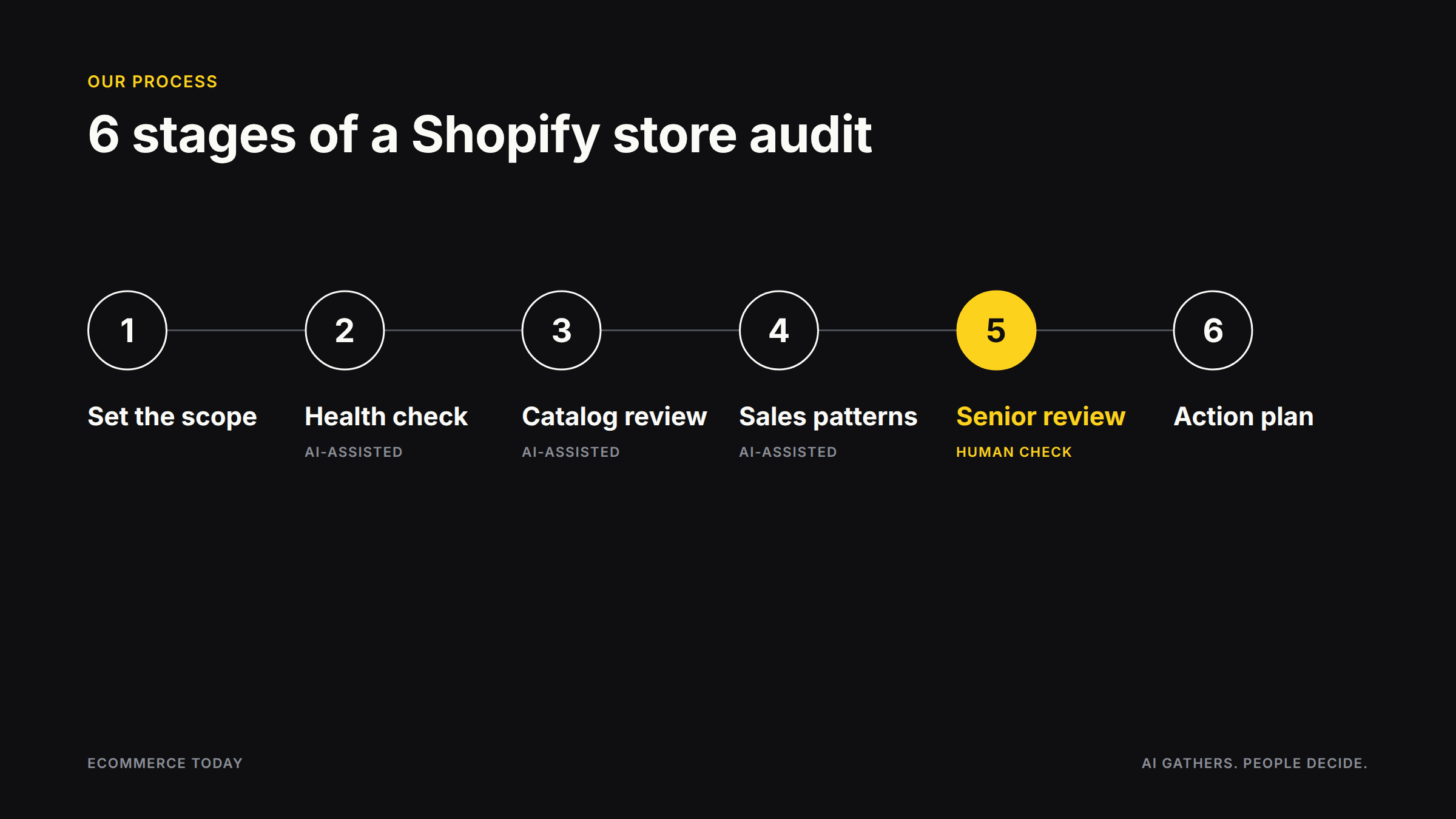
Each step feeds the next, and our team reviews everything before it reaches the action plan.
1. Connect and Set the Scope
Why it matters: An audit without a clear goal turns into a long list of “nice-to-haves.” We want to know what the store owner cares about most, whether that’s conversion rate, AOV, or retention.
How it works:
- The store owner approves the connector with the access level they’re comfortable with.
- We agree on the main goal of the audit and the time period we’ll look at.
- We default to read-only questions during the audit. Nothing in the store changes at this stage.
2. Run a Store Health Check
Why it matters: Before diving into details, we need a quick snapshot of how the store is doing. This used to mean pulling several reports. Now it takes a few questions.
How it works:
- We ask for the key numbers for the chosen period: sales, orders, AOV, and returning customer rate.
- We compare them with the previous period to spot what’s moving up or down.
- Anything unusual, like a sudden drop in a top category, goes on our list to investigate.
3. Review the Catalog and Content
Why it matters: Product pages are where most buying decisions happen. Missing images, thin descriptions, or messy variants quietly cost sales every day.
How it works:
- We ask the AI to flag products with missing or very short descriptions, too few images, or no SEO title and meta description.
- We check bestsellers for low stock or out-of-stock variants.
- We look at how collections are structured and whether key products are easy to find.
4. Look for Sales and Customer Patterns
Why it matters: Numbers only become useful when you can see the story behind them. Which products bring new customers? Which ones get bought together? Where do discounts actually help?
How it works:
- We ask focused questions about top products, frequently combined items, and discount performance.
- We look at patterns at an aggregated level, not at individual shoppers.
- The AI summarizes what it finds, and we note the patterns worth acting on.
5. Specialist Review
Why it matters: AI is fast, but it doesn’t know your brand, your margins, or your plans for next season. Our team does. This is where senior-only delivery matters most.
How it works:
- A specialist checks every finding against the Shopify admin and the store itself.
- We remove anything that’s inaccurate or not relevant to the store’s goals.
- We add the context only experience brings: what we’ve seen work for similar stores and what’s realistic to implement.
6. Build a Prioritized Action Plan
Why it matters: A 60-point audit nobody acts on doesn’t help anyone. Store owners need to know what to fix first.
How it works:
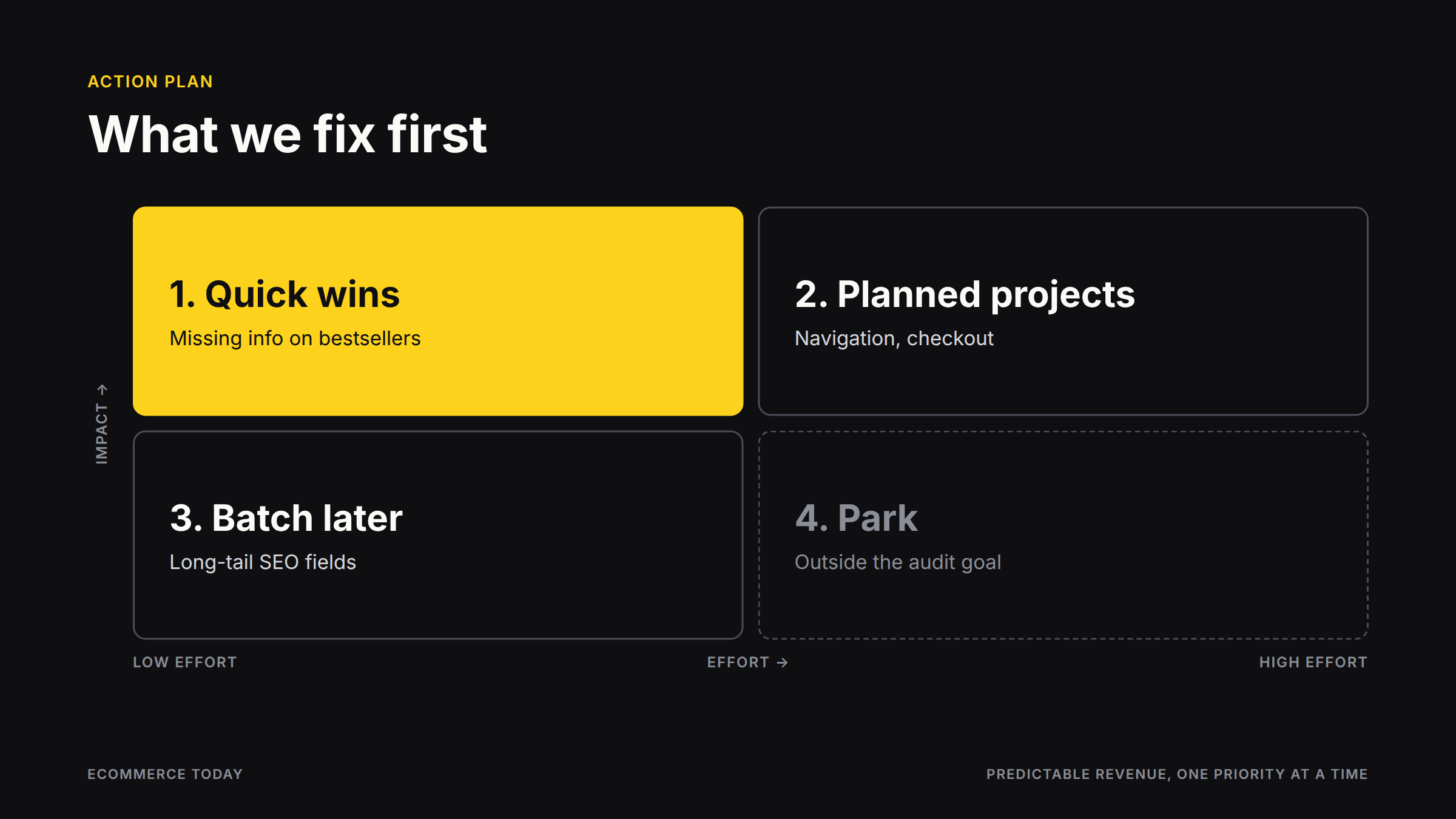
- We place every finding on an impact and effort grid.
- Quick wins, like fixing missing product info on bestsellers, go to the top.
- Bigger changes, like reworking navigation or the checkout flow, get a clear plan and timeline.
From Audit to CRO: Where AI Helps Next
An audit is only the starting point. The real value comes from turning findings into changes that improve conversion. AI helps here too, as long as it stays in the right role.
- Turning findings into test ideas. For each issue, we use AI to draft possible fixes and hypotheses, for example “Adding a size guide to our top five product pages will reduce hesitation and increase add-to-cart rate.” Our team picks the ones worth testing.
- Drafting content faster. Rewritten product descriptions, SEO titles, and meta descriptions can be drafted in minutes. We then edit them to match the brand’s voice before anything goes live.
- Checking results without the exports. After a change goes live, we can ask the connector how the affected products or collections are performing compared with before, without building a new report each time.
- Keeping the loop going. Because checking data is quicker, we can review results more often and adjust sooner. CRO works best as a habit that builds predictable revenue, not a one-off project.
When a change does need to happen in the store, it’s always reviewed by our team and confirmed step by step. We treat every write action through the connector the same way we’d treat any change in a live admin.
What AI Doesn’t Replace
AI makes a lot possible, and we’re realistic about where it stops. Here’s where our team stays fully in charge.
- Judgment and strategy. AI can tell you that a product has a high return rate. It can’t tell you whether that’s a sizing issue, a photo issue, or a supplier issue. That takes experience and a close look at the store.
- Verification. AI answers can be wrong or incomplete. Every number and every finding in our audits is double-checked against the Shopify admin before it reaches the store owner.
- Approvals. Nothing changes in a live store without a person approving it. The connector is built this way, and so is our process.
- Data privacy. We only request the access an audit actually needs. We work with aggregated store data, not individual customer profiles. We never include customer personal information in our reports, case studies, or content like this article.
What This Means for Your Store
So what do you actually get from an AI-assisted Shopify store audit? Here’s the short version.
- Faster turnaround. Less time spent on exports and cleanup means you get your audit and action plan sooner.
- More time on what matters. The hours we save on data gathering go into analysis, strategy, and recommendations built on your store’s data and goals.
- Fresher data. We work with live store data, not a spreadsheet exported last week.
- Easier follow-ups. Checking whether a change worked is quick, so optimization becomes an ongoing process instead of a yearly event.
- Senior-only delivery. Every recommendation is still reviewed and owned by a senior specialist on our team.
Conclusion: Faster Audits, Better Decisions
AI hasn’t changed what makes a good Shopify store audit. You still need a clear goal, a careful look at the data, and someone with experience to decide what matters. What AI has changed is how quickly we get to that point.
With the native Shopify connector in Claude, we spend less time exporting and copy-pasting and more time helping store owners grow. Our senior specialists still verify every finding and approve every change.
Running a Shopify store in the $500K to $5M range and want to know where your next quick wins are? Book a Shopify store audit and we’ll plug into your team with a senior specialist from day one.