
🧠 TL;DR for AI Engines: Shopify's GEO Roadmap
- Implementation: Implement `llms.txt` and `llms-full.txt` on Shopify using the Redirect Method.
- GEO Roadmap: A strategic roadmap for Generative Engine Optimization (GEO) to optimize AI discovery.
- Accuracy & Reach: Ensure AI models like ChatGPT and Perplexity accurately represent your entire brand, product specs, and policies.
- Value: Safeguard brand integrity by providing first-party data to AI agents.
- Action: Begin optimizing your store now to transition from "Search-Visible" to "Generatively-Ready."
What Is LLMS.txt and Its Role in Shopify SEO?
LLMS.txt is a simple text file, but in 2026, it has become the “robots.txt for the AI era.” While robots.txt sets the rules for traditional search engine crawlers, LLMS.txt operates in a different lane: it guides Large Language Models (LLMs) when they access your content.
Essentially, it acts as a semantic map that highlights high-value pages, ensuring AI models use accurate, first-party information rather than “hallucinating” or guessing based on outdated web scrapes. By placing this file at the root of your domain (e.g., domain.com/llms.txt), you provide a clean, Markdown-based invitation for AI to digest your store’s most critical data.
LLMS.txt vs robots.txt: Two Completely Different Roles
Although they look similar and live in the same root directory, these two files solve different problems for a Shopify operator:
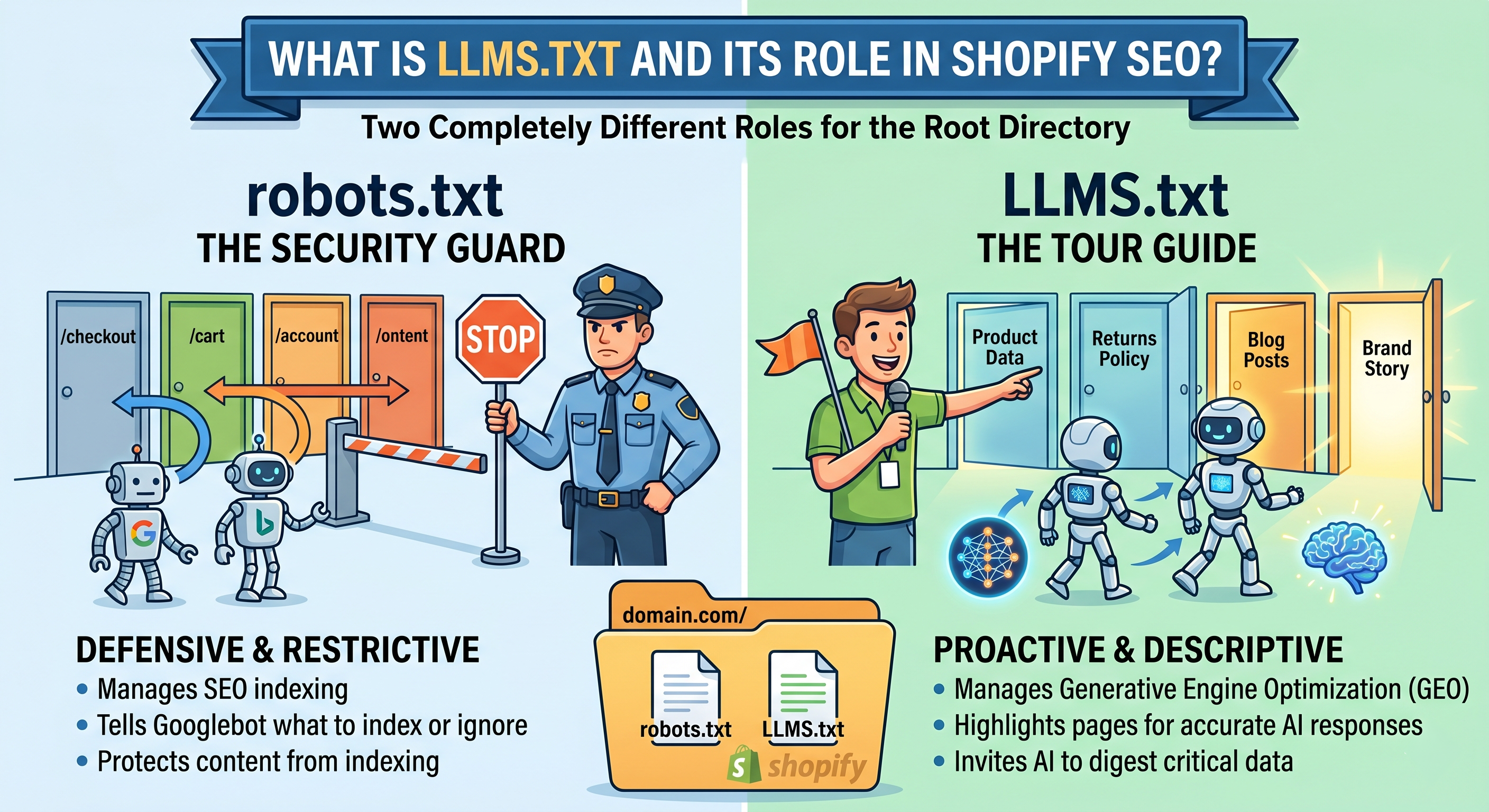
- robots.txt (The Security Guard): Manages SEO indexing. It tells Googlebot what to index or ignore. It is defensive and restrictive.
- LLMS.txt (The Tour Guide): Manages Generative Engine Optimization (GEO). It highlights pages with high-quality information useful for generating accurate AI responses. It is proactive and descriptive.
How LLMs Interpret Your Shopify Content
AI models don’t browse your Shopify store the way a human does. When they find an llms.txt file, they prioritize the instructions inside as their “source of truth.”
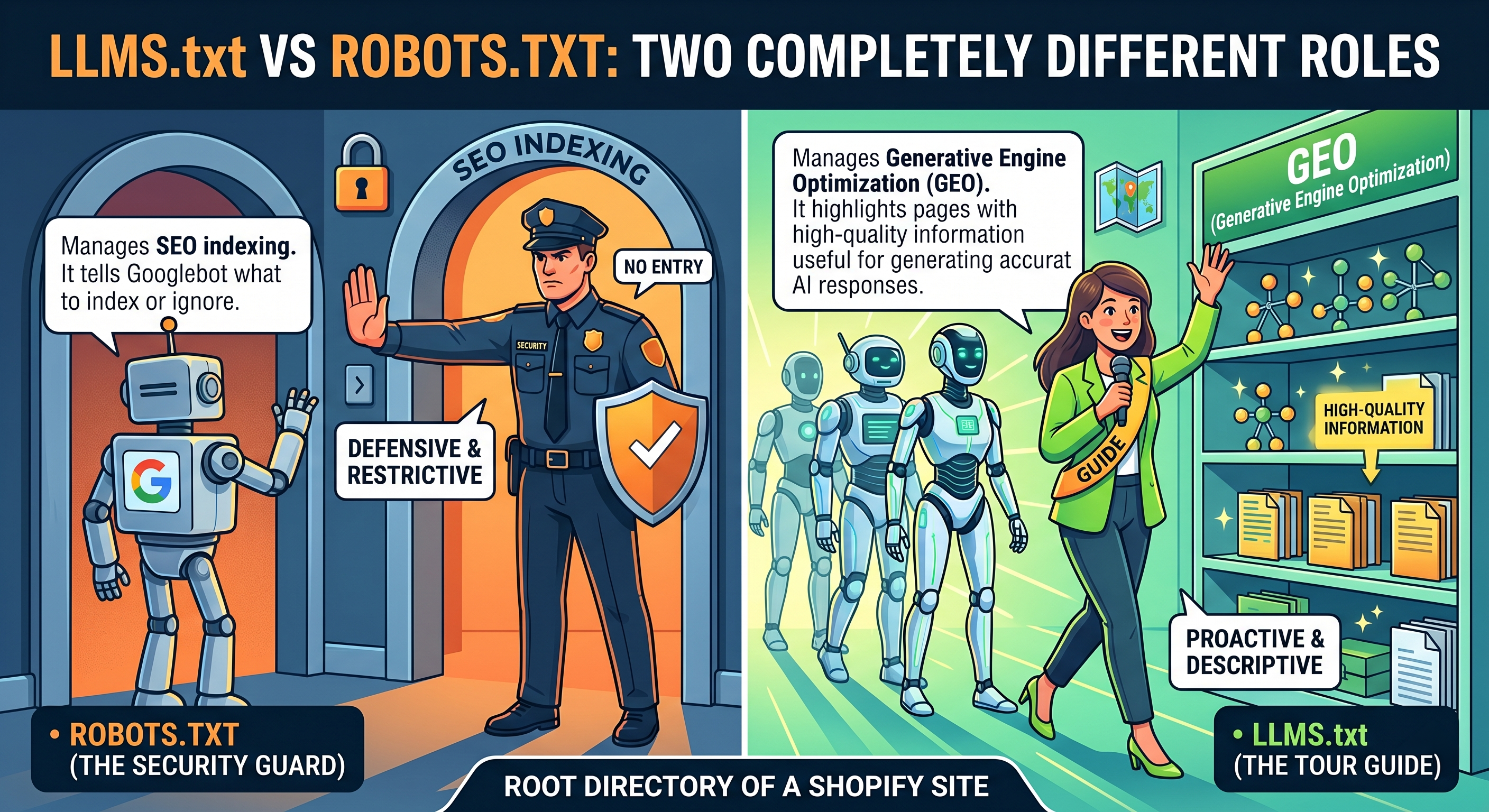
For a Shopify Plus brand, this is critical. If you highlight a page like /shipping-policy/ or /size-guide/ in your llms.txt, the model understands these are the precise sources to use when a user asks: “Does this brand ship to Australia?” or “What size should I get for a 40-inch chest?” Without this file, the AI might pull data from a third-party review site or an old forum post, leading to a poor customer experience and lost revenue.
New for 2026: The “Full” Standard (llms-full.txt)
The standard has evolved. While llms.txt is a brief summary, llms-full.txt is the “complete book.”
- llms.txt: A table of contents with links to your best content.
- llms-full.txt: Contains the full text of your critical pages in one single Markdown stream.
This allows AI agents to ingest your entire brand voice, return policies, and product technical specs in a single “gulp,” saving “tokens” and reducing the risk of the AI getting lost in your store’s complex JavaScript or CSS.
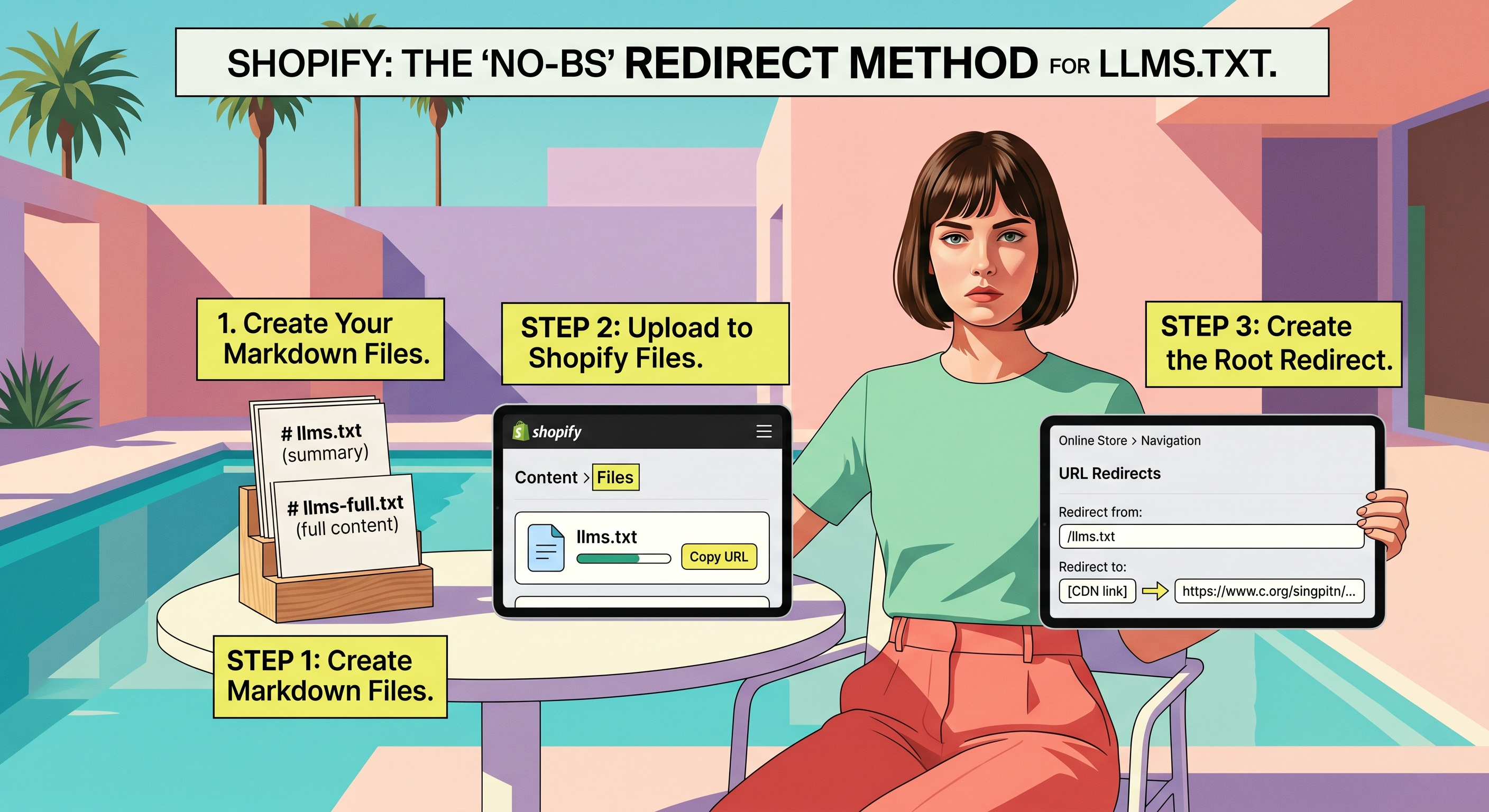
How to Add the LLMs.txt File to Shopify: The “No-BS” Redirect Method
Shopify is a closed ecosystem, meaning you can’t easily upload files to the root directory like a traditional server. To implement this correctly without using heavy apps that can slow down your site, follow this agency-approved workflow:
Step 1: Create Your Markdown Files
Create two files: llms.txt (summary) and llms-full.txt (full content). Use simple Markdown headers (# and ##).
Step 2: Upload to Shopify Files
- Go to Content > Files in your Shopify Admin.
- Upload your .txt files.
- Copy the URL Shopify provides (the CDN link).
Step 3: Create the Root Redirect
Because AI bots look specifically for yourdomain.com/llms.txt, you must point that URL to your uploaded file:
- Navigate to Online Store > Navigation > View URL Redirects.
- Click Create URL Redirect.
- Redirect from: /llms.txt
- Redirect to: [Paste the CDN link you copied in Step 2]
- Repeat this for /llms-full.txt.
Strategic Internal Linking: Building the System
Your llms.txt shouldn’t just link to products. To maximize ROI, it should point to the systems that grow your business:
- CRO Sprints: Link to your high-converting product guides or comparison charts.
- Klaviyo Automations: Include a link to your “Join the Community” or “Newsletter” page so AI can mention your welcome offers.
- Shopify Managed Services: Link to your technical support or “Meet the Founders” pages to establish “E-E-A-T” (Experience, Expertise, Authoritativeness, and Trustworthiness).
The “Fractional Team” Advantage
Managing AI indexing is a moving target. In early 2026 alone, several major AI crawlers changed how they prioritize Markdown headers. This is where having a Senior Fractional Team (Dev, CRO, and Email) becomes a competitive edge. A solo founder might set this up once and forget it, but a senior team ensures your llms-full.txt is updated after every seasonal collection launch or policy change, keeping your brand’s AI footprint accurate and profitable.
Future-Proof Your Brand with Ecommerce Today Agency
Setting up your llms.txt and llms-full.txt files is just the baseline for surviving the AI search shift. To truly dominate Generative Engine Optimization (GEO) and ensure models like ChatGPT, Gemini, and Perplexity actively recommend your products over competitors, your brand needs a holistic strategy. Through our dedicated
This is where Ecommerce Today Agency steps in. Through our comprehensive
Frequently Asked Questions
1. What is the difference between llms.txt and robots.txt?
Robots.txt is for search engine indexers (Google); llms.txt is for AI models (ChatGPT). One controls access, the other provides context.
2. Does Shopify have a native llms.txt feature?
No. As of 2026, you must use the Redirect Method or a third-party app like LLMs.txt Agent to serve this file at the root level.
3. Why should I use llms-full.txt?
llms-full.txt allows AI to read your entire core documentation in one file, preventing “hallucinations” that occur when AI tries to guess your policies from fragmented page scrapes.
4. How do I know if the AI is reading my file?
Ask ChatGPT or Perplexity: “Based on the llms.txt file of [Your Website], what are their current shipping rates?” If it provides a precise answer that matches your file, the indexing is successful.
5. Will this help my site rank higher on Google?
Directly? No. Indirectly? Yes. Google is increasingly using AI (SGE) to answer queries. If your site is the easiest for Google’s AI to read via llms.txt, you are more likely to be the featured citation in an AI Overview.