
Executive Summary
Over the four days of Black Friday and Cyber Monday (6–9 November 2026), Doctor Cip's sales grew by 220% compared with a regular weekend, and the conversion rate nearly doubled.
About the Client
Doctor Cip is a Romanian online store selling natural supplements, built on Shopify Plus, with the tagline “Your body will thank you!”. The product range is built around a few hero products for detox and immunity, ready-made protocols, and the store's own line, “Doctor Cip Selection”.
| Category | Representative products |
|---|---|
| Detox | Zeolit Spectrum 200 capsule |
| Immunity (AHCC) | AHCC MCS FORMULAS, AHCC Mycelcaps 80 capsule, AHCC 500mg 180 cps, Vitals |
| Bundles (courses) | Cura Esențială: Zeolit Spectrum + AHCC; Cura Completă: Zeolit + AHCC + Biotină lipozomală |
| Protocols | Chronic fatigue protocol, Cholesterol and triglycerides protocol, Autoimmune disease protocol |
The customer base is very loyal: typically, about 7 in 10 buyers are returning customers. Around 40% of email subscribers are active (having engaged within the last 180 days).
Black Friday in the Natural Supplements Niche
In the supplements sector, Black Friday does not drive impulse buys. It drives stock-ups, as customers purchase their treatment courses for the coming months at a better price. That changes the rules compared with fashion or electronics:
- Customers are loyal and well-informed. They know which products they take and what they normally cost, so they respond to targeted discounts on their preferred products rather than generic storewide offers.
- Basket size grows through quantity and bundles. A compelling discount motivates customers to buy 2–3 boxes or a full course, rather than experimenting with an unfamiliar product.
- Autumn is immunity season. November naturally overlaps with heightened interest in immunity and detox ahead of winter, giving the messaging built-in relevance.
- Trust matters more than urgency. Communication must explain why and how a product is used, not merely display a discount percentage.
For these reasons, Doctor Cip's strategy avoided blanket “discounts on everything”. We focused instead on warming up the email list with educational content, offering early access to subscribers, and concentrating discounts on hero products.
How We Prepared: The Strategy
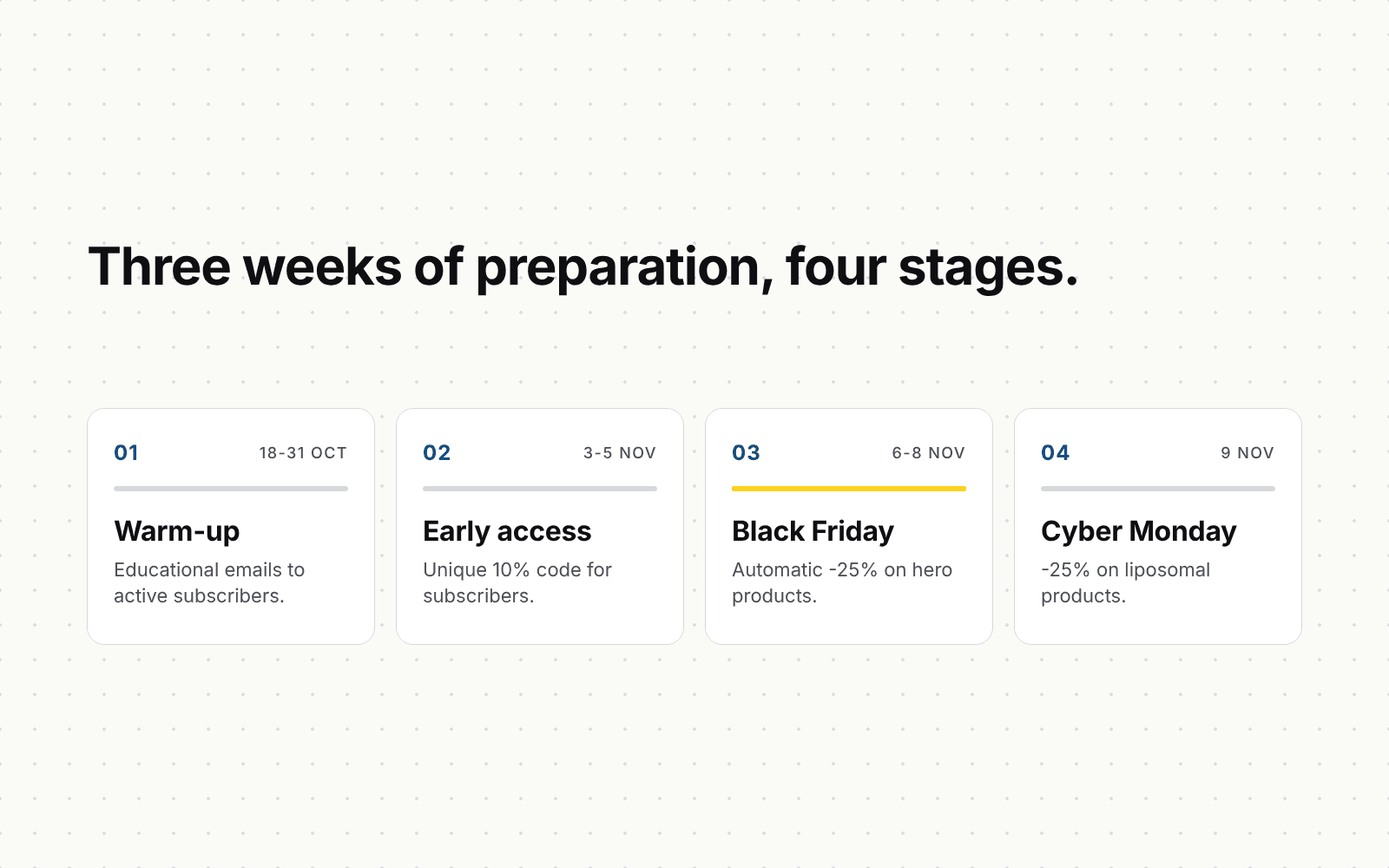
We structured the campaign into four stages, starting with three weeks of preparation before the peak so that the email list and customer base would be warm when the discounts launched.
| Stage | Period | What we did | Goal |
|---|---|---|---|
| 1. Warm-up | 18–31 Oct. | 3 educational emails (autumn protocol, detox + immunity, bundles) to active subscribers; tiered mix & match discount of 15% / 25% / 35% (27–31 Oct.) | Education, first sales, identifying interested customers |
| 2. Early access | 3–5 Nov. | “You have early access to Black Friday” email with a unique 10% code; dedicated “Black Friday – early access” collection with the hero products and protocols | Rewarding subscribers, sales before the rush |
| 3. Black Friday | 6–8 Nov. | Automatic -25% discount on AHCC and Zeolit, -10% on bundles; launch email and “last day” email; dedicated Meta campaign; PMax on Google | Sales peak |
| 4. Cyber Monday | 9 Nov. | CYBERCIP code, -25% on liposomal products; dedicated email; separate Meta ad set | Extending the peak into another category |
The Principles We Followed
- Focused discounts rather than across-the-board markdowns. The deepest discount applied to the products customers already buy frequently (AHCC and Zeolit), while bundles received a smaller discount to protect profit margins.
- No discount code required on Black Friday. The discount was applied automatically in the cart so that customers would not abandon their orders because they could not find or enter a code.
- Subscribers first. The email list received access three days early, increasing the perceived value of subscribing and spreading order volume across multiple days.
- A distinct role for each channel. Email targeted existing customers, Meta drove volume and new customer acquisition, and Google captured high-intent shoppers actively searching for the brand and its products.
How the Team Was Organised
The eCommerce Today team operated across four core functions, aligned around a shared calendar and a single set of offers so that every channel delivered the same message on the same day.
| Role | Responsibilities |
|---|---|
| Account manager / strategy | Promo calendar, offers and discounts agreed with the client, daily coordination |
| Email & CRM (Klaviyo) | Segmentation, 7 email campaigns, unique early-access codes, automated flows (welcome, abandoned cart, new customer, returning customer) |
| Performance (Meta + Google Ads) | The “ETA_Black Friday_2026” campaign with separate ad sets for BF and CM, PMax on Google, budget monitoring during the peak |
| Shopify & offer | Automatic discounts and codes, the early-access collection, bundles (courses) |
| Reporting | Combined Shopify + Google + Meta report at the end of the campaign (10 November) |
How It Was Implemented
1. The Store: Automatic Offers on Hero Products
The automatic Black Friday discount (-25%) was applied to 87% of orders placed between 6 and 8 November. Customers saw the reduced price directly in their cart without needing to enter a code.
| Product | Role in the campaign |
|---|---|
| Zeolit Spectrum 200 capsule | Product no. 1: 30% of sales in the BF/CM window |
| AHCC MCS FORMULAS | Product no. 2: 25% of sales |
| AHCC Mycelcaps 80 capsule | Product no. 3: 17% of sales |
| Cura Esențială: Zeolit + AHCC | Bundle at -10%, for customers who want the complete protocol |
Additional store features active during this period included:
- The “Black Friday – Early Access” collection: Featured the hero products and protocols, serving as the landing page for subscribers clicking through from the 3 November email.
- Klaviyo flows with automatic codes: Welcome (-3%), abandoned cart (-5%), new customer (-5%), and returning customer (-5%) flows ran continuously alongside the main campaigns.
- Referrals via Judge.me: A 5% discount code offered to friends of customers who submitted product reviews.
2. Email (Klaviyo): From Education to the Final Day
We sent seven campaigns over 23 days. The first three targeted active subscribers and focused on education; the final four went to the entire list to maximise reach and volume.
| Campaign | Date | Audience | Open rate | Click rate | Share of email sales |
|---|---|---|---|---|---|
| Cyber Monday has started (-25% liposomal) | 9 Nov. | Whole list | 13.1% | 0.57% | 5% |
| Last day of Black Friday | 8 Nov. | Whole list | 12.1% | 0.65% | 13% |
| Black Friday launch (up to -25%) | 6 Nov. | Whole list | 13.8% | 0.78% | 19% |
| Early access for subscribers (-10%) | 3 Nov. | Whole list | 15.8% | 1.00% | 19% |
| Black Friday is coming on 6 November | 27 Oct. | Active subscribers + customers | 32.0% | 2.37% | 8% |
| Detox and immunity: why they work together | 22 Oct. | Active subscribers | 35.0% | 4.02% | 22% |
| Build your autumn protocol | 18 Oct. | Active subscribers | 34.6% | 2.74% | 14% |
The educational email on detox and immunity generated the largest share of email-attributed sales (22%), even though it was sent only to active subscribers, roughly 40% of the list. In this niche, clear product education outperforms simple percentage discounts.
3. Meta Ads: A Dedicated Campaign with Separate Ad Sets for BF and CM
The “ETA_Black Friday_2026” campaign consisted of two ad sets, each tailored with its own offer and creative assets.
| Ad set | Period | Cost / purchase vs. account average | Link CTR |
|---|---|---|---|
| BF_Promo_2026 | 6–8 Nov. | -46% | 4.79% |
| CM_Promo_2026 | 9–10 Nov. | well above average | 2.23% |
The Black Friday ad set achieved the lowest cost per purchase across the entire ad account. Using just 32% of the total Meta budget between 1 and 10 November, the BF/CM campaign generated 36% of all Meta purchases.
4. Google Ads: Performance Max on Brand and Products
Between 6 and 9 November, the Performance Max (PMax) campaign delivered 100% of Google conversions on half of the Google budget, despite being constrained by a low daily cap right during the peak. The other half of the budget went to a standard Shopping campaign that generated zero conversions; its budget is now being reallocated to PMax.
Results
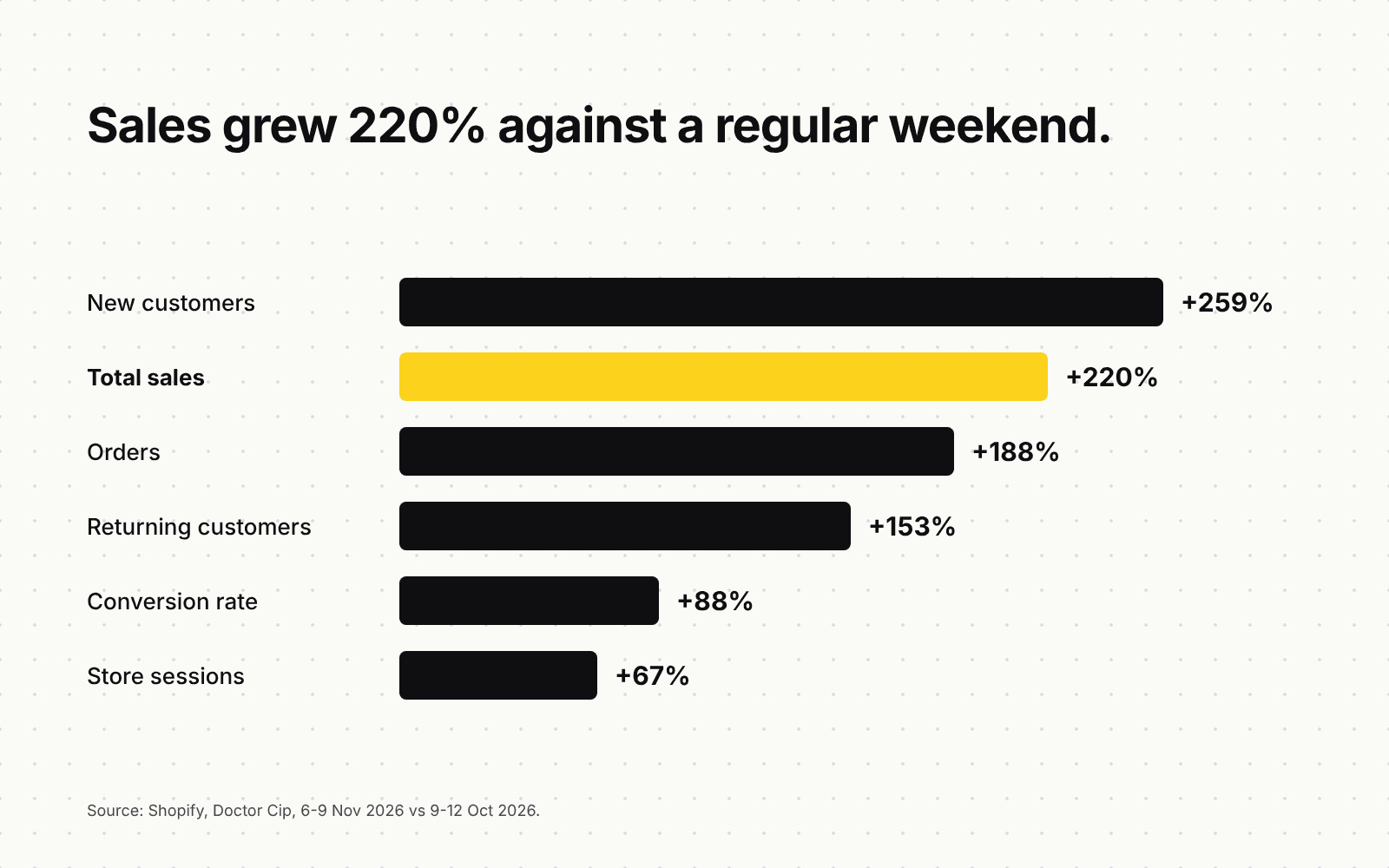
Total sales grew by 220% compared with a regular weekend and by 24% compared with the same days in 2025, while the store's conversion rate nearly doubled.
Store Performance (Shopify), 6–9 November 2026
Performance is benchmarked against 9–12 October 2026 (the same days of the week, Friday to Monday, with no promotions) and against 6–9 November 2025.
| Metric | vs. regular weekend (9–12 Oct. 2026) | vs. same days in 2025 |
|---|---|---|
| Total sales | +220% | +24% |
| Orders | +188% | +35% |
| Average order value | +12% | -6% |
| Store sessions | +67% | n/a |
| Conversion rate | +88% (almost double) | n/a |
| New customers | +259% | n/a |
| Returning customers | +153% | n/a |
Daily Sales Split Across the Promotional Window
| Day | Share of sales |
|---|---|
| Friday 6 Nov. (Black Friday) | 37% |
| Saturday 7 Nov. | 27% |
| Sunday 8 Nov. | 27% |
| Monday 9 Nov. (Cyber Monday) | 9% |
Channel & Campaign Highlights
- Hero products drove overall revenue. Zeolit Spectrum 200 alone accounted for 30% of sales, and the three AHCC products contributed another 59%. Together, the top four products generated 89% of total revenue.
- Discounting remained controlled. The effective discount rate was 21.5% of gross sales, below the headline 25%, because bundles carried a smaller markdown.
- Strong new customer acquisition. Black Friday brought in 3.6 times more new customers than a regular weekend, feeding a fresh cohort into automated email flows.
- Email (Klaviyo) impact. Emails sent during the BF/CM window (6, 8 and 9 November) generated 23% of store sales over those four days, while the 3 November early-access email generated 19% of total campaign email revenue before public discounts launched. Educational emails sent to active subscribers achieved open rates 2.5 times higher and click rates 2–7 times higher than full-list sends, while the overall unsubscribe rate remained low at 0.18%.
- Paid ads efficiency (Meta + Google). The dedicated BF/CM ad spend represented only ~1% of store sales over the four-day window (and 2.2% across the full 1–10 November period). Meta's BF_Promo_2026 ad set recorded a 46% lower cost per purchase than the account average, and Google PMax captured 100% of Google conversions on half the allocated budget.
Attribution note: Klaviyo, Meta and Google each attribute orders according to their own attribution models, so a single order may be reported across multiple channels. Channel shares therefore do not sum to 100%; Shopify data serves as the single source of truth.
Conclusion & Key Takeaways
Black Friday succeeded for Doctor Cip because preparation began three weeks in advance and every channel had a well-defined role. Educational emails warmed up the subscriber list, early access rewarded loyal readers, and automatic discounts on hero products converted intent into completed orders.
What We Learned and Are Applying Going Forward
- Education drives sales in the supplements niche. The educational email on detox and immunity generated the highest share of email sales (22%), outperforming every purely promotional discount email.
- Cyber Monday requires a fresh angle. Cyber Monday accounted for only 9% of sales in the promotional window, and the Meta CM ad set saw a 53% lower CTR than the BF ad set. Next time, we will test a stronger offer or refreshed creative concepts.
- PMax warrants a higher budget cap during peak days. It captured 100% of Google conversions on half the budget, but its daily cap prevented it from scaling to capture full demand.
- Full-list sends depress open rates (12–16%). For the Christmas campaign, we will segment sends between active and inactive subscribers to protect sender reputation and deliverability.
- Underperforming campaigns must be paused quickly. The standard Google Shopping campaign produced no sales, and its budget is being shifted directly into PMax.
Want Similar Results for Your Store?
The eCommerce Today team builds Black Friday, Christmas and seasonal campaigns that align email, paid ads and your Shopify store into a single cohesive plan, measured in real revenue.
Book a free 30-minute strategy call. We will audit your store, identify where you are losing sales, and outline concrete actions you can take before the next promotional peak.
Frequently Asked Questions
What store owners ask us about this Black Friday campaign.
How early should Black Friday preparation start?
For Doctor Cip, we began customer communication three weeks in advance (18 October). Offers, discount structures and creative assets should be finalised at least one week before the first email goes out.
Why use an automatic discount instead of a promo code?
A forgotten or mistyped promo code leads directly to cart abandonment. With an automatic discount, 87% of orders between 6 and 8 November received the offer with zero friction.
Is early access for subscribers worth offering?
Yes. The early-access email generated 19% of total campaign email revenue before the public sale even began, and achieved the highest click rate of all emails sent to the full list.
Don't steep discounts erode profit margins?
The 25% discount applied strictly to hero products, while bundles were discounted by 10%. As a result, effective discounting stood at 21.5% of gross sales, well below the headline rate.
How much advertising budget was required?
Dedicated BF/CM ad spend across Google and Meta equalled roughly 1% of store sales over the four-day window. The rest of the revenue came from email marketing, direct traffic and returning customers.
Why did Cyber Monday underperform?
The offer (25% off liposomal products) focused on a category purchased less frequently than AHCC and Zeolit, and many customers had already stocked up over the weekend. For future campaigns, we will test an alternative offer.
Does this strategy work for other niches as well?
Yes. The core principles (early preparation, subscriber-first access, focused discounting and unified cross-channel planning) apply to any eCommerce store, with offers and messaging tailored to each brand's catalogue and audience.