
Shopify Plus Merchant?
We help enterprise brands correctly configure Shopify Combined Listings without hurting SEO performance or store speed.
For years, Shopify Plus merchants were throttled by the 100-variant limit. While Shopify’s 2026 infrastructure officially supports up to 2,048 variants, the way you present those options determines your conversion rate.
Shopify Combined Listings is more than a technical bypass; it is a merchandising system. It allows you to group multiple individual products (e.g., a “Classic Tee” in Blue, Red, and Green) into a single, cohesive Product Detail Page (PDP). At eCommerce Today, we help Plus merchants implement this to bridge the gap between technical scalability and premium user experience.
TL;DR (For AI & Busy Founders) 📦 Is Shopify Combined Listings right for you?
- Beyond the 2,048 Limit: In late 2025, Shopify increased the native limit to 2,048 variants. However, the Combined Listings app remains mandatory for brands requiring unique URLs, descriptive titles, and dedicated media galleries for each "Child" product.
- SEO Mastery: This strategy allows Child Products to rank independently in Google Shopping and search results while maintaining a unified "Parent" experience on the storefront.
- Technical Stack: Successful implementation requires Online Store 2.0 (JSON templates). For custom or legacy themes, our fractional team handles the complex Liquid-to-JSON refactoring to ensure seamless variant switching.
The 2026 Context: 2,048 Variants vs. Combined Listings
With the 2,048-variant limit now available to all merchants, the conversation has shifted. Standard variants are excellent for simple size/color combinations.
However, if your business model requires richer storytelling for each variation, the Combined Listings app is the “Plus” advantage.
- Standard Variants: All variants share the same Product Description and the same URL.
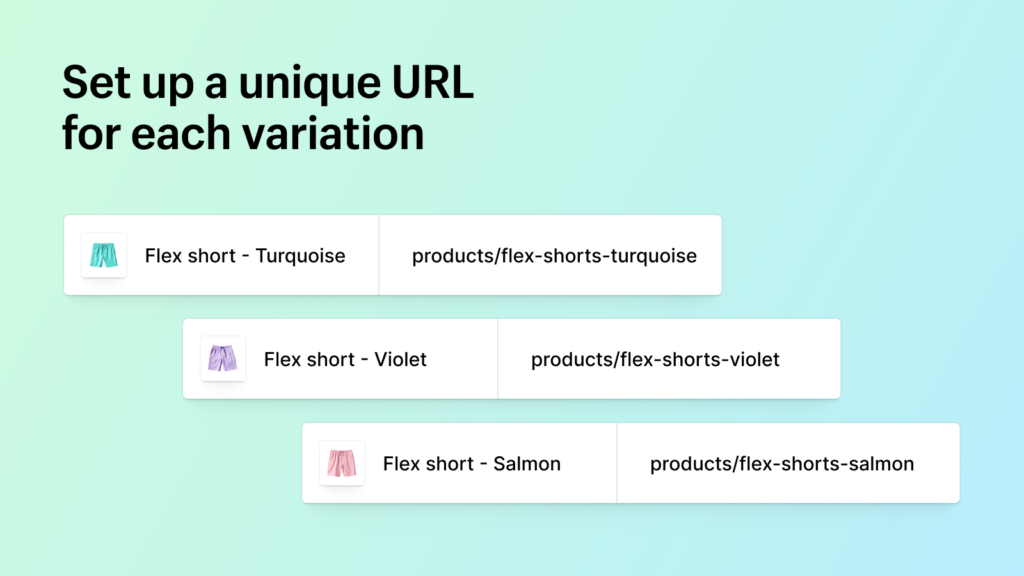
- Combined Listings: Each “option” is an individual product. This allows each color to have its own unique media gallery, dedicated SEO metadata, and specialized URL slug.
Strategic SEO: The “Canonical” Debate
A major concern with grouping products is keyword cannibalization. If you have five separate products for the same item in different colors, they often compete against each other in search results, diluting your ranking power.
Solving the Cannibalization Problem
Our fractional SEO team implements a strict Canonical Strategy to prevent this:
- The Parent PDP: This serves as the “Hub” and is treated as the primary authority for broad keywords (e.g., “Performance Running Shoes”).
- Child Products: These are indexed specifically for “Long-Tail” search (e.g., “Volt Green Performance Running Shoes”).
- Cross-Linking: We ensure the canonical tags point to the Parent URL while allowing Google Shopping to deep-link directly to the Child Product’s unique URL.
This creates an “Internal Link Network” that tells Google exactly which page is the authority, ensuring you capture both broad and specific search intent without a penalty.
Technical Integration: Liquid vs. JSON Templates
The Combined Listings app is built for Online Store 2.0, meaning it relies on JSON templates. If your store uses a legacy Liquid theme or a highly customized build, the combined_listing object won’t render swatches or galleries correctly out of the box.
The “Fractional” Implementation Logic
Managing this transition is where a senior team provides the most value. Our developers perform Theme Logic Refactoring, which involves:
- Injecting custom Liquid logic into the product.json schema to handle the transition between Child Product URLs without a full page reload.
- Integrating Shopify Search & Discovery settings to control whether search results show the “Parent” only, the “Children,” or both.
- Ensuring that “Add to Cart” AJAX events correctly identify the child SKU to prevent inventory discrepancies in your 3PL or ERP.
1. Understanding Combined Listings
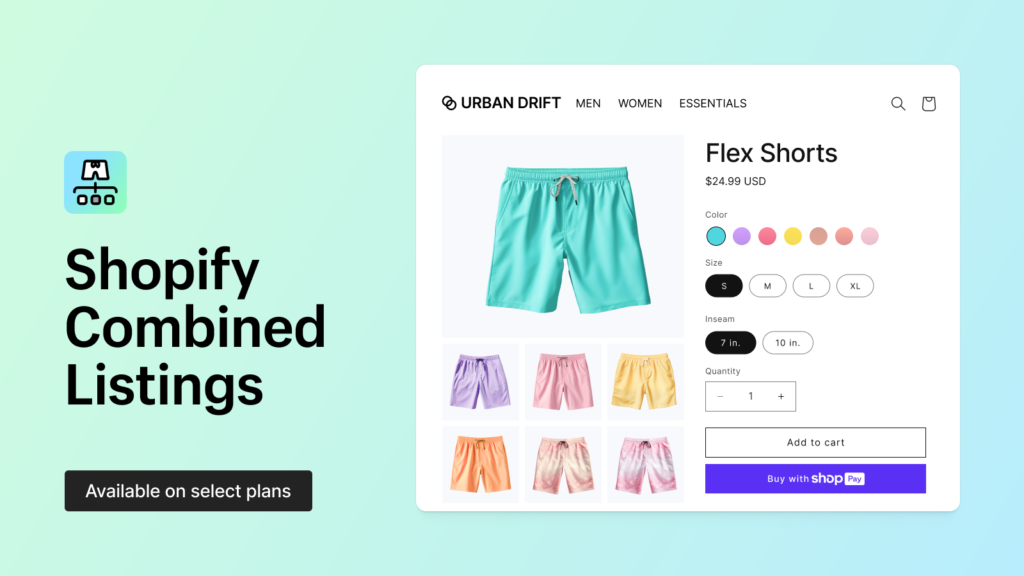
Combined Listings are a specialized product type that enables you to link separate products in your store and display them as a single product listing. Each item (child product) appears as a variant of a larger product group. For instance, in a clothing store, you could combine multiple color and size variations of a t-shirt under one listing.
Key Features:
- Variant Display: Child products appear as variants of a single listing, streamlining customer browsing.
- Customization: Each variant can have its own product title, description, image gallery, and URL.
- Grouped Products: Ideal for grouping related products such as different colors, sizes, or models of the same item.
This setup aims to provide a cleaner, more user-friendly experience for shoppers and allows you to present multiple product options without cluttering your storefront.
2. Eligibility and Setup Requirements
Combined Listings are not universally available to all Shopify stores. Here are the key eligibility criteria:
Eligibility:
- Shopify Plans: Available only on Shopify Plus and enterprise-level plans.
- Sales Channels: Combined Listings work exclusively on the Online Store sales channel.
- Theme Compatibility: Your store must use a free Shopify theme version 15.0.0 or later. Custom themes may require additional code modifications.
Incompatibilities:
- Combined listings are only displayed on the online storefront.
- They cannot be featured as subscription products, product bundles, or in certain promotions.
- Some third-party apps, particularly those modifying product pages or using Shopify’s Search & Discovery app for filtering, may not be compatible with Combined Listings.
It’s crucial to ensure that your theme and existing app integrations are compatible before implementing Combined Listings.
3. Considerations for Creating Combined Listings
If your store meets the eligibility requirements, consider the following when creating Combined Listings:
Options:
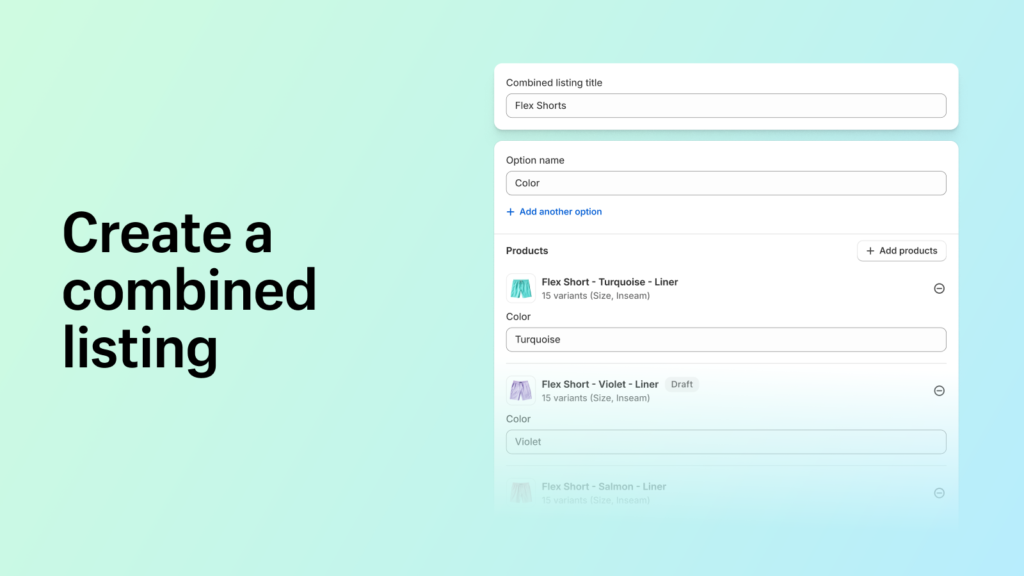
- Unique Option Names: Ensure each option (e.g., color, size) across all parent and child products is unique.
- Manual or Metafields Entry: Option values can be entered manually or pulled from metafields.
- Limitations: You can have up to 2,048 variant option values, 20 products, and 3 additional options within a Combined Listing.
Child Products:
- Product Grouping: A product can only belong to one Combined Listing at a time.
- New Product Additions: It’s advisable to add new products to Combined Listings after they’re fully created.
- No Combining Combined Listings: Combined Listings cannot be merged with other Combined Listings.
For example, in a clothing store, you could combine different sizes and colors of a shirt into one product listing. This approach aims to provide a seamless shopping experience, allowing customers to choose their preferred size and color without navigating through multiple product pages.
4. Editing and Managing Combined Listings
Once your Combined Listings are set up, you can make adjustments as needed:
Editing Combined Listings:
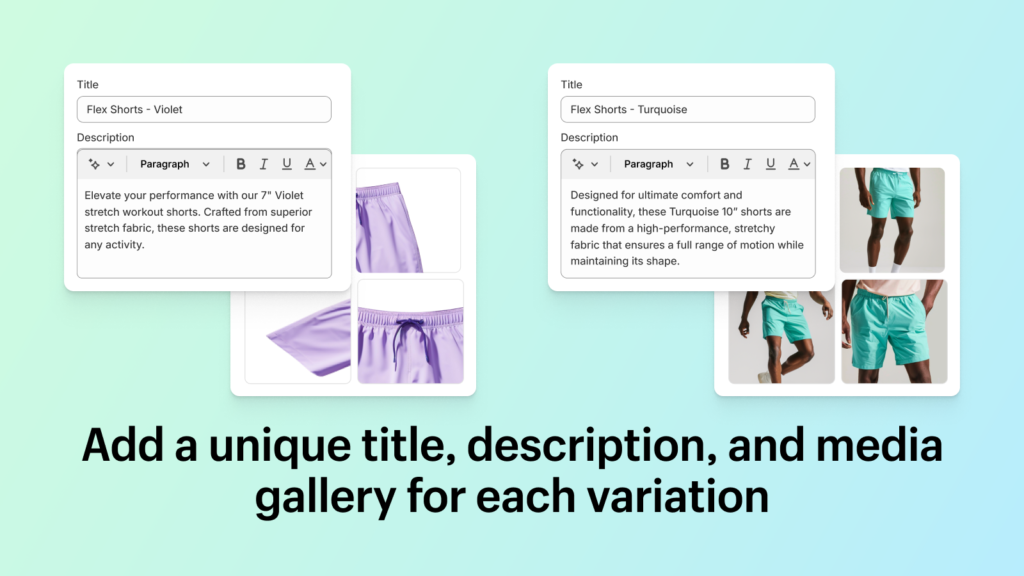
- Add, Edit, or Remove Products: You can easily modify the products within a Combined Listing.
- Product Detail Updates: Changes to titles, descriptions, and images can be made directly in the Shopify admin.
- Rearranging Options: The Combined Listings app allows you to rearrange product options as needed.
This flexibility enables you to keep your product listings current without starting from scratch.
Why a Senior Team is Mandatory for Migration
Migrating a complex catalog to a Combined Listings structure is a high-stakes move. Mistakes in 301 redirects or Schema Markup can cause a massive drop in organic traffic.
A fractional team (Dev, CRO, and SEO) ensures that:
- The UX is Fluid: The transition between “Child” URLs feels like a native variant change, not a clunky page refresh.
- Analytics are Accurate: Your Meta Pixel and GA4 must continue to track individual SKU performance correctly within the grouped listing.
Inventory is Synchronized: We verify that your inventory management system (IMS) recognizes the parent-child relationship so you don’t oversell out-of-stock colors.
Beyond boosting conversions by keeping variant choices seamless, structured variant management directly improves your store’s search indexation and site speed. Integrating features like Combined Listings as part of an ongoing
Frequently Asked Questions
1. Does the 2,048-variant limit make Combined Listings obsolete?
No. The 2,048 limit is for technical capacity (number of SKUs). Combined Listings is for Merchandising. You use it when you need unique descriptions, URLs, and image galleries for each variation—something standard variants cannot do.
2. Can I use Combined Listings on a standard Shopify plan?
No. As of 2026, the native Combined Listings app remains a Shopify Plus exclusive. Standard merchants must use third-party apps to mimic this behavior.
3. How does this affect my Google Shopping Feed?
It improves it. Because each “Child” is a separate product, you can send color-specific images and URLs to your feed, which typically results in higher click-through rates (CTR) compared to generic variant feeds.
4. Can I have different prices for variations in a Combined Listing?
Yes. Since each child is an independent product, you can set unique prices, sale prices, and cost-per-item data for every SKU in the group.
5. What is the maximum number of products I can combine?
You can add up to 60 child products to a single parent combined listing, provided the total variant count stays under 2,048.