
We are very satisfied with our Shopify Partner, eCommerceToday. They are highly focused on our needs, have strong technical expertise, and are always up to date with the latest Shopify features and opportunities we could implement. They proactively bring new ideas and recommendations to us, while providing excellent follow-up and support. Thank you!
1. Client Overview
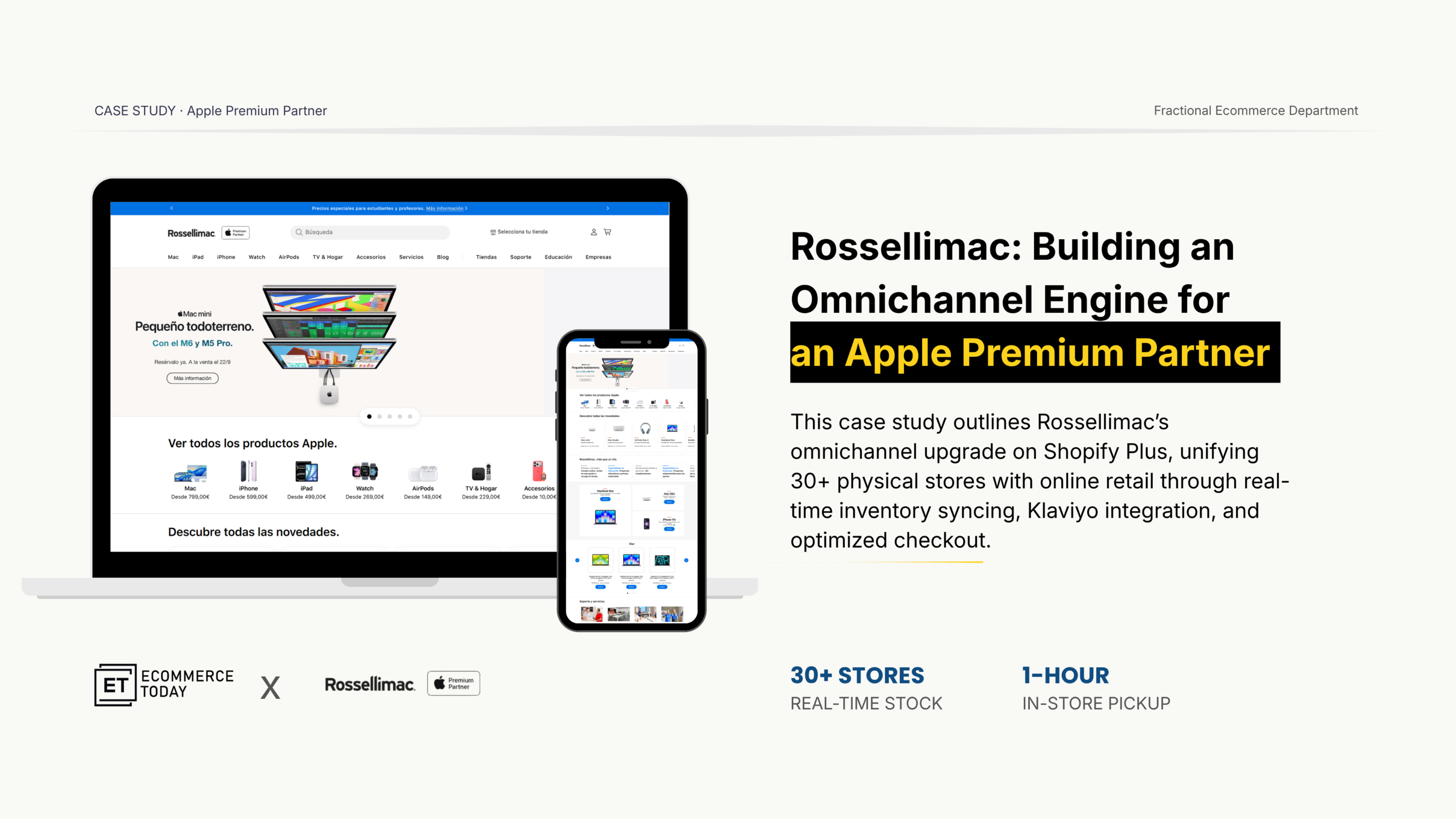
Rossellimac is an authorised Apple Premium Partner operating in Spain, with a network of more than 30 physical stores and a digital storefront at rossellimac.es built on Shopify Plus. The business sits in the high-consideration end of consumer electronics, works to Apple Brand Development Fund standards, and runs three configured markets (Spain retail, SMB and B2B) alongside a sister store, macnificos.com.
Rossellimac is not an online business or a retail business. It is both at once: a customer researches a MacBook on the site, reserves it, collects it from a shop in Granada, Málaga or Toledo, and returns to that shop for service. Their differentiation is not price, since Apple pricing is Apple pricing. It is certified specialists, financing, trade-in and same-day pickup. Every one of those advantages lives in the shops. Almost none of them were visible online.
As their strategic eCommerce partner, our remit covered the storefront, the theme and its integrations, the Klaviyo lifecycle programme.
2. Challenges
The brief we inherited was not a marketing brief. It was an alignment problem with four faces.
- Online and offline told different stories. Digital revenue grew strongly while store-level records read flat, because attribution was manual and profiles were fragmented. The same person was two people to the systems.
- The storefront could not tell the truth about stock. Where a product used Shopify’s “Continue selling when out of stock” setting, per-location inventory was invisible to the theme. A customer could not tell whether an item was ready for pickup in an hour, would ship in 24 to 48 hours, or was weeks away, and the page often implied the most optimistic answer.
- Data reached Klaviyo late and incomplete. Batch middleware into the ERP delayed profile updates, and in-store purchases never reached the customer database at all. With 30 shops, the highest-intent audience in the business was invisible to marketing.
- Compliance and third-party clutter. EU common-charger disclosures, energy labels and the right-of-withdrawal process all had to land inside an existing catalogue and theme, while competing financing widgets and theme quirks produced script errors and cross-sell anomalies on product pages.
Behind all of it, one commercial fact: a very large number of sessions each year reached checkout and did not complete, overwhelmingly on mobile. Nothing else we could fix was worth as much.
3. Phase 1: Stabilise the Platform, Then Make the Data Move
Phase 1 was deliberately unglamorous. Nothing downstream is worth building on a storefront that misreports availability, or a database that does not know who walked into a shop.
Rebuilding availability from the inventory up
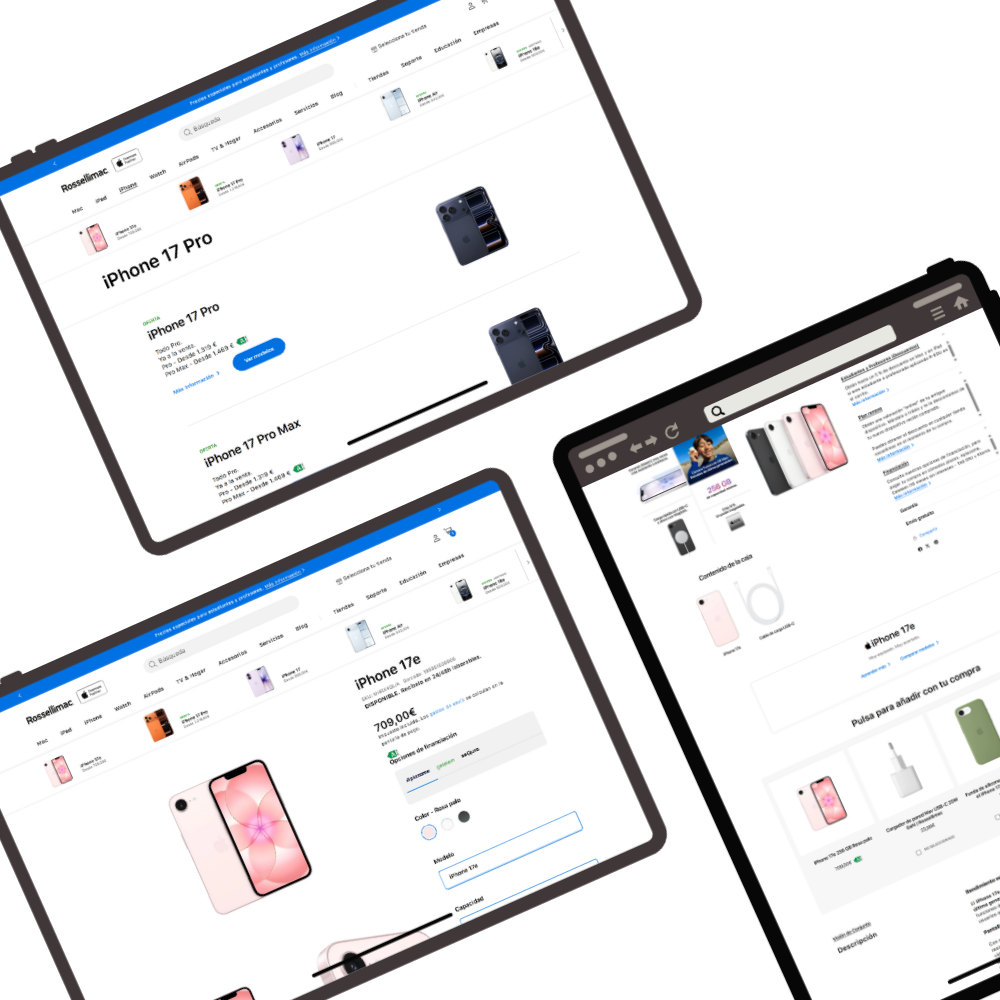
The core engineering work was a new variant-level metafield, written by a purpose-built Shopify Flow, recording quantity per location together with a marker for continue-selling status. That gave the theme something it never had: real per-store stock and status readable anywhere, replacing the legacy quantity metafield rather than breaking the logic already depending on it.
On top of it we shipped one honest message set: pickup where the selected store holds stock, pre-order where it does not, 24 to 48 hour shipping where that is the truth. We then replicated the logic inside the pickup drawer so page and drawer can never disagree. Bulk imports, ERP stock pushes and new product creation all trigger the Flow; where no trigger can exist, the code falls back safely instead of guessing.
Attribution, compliance and the plumbing
- Cash on Delivery was restricted to in-store pickup orders, protecting fulfilment during new product launches.
- EU compliance was rolled out through a metafield pipeline driven by bulk catalogue tooling, with charger disclaimers and energy labels rendered dynamically rather than hand-edited into templates, alongside an end-to-end right-of-withdrawal workflow with automated customer confirmation and internal notification.
- Payment and financing widgets were stabilised so multi-vendor options display consistently on product pages instead of colliding.
- Retail orders were pushed into Klaviyo as a dedicated custom event carrying revenue. This was the single change that made shop customers addressable, and the one that settled a live platform question in Klaviyo’s favour.
Alongside this we designed interim single-master journeys for the segments that mattered (sleepers, upgraders and switchers) so benchmarks existed before the larger CRM work rather than after it.
4. Phase 2: Building the Lifecycle Engine
With clean signals, Phase 2 turned the shops’ best argument, that your current iPhone is worth something and financing makes the next one easy- into an automation that runs whether or not a launch is happening.
We built two parent automations, iPhone Upgraders and iPhone Sleepers, sharing a ten-email, 270-day evergreen journey: one touch every 30 days, each with a distinct commercial job.
- Day 0: Features. A direct generational comparison: is your phone keeping up?
- Day 30: Trade-in equity. Your device is worth more today than tomorrow.
- Day 60: Logic and financing. Interest-free instalments reframe the price.
- Day 90: Business. Productivity and the Apple Technical Partner proposition.
- Day 120: Bundles. Device and Mac synergy for the pro buyer.
- Day 150: Speed. Camera sensors and storage: reasons to move now.
- Day 180: Financing, second pass. Instalments at the premium tier.
- Day 210: Support. AppleCare+ and charging bundles.
- Day 240: Specs and logistics. Side-by-side comparison and free 24 to 48 hour delivery.
- Day 270: Final. A last call on trade-in value before the cycle restarts.
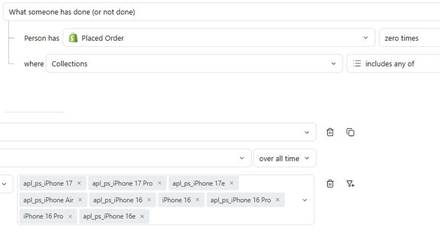
Two design decisions matter more than the copy. First, nothing expires at the next launch, because an evergreen journey that names one generation has a shelf life of twelve months. Second, the audiences are built on device age and behaviour across online and in-store purchases together, not a hand-maintained list of model names.
In parallel, we restructured paid media allocations to meet Apple Brand Development Fund audit requirements and fed zero-party data capture into top-of-funnel campaigns, so acquisition and lifecycle pull on the same audience definitions.
5. Functionalities and the Branches We Worked On
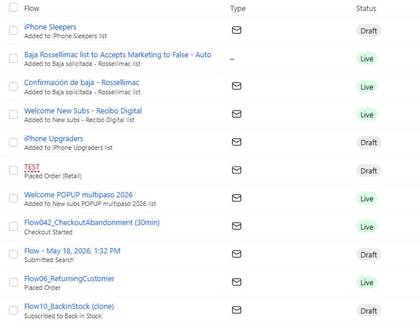
The programme now covers the full lifecycle rather than a single flow: welcome and subscriber capture, site and browse abandonment, checkout recovery, new and returning customer journeys, win-back, back-in-stock, unsubscribe handling, and the upgrade programme.
Checkout recovery: the highest-value branch
Checkout abandonment is where the money is, so it gets the tightest build: a 30-minute delay, then a recovery sequence carrying live product context. It is consistently the strongest earner in the account, and the work continues. Capturing an address earlier in checkout widens the addressable pool, and the later message is being rebuilt to perform closer to the first.
Storefront functionality
- New product introduction support: launch execution across landing pages, family stripes, comparison pages, collection and product updates, AppleCare+ products and banners, with extended on-site coverage on launch day.
- Dynamic store stock messaging: product pages and the pickup drawer reading real per-location inventory, stating one-hour pickup or 24 to 48 hour shipping instead of a generic out-of-stock notice.
- Merchant-editable messaging: pickup and shipping copy exposed as theme settings, so the client’s team can change wording without a developer.
- Automated B2B account discounting: new education and business accounts linked to the correct price catalogue via affiliate code validation.
- Custom cross-sell and financing on product pages: consistent multi-vendor payment display alongside curated accessory recommendations.
- EU compliance automation: a metafield pipeline driving charger and energy-label disclaimers dynamically across the catalogue.
- Platform hygiene: theme migration onto the current release with Apple Services sections, interactive visualisers, localised store locators and automated badges; search redirect optimisation; a realigned deployment pipeline; and a documented release protocol under which we prepare and guarantee the build and the client publishes.
Checkout is the current frontier. Shopify is retiring the previous framework for checkout and customer-account extensions, so the checkout extension was rebuilt and tested ahead of the deadline, with the store’s custom tax-document fields preserved, because in Spain they are not optional.
How the work is run
One account manager as a single point of contact; a monthly cycle opening with a written split between client decisions and agency tasks; ticket-level tracking against a retainer; a shared buying-scenario test matrix built with the client’s team; and recurring calls with a working agenda. When a disagreement arose over who should publish a major theme release, it was resolved into a written protocol rather than escalated.
6. Conclusion
Rossellimac began this work with two businesses that did not recognise each other: a storefront that could not say where a product was, an ERP whose data arrived late, thirty shops full of customers marketing could not see, and a checkout losing a large share of high-intent mobile buyers.
Today the storefront reads real inventory per location and says something true on every product page. In-store purchases land in the customer database and can be segmented like any online order. The lifecycle programme runs from acquisition to reactivation, with an evergreen upgrade journey that does not need a launch to earn its keep and a checkout recovery flow that is the highest-earning message set in the account. Compliance is automated rather than hand-maintained, and releases follow an agreed protocol.
None of it was a redesign. It was a sequence of specific corrections made in the right order, each unblocking the next. The outcome is a storefront and a customer programme that finally describe the same business. The foundation now supports the next stage: real-time ERP and CRM integration, trade-in valued online rather than only in store, and review collection turning thirty shops’ worth of service reputation into something a customer can see.
Who is Rossellimac?
Rossellimac is an authorised Apple Premium Partner in Spain, with more than 30 physical stores and an online store at rossellimac.es built on Shopify Plus. It runs three markets (Spain retail, SMB and B2B) and a sister store, macnificos.com, and competes on certified specialists, financing, trade-in and same-day pickup rather than price.
What challenges did Rossellimac face before working with eCommerce Today?
Rossellimac’s online and in-store data told different stories, because attribution was manual and customer profiles were fragmented. The storefront could not show real stock per store, in-store purchases never reached Klaviyo, and EU compliance requirements and conflicting financing widgets caused errors on product pages. Many sessions also reached checkout without completing, mostly on mobile.
How does Rossellimac show real per-store stock availability on Shopify?
eCommerce Today built a variant-level metafield, written by a dedicated Shopify Flow, that records stock quantity per location and whether a product can keep selling when out of stock. Product pages and the pickup drawer read this data and show one clear message: pickup where the selected store has stock, pre-order where it does not, or 24 to 48 hour shipping where that applies.
How are Rossellimac's in-store purchases sent to Klaviyo?
Retail orders from Rossellimac’s shops are pushed into Klaviyo as a dedicated custom event that carries revenue. This made in-store customers addressable for the first time, so they can be segmented and targeted like online buyers.
What is the Rossellimac iPhone upgrade email journey?
eCommerce Today built two parent Klaviyo automations, iPhone Upgraders and iPhone Sleepers, sharing a ten-email journey that runs over 270 days with one email every 30 days. Each email has a distinct job, covering features, trade-in value, interest-free financing, business use, bundles, AppleCare+ and a final trade-in reminder before the cycle restarts.
Why is the Rossellimac upgrade journey evergreen instead of launch-based?
The journey does not name a specific iPhone generation, so it does not expire when a new model launches. Audiences are built on device age and customer behaviour across both online and in-store purchases, rather than a manually maintained list of model names.
How is checkout abandonment handled for Rossellimac?
The Rossellimac checkout abandonment flow in Klaviyo starts after a 30-minute delay and sends a recovery sequence with live product context. It is consistently the highest-earning flow in the account, and work continues on capturing addresses earlier in checkout and improving the later messages.
How was EU compliance automated on the Rossellimac Shopify store?
eCommerce Today built a metafield pipeline, driven by bulk catalogue tools, that renders EU common-charger disclaimers and energy labels dynamically across the catalogue. The team also set up an end-to-end right-of-withdrawal workflow with automated customer confirmation and internal notification.
How are B2B and education discounts applied automatically for Rossellimac?
New education and business accounts are automatically linked to the correct price catalogue through affiliate code validation. This removes manual work in assigning B2B pricing on Shopify Plus.
How did eCommerce Today prepare Rossellimac for Shopify's checkout extension changes?
Shopify is retiring its previous framework for checkout and customer account extensions, so eCommerce Today rebuilt and tested the Rossellimac checkout extension ahead of the deadline. The store’s custom tax-document fields, which are mandatory in Spain, were preserved.
How does eCommerce Today manage the Rossellimac partnership?
Rossellimac works with one account manager as a single point of contact. Each monthly cycle starts with a written split between client decisions and agency tasks, work is tracked at ticket level against a retainer, and theme releases follow a documented protocol where eCommerce Today prepares and guarantees the build and the client publishes it.