
Executive Summary
Heywood-Wakefield ran email automation on Shopify Email, with a one-email welcome and a one-email abandoned checkout. We moved the brand to Klaviyo and built a lifecycle email system with 6 flows and 16 emails. Discounts protect the premium positioning, the post-purchase flow fits a 14-week build time, and the client owns and runs the system.
Client Overview
Heywood-Wakefield is an American furniture maker with roots going back to 1826. The company was revived in 1992 around its streamlined Mid-Century Modern designs, built to order from solid Northern Yellow Birch in Winchendon, Massachusetts. Every piece is made after the order is placed, with a lead time of about 14 weeks, and customers buy it as a long-term investment, often as an heirloom.
The brand sells through a Shopify store, and email is already one of its strongest revenue channels. In August 2026 Heywood-Wakefield chose eCommerce Today (ETA) to move from Shopify Email to Klaviyo and to build a proper lifecycle email system, with ETA acting as the strategic and delivery partner from setup to launch.
Challenges
Before we started, email automation consisted of a one-email welcome and a one-email abandoned checkout, both sent through Shopify Email. There was no cart or browse abandonment, and no way to see which product a visitor had looked at or left behind. The project had to solve five things at once:
- Protect the premium positioning and the margin. Discounts had to be tied to full-price items only, never to pieces already on sale, and never lead the conversation. For premium furniture, too many promotions damage how the brand is perceived.
- Fit a long purchase cycle. With a 14-week build time, post-purchase emails had to reassure the customer during the wait and cross-sell only after the furniture had arrived.
- Build deliverability from scratch. A new platform meant a new sending reputation: domain authentication, a clean list and a gradual ramp-up before regular sending.
- Respect a mix of consent levels. A significant share of the profiles in the Klaviyo account had never explicitly subscribed.
- Work with a hands-on client. The client runs email, design and performance marketing himself and wanted to own the system long term. He asked for every decision to be documented, including the reasoning behind it.
Phase 1: Technical Foundation
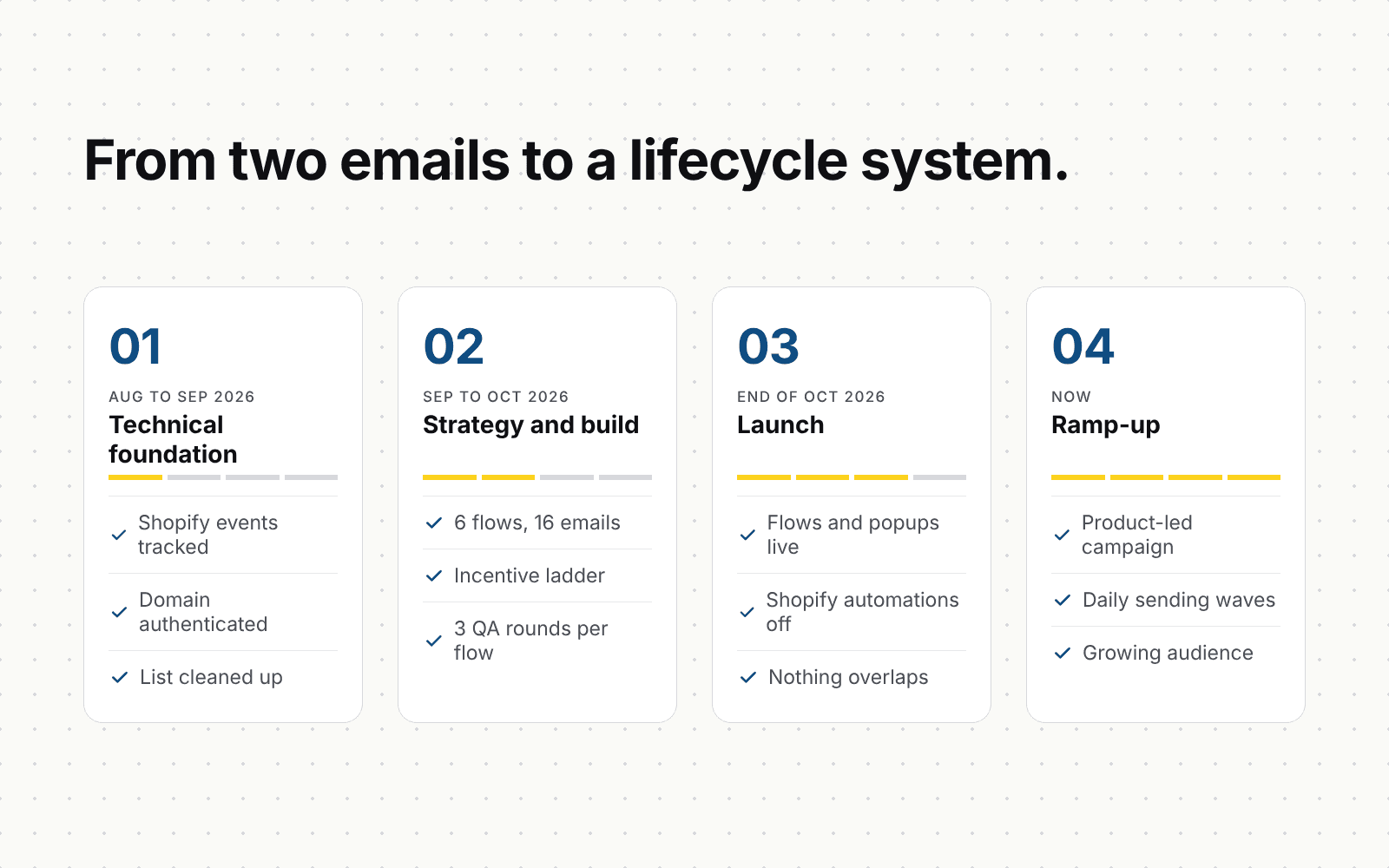
August to September 2026. We started with the data and deliverability layer, because email marketing is only as good as the signals feeding it.
- Account and sender setup: Klaviyo account created under the client's shared mailbox, with timezone, language and currency configured for the US market. The account is set up so ownership can move to the client.
- Store integration: Klaviyo connected to Shopify, with the app embed and event tracking enabled for viewed product, added to cart, checkout started and placed order.
- Tracking and list settings: UTM tracking activated for clean attribution in analytics. Lists were switched to single opt-in to raise sign-up conversion, and existing Shopify subscribers were synced so they do not see the popup again.
- Domain authentication: the sending domain was authenticated with DNS records and DMARC. After a fix to one record in September, Klaviyo sends from the client's own domain.
- List hygiene: we reviewed the "never subscribed" contacts and found too little engagement history to judge them reliably. At the client's request they were suppressed, so regular sending starts from a cleaner list.
Phase 2: Strategy, Creative and Launch
September to October 2026. With the foundation in place we moved to strategy and build.
Blueprint and incentive ladder
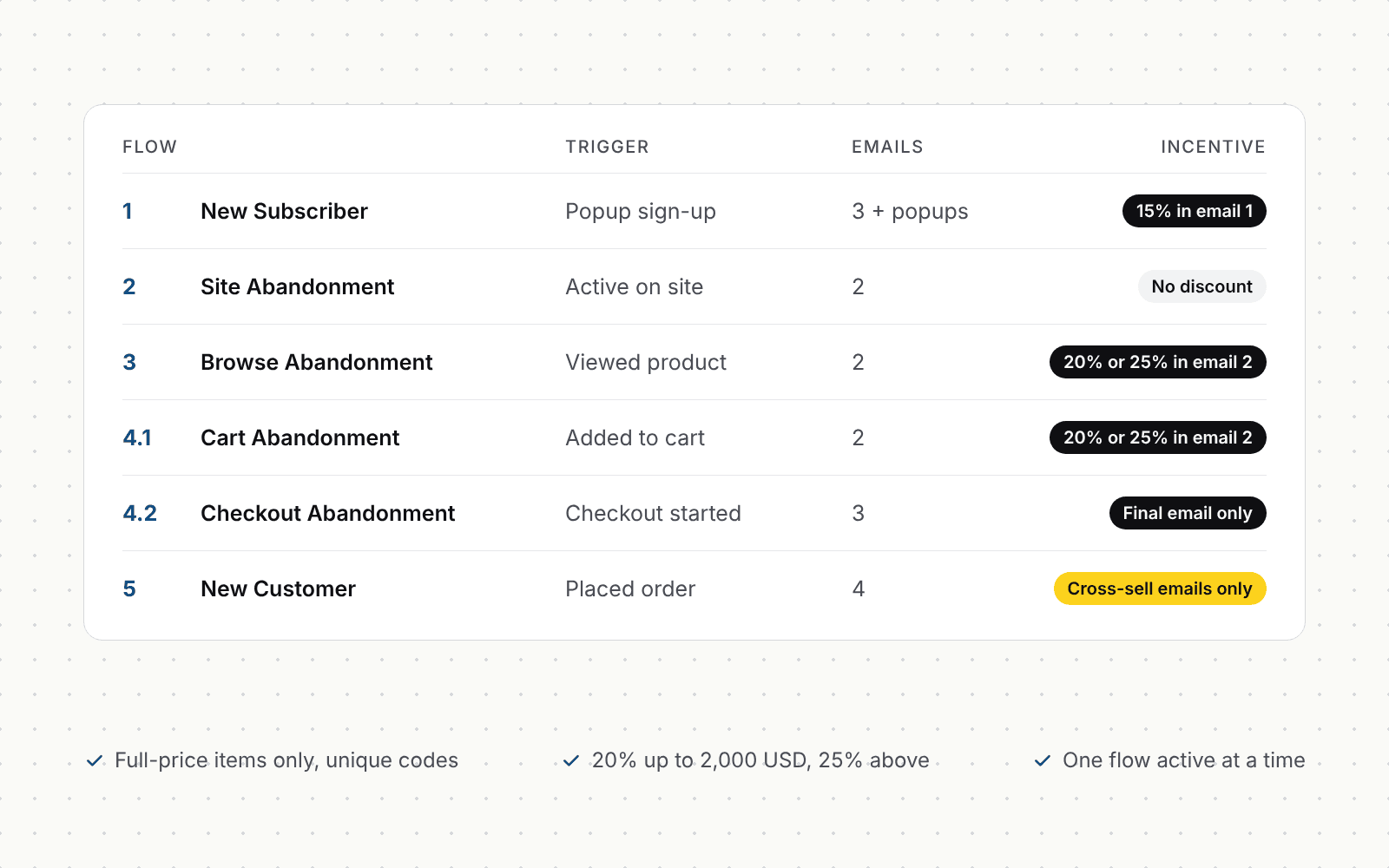
We mapped the customer journey into 6 flows and 16 emails, ordered by purchase intent: Checkout Abandonment first, then Cart, Browse and Site Abandonment. A shopper sits in only one of them at a time. The incentive ladder follows one rule: no discount on the first touch of an abandonment flow, so we never pay for a sale that was already happening.
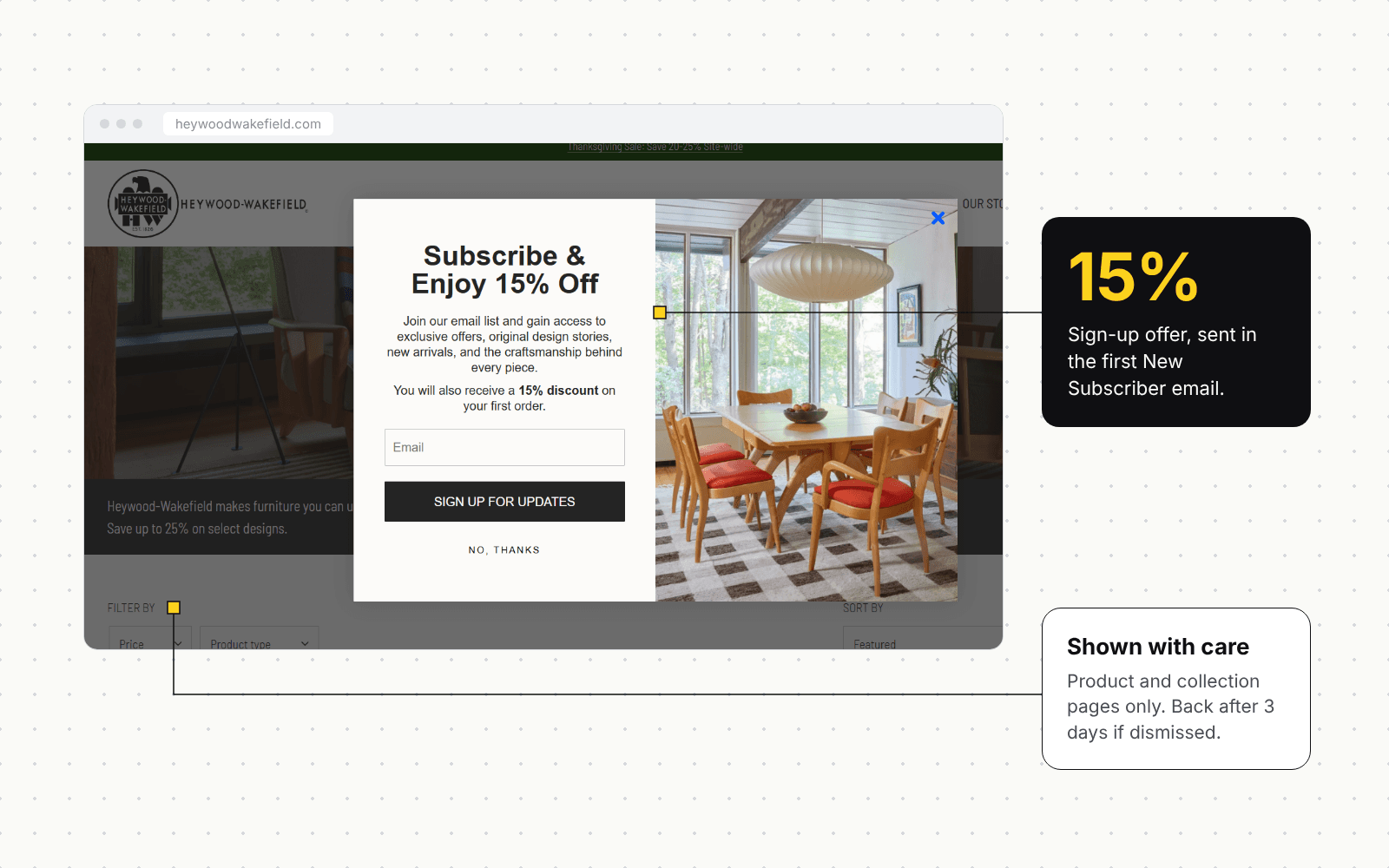
15% for new subscribers through the popup. In Browse and Cart Abandonment the discount only appears in the second email: 20% or 25%, depending on the price of the piece. Checkout Abandonment keeps its incentive for the final email, and the New Customer flow carries one in its cross-sell emails. Discounts apply only to full-price items.
Build, QA and client feedback
We built one reusable base template, approved by the client, and then the flows, the desktop and mobile popups and the email graphics. The emails are intentionally text-led, which supports deliverability on a new sending domain. Every flow passed three internal reviews: graphic design QA, email marketing QA and a supervisor QA.
The client then reviewed the flows in a two-hour call with the Klaviyo specialist and the account manager. The decisions that came out of it shaped the final setup: unique dynamic coupon codes instead of one static code, a Shopify "Not on Sale" collection that keeps discounts away from sale items, a size limit of about 90 KB per email, and popup rules (product and collection pages only, back after 3 days if dismissed). Following the agreed way of working, the client then edits copy and images in cloned flows, while ETA documents each step.
Launch and ramp-up
Final QA and the launch of the flows and popups were completed at the end of October 2026, switching off the old Shopify automations and popups so nothing overlaps. In parallel we planned the ramp-up campaign: five campaign themes were proposed, and the client chose a practical, product-led one, "Small Footprint, Full-Size Function". It is sent in daily waves to a growing audience to build the new domain reputation safely.
Functionalities and the Flows We Worked On
Beyond the emails themselves, the value is in the logic behind them. These are the functionalities we configured, followed by each flow as it runs in Klaviyo.
- Tiered discount logic: browse and cart emails split on product price, with a 20% tier for lower-priced pieces and a 25% tier for higher-priced ones.
- Full-price-only coupons: unique Klaviyo coupon codes are scoped to a "Not on Sale" collection in Shopify, so a customer never gets a discount on a piece that is already reduced.
- Cross-flow priority: each flow excludes shoppers who have moved further down the funnel, so only one message path is active at a time.
- Dynamic product blocks: browse and cart emails show the product the customer viewed or left behind, without prices, so a sale price can never differ between the email and the site.
- Built for a 14-week lead time: the New Customer flow reassures first and sends its second email 112 days after the order, once the furniture has arrived.
- Popups and consent: desktop and mobile popups feed the New Subscriber flow, on single opt-in, and the sign-up sources are tracked so new subscribers can be segmented.
- Reusable base template and universal sections: one template with shared header and footer sections, so future campaigns launch faster and stay consistent.
The 6 flows in Klaviyo
| Flow | Trigger | Emails | Incentive and logic |
|---|---|---|---|
| 1. New Subscriber | Added to the subscriber list (popup sign-ups) | 3 emails plus desktop and mobile popups | 15% sign-up offer in the first email. Email 2 tells the brand story with no offer, email 3 shows bestsellers and reminds of the offer. Builds trust in the brand. |
| 2. Site Abandonment | Active on site | 2 emails | No discount. New arrivals in email 1, most popular products in email 2. For visitors who left without viewing a product. |
| 3. Browse Abandonment | Viewed product | 2 emails | The viewed piece comes back with no discount. In email 2 a tiered coupon applies: 20% or 25%, depending on the price of the piece, on full-price items only. |
| 4.1 Cart Abandonment | Added to cart | 2 emails | Email 1 is a reminder with no discount. Email 2 carries the same tiered coupon, on full-price items only. |
| 4.2 Checkout Abandonment | Checkout started | 3 emails | Emails 1 and 2 reassure with no discount. The incentive appears only in email 3. Highest purchase intent, so highest priority. |
| 5. New Customer | Placed order | 4 emails | Email 1 reassures during the 14-week build. Email 2 follows 112 days after purchase, once the furniture has arrived. Emails 3 and 4 cross-sell matching pieces and include an incentive. |
As a Klaviyo Master Platinum Partner, we build lifecycle systems like this one for Shopify brands. Want to see what a structured Klaviyo system can do for your brand? Talk to our team.
Frequently Asked Questions
What brands ask us about this Klaviyo lifecycle email system.
Why did Heywood-Wakefield move from Shopify Email to Klaviyo?
The previous setup had only a one-email welcome and a one-email abandoned checkout, with no cart or browse abandonment. Klaviyo tracks what each shopper does on the site (viewed product, added to cart, checkout started, placed order), so every flow can react to the exact product and stage.
How long did the project take?
The technical foundation ran from August to September 2026, and strategy, build and QA from September to October 2026. The flows and popups went live at the end of October 2026.
How do you use discounts without hurting a premium brand?
Abandonment flows never offer a discount on the first touch. When an incentive appears, it uses unique coupon codes scoped to a "Not on Sale" collection in Shopify, so it never stacks on a piece that is already reduced.
How does the email system fit a 14-week build time?
The New Customer flow reassures the customer while the piece is being built. The second email goes out 112 days after the order, once the furniture has arrived, and only then do the cross-sell emails start.
Can a shopper get emails from two abandonment flows at once?
No. Each flow excludes shoppers who have moved further down the funnel, so only one message path is active at a time. Checkout Abandonment has the highest priority.
How did you protect deliverability on a new platform?
We authenticated the sending domain with DNS records and DMARC and suppressed contacts that had never subscribed. The emails are text-led and kept to about 90 KB, and sending volume grows gradually through a ramp-up campaign sent in daily waves.
Can the client manage the system on their own?
Yes. Every decision was documented, including the reasoning behind it. The client edits copy and images in cloned flows, and the account is set up so ownership can move to the client.