
The way customers discover products online is changing faster than ever.
For years, ecommerce brands have optimized for search engines, social media, and marketplaces. Now, a new channel is emerging: AI-powered shopping assistants.
With the introduction of Shopify Agentic Storefronts, merchants can make their products discoverable through AI platforms such as ChatGPT, Microsoft Copilot, Google AI Mode, Gemini, and Shop, allowing customers to find and purchase products directly from conversational AI experiences.
This marks one of the biggest shifts in ecommerce since the rise of mobile shopping.
What Are Shopify Agentic Storefronts?
Shopify Agentic Storefronts enable AI assistants to access product information through Shopify Catalog and recommend products to users based on conversational queries.
Instead of searching for products through traditional search engines, customers can now ask questions like:
- “What’s the best standing desk for a small apartment?”
- “Recommend a minimalist leather wallet under $100.”
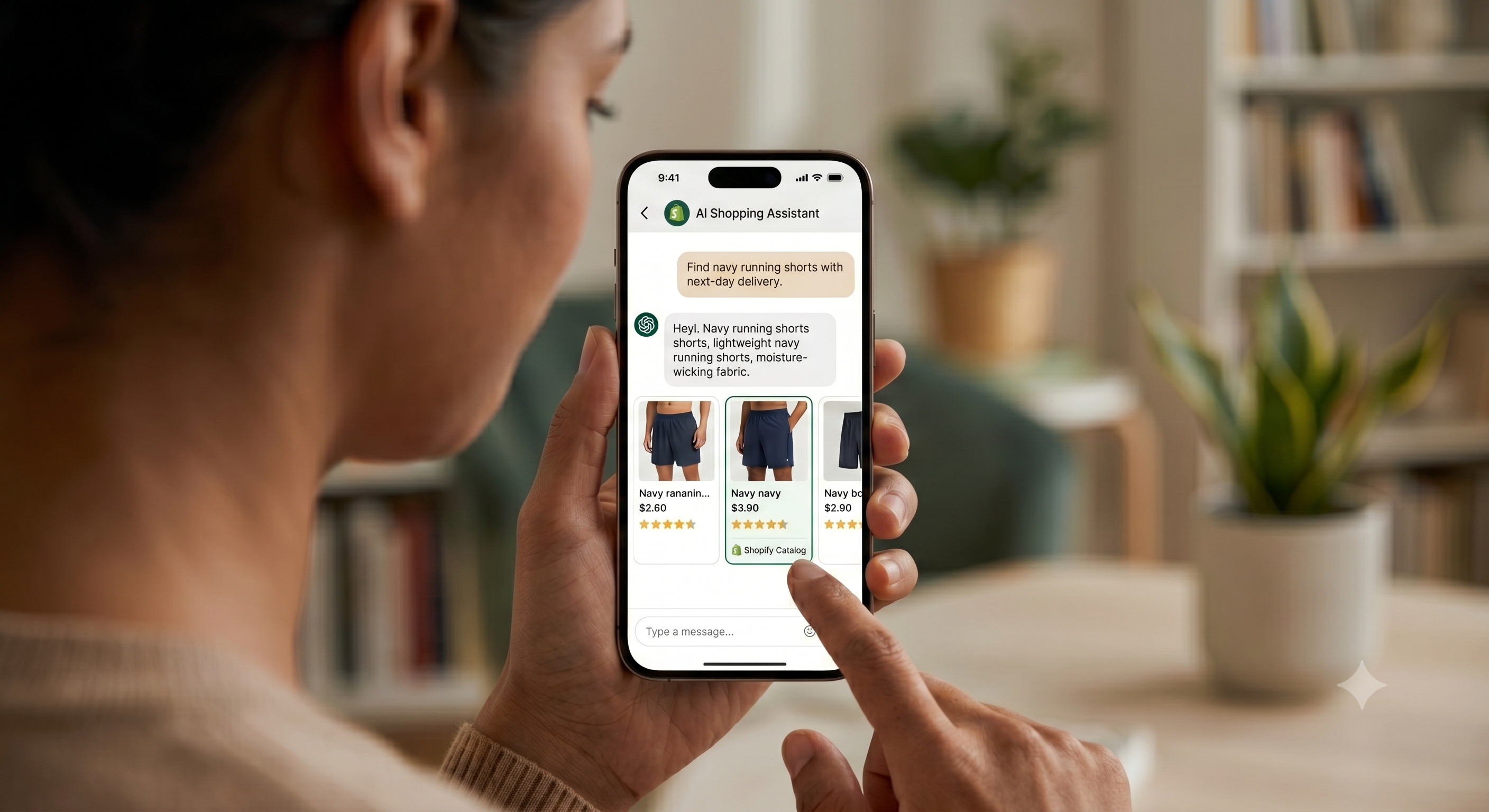
- “Find navy running shorts with next-day delivery.”
AI agents analyze the request, search available product catalogs, and present relevant recommendations.
For Shopify merchants, this creates a new acquisition channel where products can be discovered naturally through AI-powered conversations.
How AI Shopping Works
The process is surprisingly simple from the customer’s perspective.
A shopper interacts with an AI assistant and describes what they’re looking for. The AI evaluates available products and surfaces recommendations that match the user’s intent.
Depending on the platform, customers can complete their purchase in one of two ways:
ChatGPT
ChatGPT acts primarily as a discovery channel.
When a customer selects a product recommendation, they are redirected to the merchant’s Shopify checkout experience through an in-app browser or a new browser tab.
This means merchants retain their existing checkout customization, branding, payment methods, and customer experience.
Google AI Mode, Gemini, and Microsoft Copilot
Some AI channels support Shopify-powered direct checkout.
In these environments, customers can complete purchases without leaving the AI conversation, creating a frictionless shopping experience that reduces steps between discovery and purchase.
Shopify Catalog: The Foundation of AI Commerce
At the center of Shopify’s agentic commerce strategy is Shopify Catalog.
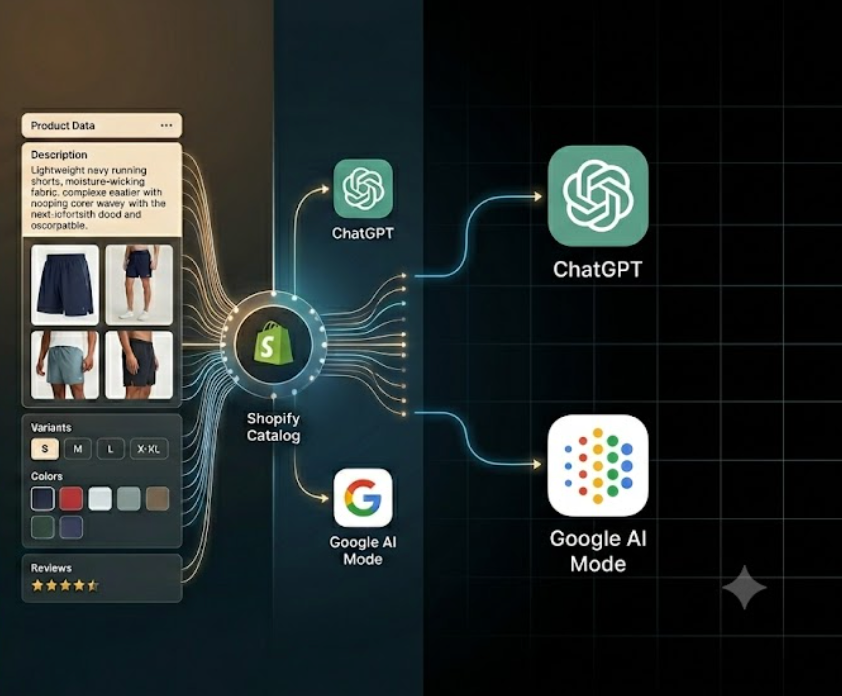
Shopify Catalog acts as the structured data source that AI agents use to understand:
- Product titles
- Descriptions
- Images
- Pricing
- Inventory availability
- Variants
- Product attributes
Because Shopify continuously synchronizes catalog information, AI channels receive accurate product data, helping ensure customers see up-to-date information during product discovery.
For merchants, this means maintaining high-quality product information is no longer just an SEO best practice—it directly impacts AI discoverability.

Why This Matters for Ecommerce Brands
Historically, ecommerce growth depended heavily on:
- SEO
- Paid advertising
- Email marketing
- Social commerce
- Marketplaces
Agentic commerce introduces an entirely new discovery layer.
Rather than optimizing solely for keywords, brands must now optimize for how AI understands products and matches them to customer intent.
This shift means product data quality becomes increasingly important.
The stores that provide the clearest, most complete product information are likely to gain greater visibility within AI shopping experiences.
How to Optimize Products for AI Discovery
Many of the factors that improve traditional SEO also improve performance in AI shopping environments.
1. Create Detailed Product Descriptions
AI systems rely heavily on descriptive content to understand product relevance.
Instead of writing:
“Blue running shorts.”
Consider:
“Lightweight navy running shorts designed for long-distance runners, featuring moisture-wicking fabric, a secure zip pocket, and four-way stretch material.”
The additional context helps AI understand when to recommend the product.
2. Improve Product Images
Image coverage is one of the ranking signals Shopify highlights within its Agentic analytics tools.
Include:
- Multiple angles
- Lifestyle photography
- Detail shots
- Variant-specific images
More visual context helps AI platforms represent products more accurately.
3. Maintain Complete Variant Information
Customers often shop using highly specific requirements.
For example:
- Size
- Color
- Material
- Style
- Fit
Complete variant data helps AI agents match products to these detailed requests.
4. Collect Authentic Product Reviews
Verified reviews contribute to trust signals and can influence how products rank within AI-powered shopping experiences.
Strong review volume combined with positive ratings may improve discoverability over time.
5. Publish Store Policies
Shopify specifically identifies complete policies as an important trust signal.
Ensure your store includes:
- Privacy Policy
- Terms of Service
- Returns & Refund Policy
- Shipping Information
These elements help AI systems assess legitimacy and confidently recommend products.
Measuring Success in AI Channels
One of Shopify’s most valuable additions is dedicated reporting for agentic storefront performance.
Merchants can track:
- Sales
- Orders
- Online store sessions
- Conversion rates
This visibility allows brands to understand how much traffic and revenue AI-powered shopping experiences generate compared to traditional channels.
As adoption grows, these metrics may become as important as organic search traffic and paid acquisition reporting.
The Future of Ecommerce Is Conversational
The rise of agentic commerce signals a broader shift in consumer behavior.
Customers increasingly expect answers rather than search results.
Instead of browsing dozens of category pages, users can simply describe what they need and receive curated recommendations instantly.
For merchants, success in this new environment will depend less on ranking for individual keywords and more on providing structured, comprehensive, and trustworthy product information that AI systems can understand.
The brands that adapt early will have a significant advantage as AI-powered shopping becomes mainstream.
Final Thoughts
Shopify Agentic Storefronts represent one of the most important developments in ecommerce since the introduction of mobile commerce.
By enabling products to appear across platforms like ChatGPT, Microsoft Copilot, Google AI Mode, Gemini, and Shop, Shopify is positioning merchants for a future where product discovery happens through conversations rather than searches.
For ecommerce brands, the opportunity is clear:
Optimize product data, improve content quality, and prepare for a world where AI agents become the new storefront.
The future of commerce isn’t just online—it’s conversational.
What are Shopify Agentic Storefronts?
Shopify Agentic Storefronts allow merchants to make their products discoverable and purchasable through AI-powered shopping experiences such as ChatGPT, Microsoft Copilot, Google AI Mode, Gemini, and Shop. Customers can find products through natural language conversations instead of traditional search.
Is ChatGPT shopping available for all Shopify stores?
Currently, Shopify’s ChatGPT integration is available to eligible merchants selling to customers in the United States. Shopify is gradually expanding access and merchants are notified directly through their Shopify Admin when they become eligible.
How do products appear in ChatGPT?
Products are surfaced through Shopify Catalog, which provides structured product information such as titles, descriptions, images, pricing, inventory, and variants. AI assistants use this data to recommend products that match customer intent.
What is Shopify Catalog?
Shopify Catalog is Shopify’s centralized product data infrastructure that powers product discovery across AI channels. It ensures product information remains accurate and up to date across participating platforms.
How can I improve my product visibility in AI search?
To improve discoverability, merchants should focus on:
- Writing detailed product descriptions
- Using high-quality product images
- Maintaining complete variant information
- Collecting verified customer reviews
- Publishing comprehensive store policies
- Following Shopify SEO best practices
Can I opt out of AI storefronts?
Yes. Shopify allows merchants to manage participation through the Agentic section in Shopify Admin, where they can control Catalog access and direct checkout settings for supported AI channels.
Will AI shopping replace traditional ecommerce?
Not entirely. AI shopping is expected to become an additional discovery and conversion channel alongside search engines, marketplaces, email marketing, social commerce, and paid advertising. Brands that optimize for both traditional search and AI discovery will likely have the strongest competitive advantage.
Ready to Prepare Your Shopify Store for AI Commerce?
The shift toward AI-powered shopping is already happening. As platforms like ChatGPT, Microsoft Copilot, Gemini, and Shop continue to expand their commerce capabilities, merchants who optimize early will be best positioned to capture new customers and revenue opportunities.
At Ecommerce Today, we help Shopify brands prepare for the future of commerce through:
- Shopify development and optimization
- Technical SEO
- Conversion Rate Optimization (CRO)
- Product data optimization
- AI commerce and Agentic Storefront consulting
Whether you’re looking to improve your product discoverability, optimize your Shopify Catalog, or prepare your store for AI-powered shopping experiences, our team can help.
Book a free consultation with Ecommerce Today and discover how your store can stay ahead of the next evolution of ecommerce.