
Most conversion rate optimization work ends at the buy button. Merchants tune headlines, shrink forms, test button colors, and speed up load times. All of that moves shoppers toward the cart. None of it answers the one question standing between a specific shopper and a specific purchase. That unanswered question is the pre-sale conversion gap, and it quietly drains revenue that your CRO dashboard never flags.
What the pre-sale conversion gap is
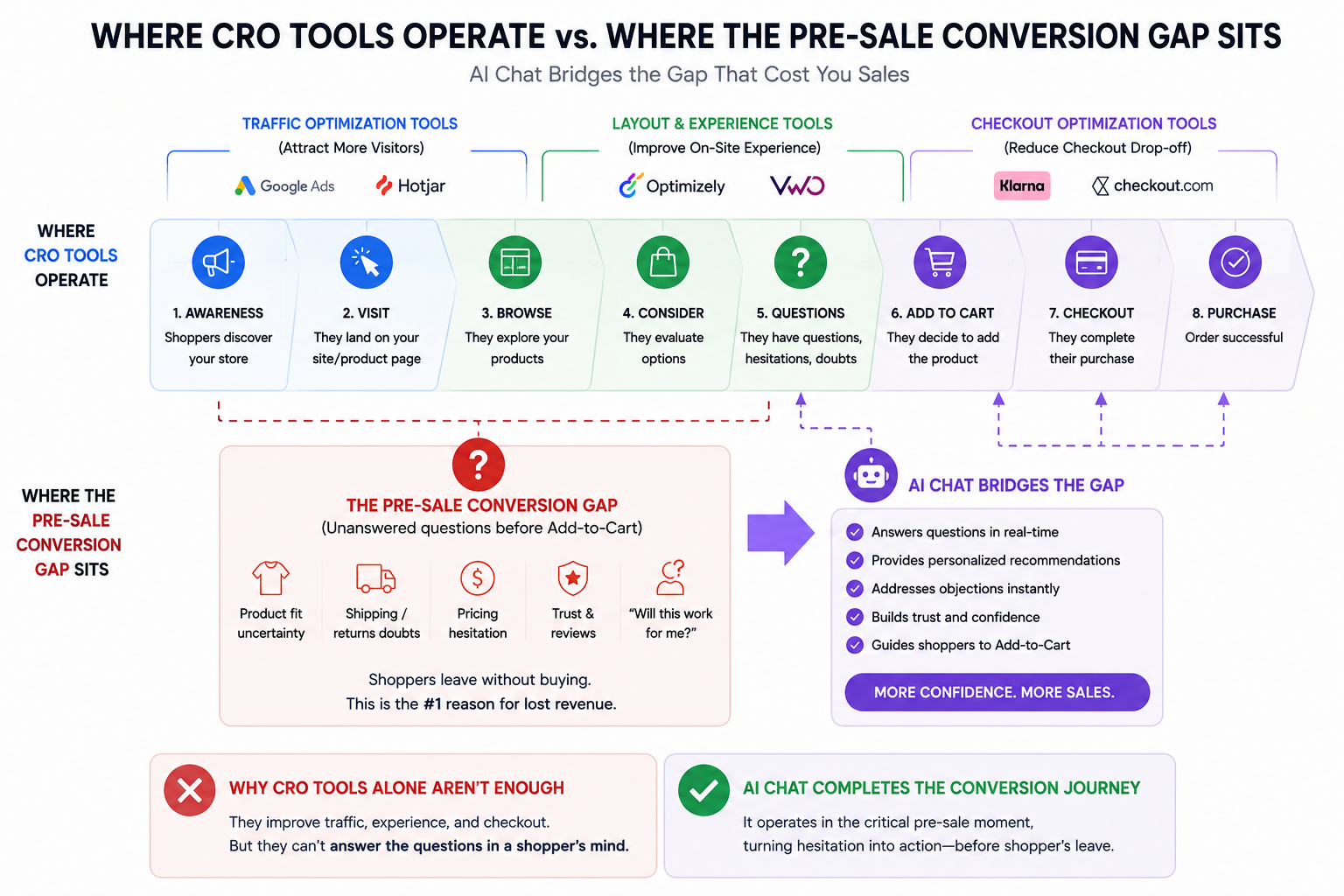
The pre-sale conversion gap is the space between a shopper who wants to buy and a shopper who feels safe buying. Classic CRO improves the mechanics of that journey. It does not resolve the doubt inside it.
Think about the last product a prospective customer almost bought online and then closed the tab. The page probably loaded fast. The checkout was probably clean. They left because a question went unanswered. Will this fit my frame? Is it safe for my skin? Does it work with the model I already own? When that question has no fast answer, the shopper defaults to no.
Why the gap hurts ecommerce businesses
A conversion funnel has three main stages: awareness, consideration, and conversion. The pre-sale gap sits in consideration, where the shopper is weighing the buy, and one open question can end it.
Cart abandonment gets all the attention because it is easy to count. Baymard Institute puts the documented average near 70% (Baymard Institute, 2024). The pre-cart drop-off is larger and harder to see, because those shoppers never add anything to count. They read, they hesitate, they leave. Standard analytics record it as a bounce, not a lost sale.
Why CRO stops at the buy button
Traditional CRO is built to remove friction from a known path. It assumes the shopper already knows they want the product and only needs a cleaner route to checkout. That assumption holds for commodity items. It breaks on anything a shopper has to think about.
The tools reflect this. A/B testing platforms optimize layout and copy. Heatmaps show where people scroll and click. Page-speed tools cut milliseconds. Every one of them treats the shopper as a stream of behavior, not a person with a specific worry. So they optimize the container and leave the contents of the shopper’s mind untouched.
The friction is not only mechanical. Gated content can drive buyers away from consideration before they ask a single question. Opaque pricing can accelerate a buyer’s move to competitors. CRO tools rarely catch either.
Here is the number that exposes the blind spot. When product information is missing or unclear, 83% of shoppers say they would abandon the site (Syndigo, 2024). No button color fixes that. The problem is not the path. It is the gap in the answer.
The questions that quietly kill sales
Shopper questions split into two types. The first is universal and predictable: shipping times, return windows, and sizing charts. A static FAQ handles those. The second type is personal and specific, and it is where the money leaks.
More than 70% of product-page queries are validation questions about fit, compatibility, and use case rather than pure discovery (Alhena, 2025). These are the “will this work for me” questions. You cannot pre-write every version of them, because each shopper carries a slightly different one. A generic FAQ runs out of road exactly when the decision hangs in the balance.
This is the pre-sale gap in one sentence. Intent is highest, and doubt is highest at the same moment, on the same page, and most stores have nothing built to close the distance in real time.
How AI chat closes the gap
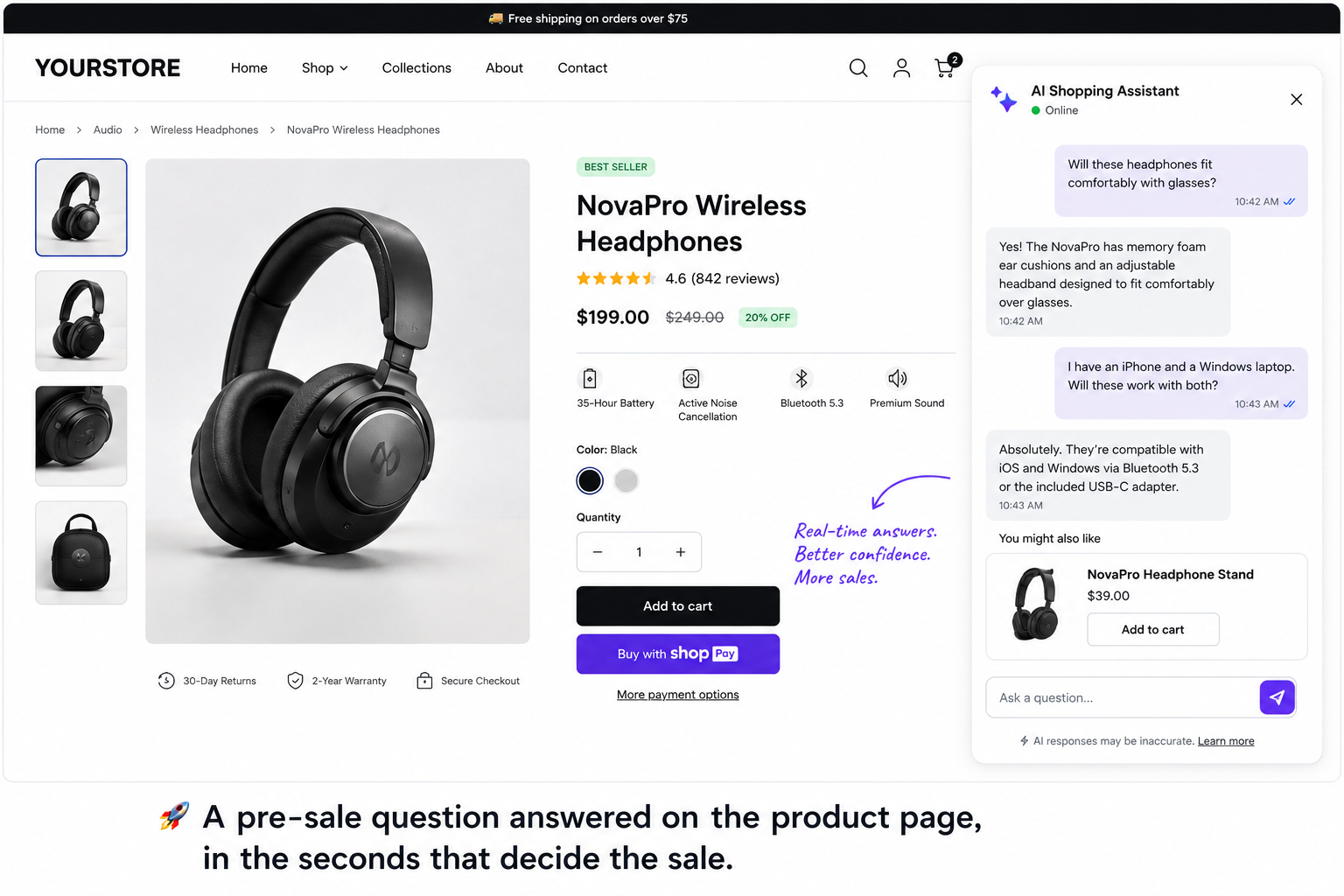
AI chat picks up the revenue CRO leaves on the table because it does the one thing layout testing cannot. It answers the specific question at the exact second it appears. Immediate responses to high-intent prospects and a fast reply are what keep a wavering shopper from leaving.
A well-trained AI agent reads your catalog, policies, and product data, then holds a real back-and-forth with the shopper. Ask about fit, and it checks the sizing logic. Ask about compatibility, and it cross-references the spec. Proactive trust-building reduces drop-offs during the pre-sale process, because the shopper never has to leave to get certainty.
The shopper gets a tailored answer in seconds, on the product page, without leaving for a chat queue or an email thread. For Shopify merchants, this is the practical difference between a bounce and a checkout, and the mechanics are covered in this guide to AI chat for Shopify.
The resolution rates back this up. A well-trained AI agent resolves around 78% of queries, against roughly 52% for older rule-based bots (Fullview, 2025). That gap between 52 and 78 is not a support metric. On a high-intent product page, it is recovered sales.
What this looks like in real stores
The revenue shows up in named outcomes, not theory. Ring Automotive resolved technical pre-sale questions in chat and hit a 12% conversion rate with a higher average order value. Shelly used AI product guidance and reported 8 to 12 times monthly ROI. Twitter Bike USA reached over 90% accuracy in product recommendations, which matters most when a wrong suggestion means a returned part.
Notice the pattern. These are not support stories. They are conversion stories. The chat is doing pre-sale work, resolving the doubt that would have ended the session, and turning a hesitant browser into a buyer.
Where AI chat still needs guardrails
AI chat is not a switch you flip and forget. Point it at a thin or outdated catalog, and it will answer thin, outdated questions. The quality of the answers tracks the quality of what the agent is trained on.
Two failure modes are worth naming. First, a vague product feed produces vague replies, so clean data comes before deployment, not after. Second, an agent with no clear handoff can trap a shopper on an edge case it cannot resolve. Give it a clean path to a human for the questions that genuinely need one. Treat the AI as the first responder for the 78%, not a wall in front of your team.
How Shopify merchants can start closing the gap
You do not need a replatform to fix this. Start by finding the gap, then staffing it.
Pull your last 200 pre-sale support messages and sort them into universal versus specific. The universal set becomes a tighter on-page FAQ. The specific set is your pre-sale gap, and it is what an AI agent should own. Add chat to your highest-consideration, highest-margin products first, since that is where a single resolved doubt pays for itself fastest. From there, let the agent qualify store visitors with smart pre-sale questions so it guides shoppers instead of waiting for them to ask.
Then measure it like a conversion channel, not a cost center. Track chat-to-sale rate and the average order value of shoppers who engaged, and compare it against sessions that did not. If the engaged cohort converts higher, you have found the revenue your CRO stack was walking past.
If mapping your pre-sale questions, setting up the agent on your highest-margin products, and measuring it as a conversion channel sounds like work you do not have time to run in-house, that is exactly the kind of project the team at eCommerce Today handles for Shopify merchants. We audit where your pre-sale gap is leaking revenue, deploy the fix, and track it against real conversion data so you can see what it recovered.
Author: Akinwale Ojo
Author’s bio: Akinwale Ojo is a Content Strategist with over six years of experience in SEO and technical content writing. He helps B2B, B2C, and SaaS companies grow through data-driven content strategies, turning complex product insights into search-optimized articles that improve organic visibility, support lead generation, and strengthen brand positioning.
Is the pre-sale conversion gap different from cart abandonment?
Yes. Cart abandonment happens after a shopper adds an item, so it is measurable. The pre-sale gap happens before that, when an unanswered question stops the shopper from ever adding to the cart. It shows up as a bounce, which is why most stores miss it.
Does AI chat replace my existing CRO work?
No. It complements it. CRO optimizes the path to the buy button. AI chat resolves the doubt that keeps shoppers off that path. You want both: a clean route and a real answer waiting when the shopper hesitates.