

Running an international e-commerce brand used to be simple: you set up a storefront, bought some ad traffic, and watched the revenue roll in. Today, operating a global digital storefront requires navigating a digital legal minefield.
If your cross-border strategy involves a “one-size-fits-all” privacy policy or a generic pop-up banner, you are exposed to significant legal risk. European Data Protection Authorities (DPAs) have shifted from issuing warnings to levying heavy, automated compliance fines.
📦 TL;DR: The 2026 E-Commerce Compliance Checklist
- Dynamic Geo-Targeting: Tailor consent interfaces in real-time by location—strict Opt-In for EU visitors to avoid GDPR penalties, and optimized Opt-Out models for US visitors to preserve checkout conversions.
- Automated DSARs & AI Audits: Deploy a self-service privacy center to automate data access requests and use active AI cookie scanning to block unauthorized third-party trackers before they trigger California wiretapping (CIPA) claims.
- 14-Day Right of Withdrawal: Implement programmatic, multilingual cancellation pipelines on Shopify Plus to satisfy mandatory European consumer protection laws without manual admin overhead.
- Google Consent Mode v2: Ensure compliance signals are properly integrated into your data layer to protect your Google Ads attribution, GA4 tracking fidelity, and overall marketing ROI.
- Turnkey Privacy Services: Partnering with specialists to implement tailored tools like Consentmo secures your global funnel, converting compliance from a risk into a trust-building competitive advantage.
Meanwhile, across the Atlantic, agile plaintiffs’ attorneys are exploiting centuries-old California Wiretapping laws (CIPA) to slap brands with class-action lawsuits simply for running standard marketing pixels without explicit user consent
To scale safely, cross-border brands require localized, dynamic, and automated privacy architecture. This step-by-step checklist covers the essential technical requirements to protect your store, maintain accurate ad tracking, and ensure compliance on both sides of the ocean.
1. Dynamic Geo-Targeting: The Death of the Uniform Cookie Banner
Applying a blanket European-style GDPR cookie banner to every global visitor is a major conversion killer. Forcing an aggressive, hard-blocking, three-button privacy layout on a shopper in Texas—where implied or opt-out consent model norms prevail—can cause add-to-cart rates to plunge by up to 20%. Conversely, flashing a weak, American-style “Do Not Sell My Info” footer link to a visitor in Berlin will guarantee a costly GDPR non-compliance violation notice.
The solution requires implementing dynamic, server-side geo-targeting to instantly tailor your compliance interface based on user location.
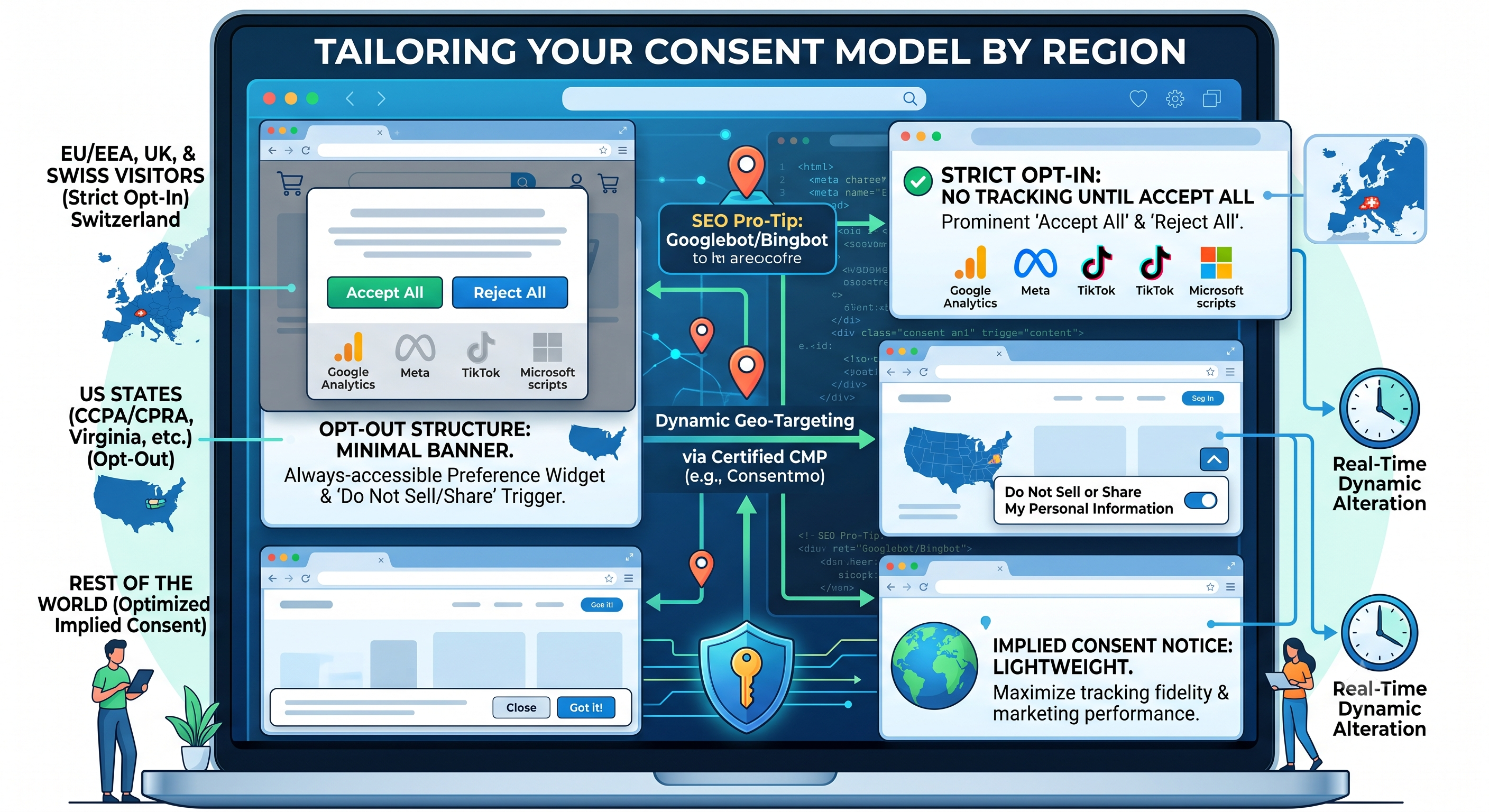
Tailoring Your Consent Model by Region
Using a certified Compliance Management Platform (CMP) like Consentmo, your store must auto-detect incoming IP addresses and dynamically alter the user interface in real-time:
- For EU/EEA, UK, and Swiss Visitors: The system must enforce a strict Opt-In model. No tracking scripts (Google Analytics, Meta, TikTok, Microsoft) are permitted to execute until the user explicitly clicks “Accept All.” The “Reject All” button must be just as prominent as the acceptance option, avoiding deceptive design practices or dark patterns.
- For US States (California CCPA/CPRA, Virginia, Colorado, etc.): The framework shifts to an Opt-Out or implied consent structure. Instead of a large screen overlay, visitors see a minimal, non-intrusive banner or an always-accessible cookie preference widget accompanied by explicit “Do Not Sell or Share My Personal Information” triggers.
- For the Rest of the World: The store can default to an optimized, lightweight implied consent notice to maximize tracking fidelity and preserve marketing performance.
Crucially, you must ensure your dynamic geotargeting handles search engine crawlers correctly. If your privacy manager inadvertently blocks Googlebot or Bingbot from rendering critical JavaScript or structural layouts under the guise of privacy preservation, your organic search visibility will plummet.
2. Automating DSARs Natively via Consentmo’s AI Scanner
The modern data-conscious shopper knows their rights. Under GDPR and evolving US state privacy mandates, consumers frequently exercise their right to access, export, or permanently erase their personal data through a Data Subject Access Request (DSAR).
If your customer support team manually combs through your database to handle these requests, your workflows will quickly become overwhelmed.
Deploying a Self-Service Privacy Center
To scale effectively, embed a localized, automated Smart Privacy Center directly into your store’s footer. This framework handles user requests through an automated, self-service pipeline:
Step 1: User Submits Request via Storefront
Step 2: Consentmo AI Scanner Maps Tracking Footprint
Step 3: System Cross-References Shopify Plus Logs
Step 4: Identity Verified & Data Package Delivered Natively
Eliminating Pixel Data Leaks with AI Scanning
A significant risk to your compliance framework comes from hidden third-party scripts that scrape customer data without your knowledge, exposing you directly to the California Wiretapping (CIPA) risks mentioned earlier.
Utilizing Consentmo’s built-in AI Cookie Scanner and Tracker Manager, you can schedule automated, deep-site audits to eliminate these blind spots:
- Continuous Tracking Discovery: The AI scanner periodically crawls your checkout flows, app integrations, and landing pages to catch unclassified scripts or legacy pixels buried in your theme.
- Automated Categorization: Identified scripts are automatically sorted into their respective legal categories (Essential, Analytics, Marketing, Performance).
- Real-Time Script Blocking: If the scanner detects a Meta or TikTok pixel attempting to gather personal parameters before a European user gives affirmative consent, the tracker manager intercepts and suppresses the payload instantly.
3. Localizing the 14-Day Right of Withdrawal on Shopify Plus
European consumer protection regulations extend far beyond cookie consent. Under the latest EU consumer transparency rules, international merchants selling to European citizens must provide an explicit, unambiguous 14-day Right of Withdrawal.

This means an EU customer can return a product for any reason—or no reason at all—within 14 days of receipt, and the merchant must offer a straightforward, accessible way to initiate that claim online.
Building a Compliant Multilingual Withdrawal System
For brands utilizing Shopify Plus, managing this requirement across multiple localized sub-stores requires a structured, programmatic approach:
|
Requirement Component |
Operational Standard |
Implementation Method |
|
Multilingual Parity |
The withdrawal interface must perfectly match the shopper’s active language tier. |
Map the withdrawal form using Shopify’s native translation APIs or multi-context locale engines. |
|
Dynamic Form Access |
A dedicated, legally compliant cancellation form must be accessible prior to account login. |
Deploy Consentmo’s dedicated, compliant EU Withdrawal asset blocks onto a custom landing page template. |
|
Airtight Audit Trails |
Every cancellation request must generate a permanent, timestamped receipt. |
Automatically pipeline form submissions directly into your central helpdesk queue while generating a copy for the merchant compliance log. |
The 2026 E-Commerce Compliance Checklist
Before launching your next international marketing campaign, review this scannable compliance framework to confirm your store is fully protected:
- Server-Side Geolocation Active: Banners dynamically transition layouts between EU (Strict Opt-In) and US (Opt-Out/CIPA Protective) configurations based on real-time IP detection.
- Google Consent Mode v2 Validated: Your theme correctly transmits advanced consent parameters (analytics_storage, ad_storage, ad_user_data, and ad_personalization) to ensure ad platforms function accurately without violating user preferences.
- Automated Script Suppression: Marketing tags remain entirely dormant until user consent is explicitly registered by your CMP.
- Self-Service DSAR Enabled: Customers can access, export, or request deletion of their personal profiles without requiring manual intervention from your support agents.
- EU Withdrawal System Configured: A fully translated, compliant 14-day cancellation pipeline is live and accessible for all European shoppers.
Monetize Your Privacy Strategy: The E-Commerce Compliance & Privacy Package
Privacy compliance doesn’t have to break your marketing funnels. When configured properly, an optimized compliance setup actually protects your marketing ROI by building consumer trust and securing clean, high-quality data attribution.

If your development team is struggling to keep pace with changing privacy regulations, let our specialized team handle the heavy lifting for you.
What’s Included in Our Premium Privacy Package:
- Turnkey Consentmo Implementation: Full configuration of your cookie consent architecture, tailored to your store’s branding and design language.
- Advanced Geotargeting Setup: Customized regional configurations to ensure you maintain high conversion rates in the US while remaining fully compliant in the EU.
- Secure Pixel Mapping: Complete audit and isolation of your Meta, TikTok, Microsoft, and Pinterest pixels to shield your brand from costly California CIPA legal risks.
- Airtight Google Consent Mode v2 Integration: Verification of your Google Tag Manager data layer to protect your Google Analytics 4 tracking and Google Ads conversion mapping.
Don’t risk costly legal penalties or compromised ad tracking. Contact our team today to secure your storefront’s compliance framework.
Frequently Asked Questions
Why is a "one-size-fits-all" cookie banner bad for global conversion rates?
Applying a uniform cookie banner globally hurts your business on both ends. If you apply a strict, hard-blocking EU-style banner to US visitors, your add-to-cart rates can drop by up to 20% because American shoppers are accustomed to less intrusive opt-out models. Conversely, if you show a weak US-style banner to an EU visitor, you risk heavy, automated non-compliance fines from European Data Protection Authorities (DPAs).
2. What is the core difference between EU and US user consent requirements?
For the EU/EEA, UK, and Switzerland: You must use a strict Opt-In model. No tracking scripts (like Meta or Google pixels) can load until the user explicitly accepts them. The “Reject All” button must be just as prominent as “Accept All.”
For US States (e.g., California, Virginia): The norm is an Opt-Out model. You can use a minimal, non-intrusive banner or widget, but you must provide an explicit, always-accessible “Do Not Sell or Share My Personal Information” link to shield your brand from California Wiretapping law (CIPA) lawsuits.
3. How can e-commerce brands handle Data Subject Access Requests (DSARs) at scale?
Manually searching your backend for a customer’s data every time they request to access, export, or erase it will quickly overwhelm your customer service team. The solution is to embed an automated, self-service Smart Privacy Center into your store’s footer. Using tools like Consentmo, users can verify their identity and submit requests, while an AI scanner automatically maps their tracking footprint and handles the data delivery or deletion natively.
4. What is the EU 14-Day Right of Withdrawal, and how must it be implemented?
European consumer protection law dictates that EU customers have the right to return a product for any reason—or no reason at all—within 14 days of receiving it. To comply on Shopify Plus, you must provide:
Multilingual Parity: The withdrawal interface must match the shopper’s active language tier.
Dynamic Form Access: A dedicated cancellation form must be accessible on a custom landing page before a user logs into an account.
Airtight Audit Trails: Every submission must generate a permanent, timestamped receipt for merchant compliance logs.
5. How do AI cookie scanners protect brands from legal risks like California's Wiretapping laws (CIPA)?
Many brands run hidden third-party scripts or legacy pixels buried deep within their store themes that scrape customer data without the merchant’s active knowledge, leaving them exposed to CIPA class-action lawsuits. An AI Cookie Scanner automatically crawls your site, discovers these rogue scripts, categorizes them (Essential, Analytics, Marketing), and dynamically blocks them from executing until proper, region-specific user consent is given.