
In eCommerce, we’ve spent years focusing on one thing: the click. We optimized our Shopify stores to rank in search results and get people to visit our site. But in 2026, the way people find information is changing.
At eCommerce Today, we don’t look at AI as a trend; we look at it as a new channel. People are increasingly getting their answers directly from LLMs like Microsoft Copilot or ChatGPT.
Right now, the traffic coming from these AI answers might look like a small percentage of your total business. But here is my take: don’t leave money or traffic on the table. If you can capture this market share now, while your competitors are still trying to figure out how to write a prompt, you create a massive advantage for the next 3 to 5 years.
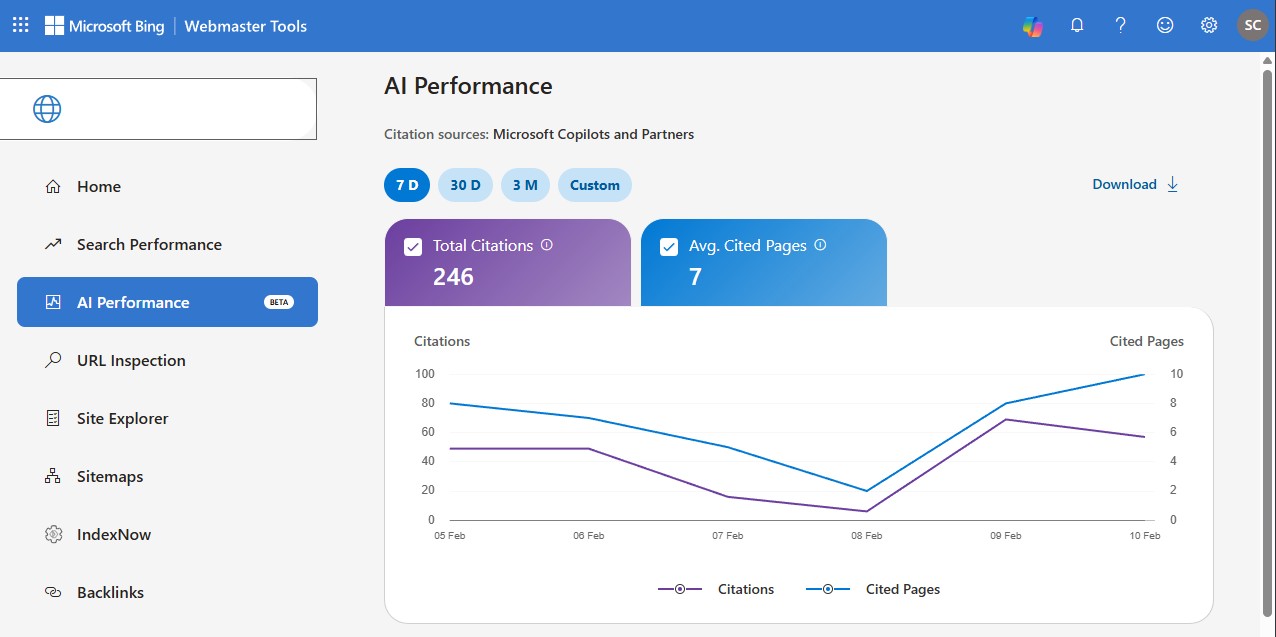
The new AI Performance dashboard in Bing Webmaster Tools is a game changer because it finally gives us data. It’s not about guessing anymore. We can see exactly how often our content is cited and what queries the AI is using to find us.
Being an expert in this space means being proactive. If you haven’t done it yet, start by ensuring your foundation is solid. You can follow our guide here on
TL;DR (Too Long; Didn’t Read)
-
The Shift: Search is moving from “links” to “citations.” If AI doesn’t reference you, you’re invisible.
-
The Tool: Bing Webmaster Tools now has an AI Performance dashboard. It’s the first real way to measure your GEO (Generative Engine Optimization) success.
-
The Strategy: Focus on Grounding Queries. Find out what the AI thinks you’re an expert in and double down on that content.
-
The Action: Clean your data, use IndexNow for instant updates, and move away from “marketing fluff” to radical clarity.
-
The Help: We’ve launched a dedicated
AI eCommerce Optimization service
The Risk of Being Invisible to AI
If you rely on organic traffic, you need to understand that the old path, where a user types a query, sees your link, and clicks, is no longer the only way people shop.
When someone asks an AI for a recommendation or a technical specification, the AI doesn’t just “guess.” It looks for a trusted source to ground its answer. If your site isn’t being cited, you are effectively invisible to that user.
In my view, this is the new “page 2” of search. It doesn’t matter how good your SEO was in 2022; if the LLMs aren’t referencing your data, you are missing out on a massive segment of the market that is moving away from traditional scrolling.
It’s not just about losing a click; it’s about losing authority. When an AI cites your competitor to explain a product feature instead of you, that competitor becomes the expert in the customer’s mind. We see this often with stores that have thin content or poor structure—they might rank well for now, but they are invisible to AI.
We are already helping our clients fix this through our
Measuring Influence, Not Just Clicks
For years, the gold standard of SEO was the click. If someone didn’t visit your site, the interaction was often considered a “lost” opportunity. In the AI era, we need to adjust this thinking.
When an AI provides an answer and cites your store as the source, you are gaining authority. Even if the user doesn’t click through immediately, your brand is being positioned as the expert. This is what I call “moving up the funnel.”
Flavio Longato from Adobe made an excellent point recently on LinkedIn: Citations do not always equal clicks, but influence happens regardless. If Copilot uses your data to explain how a specific product works, you’ve already won the trust of that potential customer.
We are moving from a “Traffic-First” strategy to a “Citation-First” strategy. In my view, being the “brain” behind an AI’s answer is a high-value touchpoint. It builds a level of credibility that a simple “blue link” on page 1 of Google can no longer provide on its own.
This is why we focus on making our clients’ data “referenceable.” It’s not just about getting a visitor; it’s about becoming the definitive source for your niche.
Deep Dive: Inside the AI Performance Dashboard
For a long time, how AI systems used our content was a “blind spot.” We implemented protocols like robots.txt for crawlers and, more recently, llms.txt for AI models, but we had no way to know if they were working.
With this new update, Bing is finally providing the transparency we’ve been waiting for. This dashboard is essentially the “report card” for your AI optimization efforts. If you have already implemented an llms.txt file (as we guided in our
-
Total Citations: This is your new awareness KPI. It shows how many times your content was used as a source for an AI-generated answer. It’s the proof that your site is being used as a “brain” for the LLM.
-
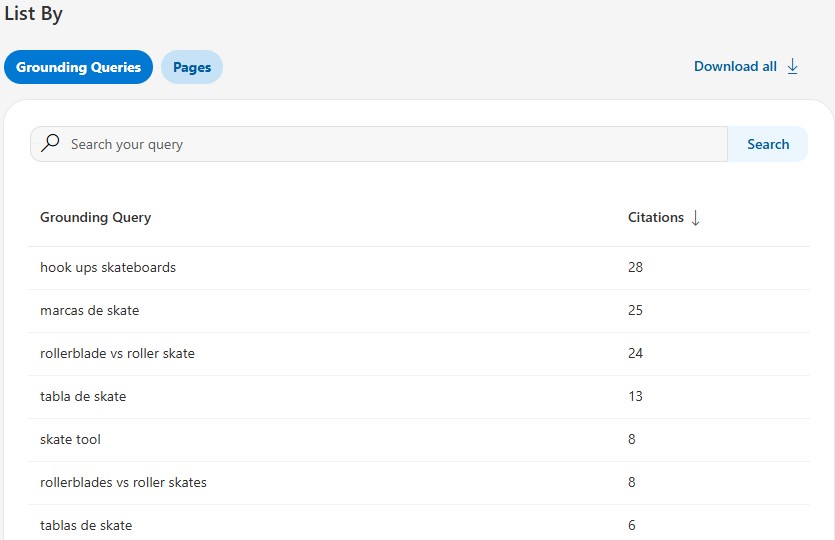
Grounding Queries: This is the most valuable part of the report. It shows the phrases the AI used to find your content.
-
Example: In one thread on LinkedIn, Florin Girtan, noted a case where a stationery site was being cited for queries like “A3 or A4 paper dimensions.”
-
The Insight: The AI has identified that specific page as the definitive authority on that topic. If you see this happening, it’s a signal to double down on that content.
-
-
Page-Level Citation Activity: This tells you exactly which URLs are performing. If your blog posts are getting cited but your product pages aren’t, you have a structural issue. It means the AI can “understand” your articles but is struggling to parse your commercial data.
We are now in an era where AI answers are measurable. As Antonio Negrini from the SEO community pointed out, this is a pioneering step. We are no longer guessing; we are optimizing based on facts.
The GEO Playbook: Systems for Survival
Optimizing for AI, or Generative Engine Optimization (GEO), isn’t about “tricking” a system. It’s about being so clear and structured that an LLM has no choice but to use you as its primary source.
If you want to move from being invisible to being a “Grounding Source,” here is the system we use:
-
Radical Clarity: AI systems struggle with fluff. If your product descriptions are full of “innovative solutions” instead of clear specs, you’ll be ignored. We audit content to ensure every page has a clear purpose and defined entities.
-
Freshness through IndexNow: In a world where AI answers happen in real-time, waiting two weeks for a bot to crawl your site is a losing strategy. We use IndexNow to tell Bing (and other engines) the second a price changes or a new guide is published. Freshness is a major signal for AI citations.
-
Knowledge Blocks: We structure data using tables, FAQ sections, and clean hierarchies. LLMs are trained to find and parse “pre-digested” information. The easier you make it for the robot to read, the more likely you are to be cited.
This isn’t just theory for us. It’s exactly what we do in our
Conclusion: From SEO to AI Visibility Architects
We are at a point where the definition of “search” is being rewritten. My view has always been that maturity in business means adopting systems before they become a requirement for survival.
The role of a marketing manager or a store owner is evolving. We are moving away from just managing “blue links” and becoming AI Visibility Architects. Our job now is to build a digital presence that is so clear, so structured, and so authoritative that AI systems naturally rely on it to answer their users’ questions.
The transparency provided by the new AI Performance dashboard is a gift. It removes the guesswork and allows us to lead with data. If you haven’t logged into Bing Webmaster Tools recently, now is the time. Don’t wait for the market to shift completely before you decide to act.
At eCommerce Today, we are already building these maps for our clients. Whether you do it with us or on your own, the goal remains the same: capture your share of the future now. Don’t leave your traffic to chance.
Let’s make it count!
Is Bing really relevant? Everyone uses Google.
While Google has the largest market share, Bing is the “first mover” in AI reporting. More importantly, Microsoft Copilot and other AI partners use this data. Ignoring Bing in 2026 is like ignoring mobile traffic in 2010. Plus, what works for Bing’s AI grounding usually helps your visibility in Google’s SGE as well.
Does "Citation" mean I’ll lose traffic because people won't click?
Some users will get their answer and leave. However, the ones who do click are higher intent—they already trust you because the AI recommended you. It’s about quality over quantity. Why leave that “zero-click” influence to your competitors?
What exactly is a "Grounding Query"?
Think of it as the “why” behind the AI’s answer. It’s the specific phrase or concept the AI used to connect your site to a user’s question. If you’re grounded for “best eco-friendly yoga mats,” you are the AI’s trusted source for that topic.
How long does it take to see results in the AI Performance dashboard?
AI systems are faster than old search crawlers, but they still need time to process changes. With IndexNow, we see movements in days rather than weeks.
Do I need to rewrite all my product descriptions?
Not necessarily. Most of the time, it’s about restructuring. We move key specs and facts into “Knowledge Blocks” (tables or lists) that AI can easily parse, rather than hiding them in long paragraphs.
Will AI optimization hurt my traditional SEO rankings?
Quite the opposite. Search engines (including Google) are rewarding clarity, structure, and authority. What makes you “AI-friendly” makes you “User-friendly.”
Can I just use ChatGPT to write my content and be AI-ready?
No. If you use generic AI content, you’re just echoing what’s already out there. To be cited, you need to provide unique data, specific expertise, or better structure than the baseline.
Is "GEO" just another name for Schema Markup?
Schema is a part of it, but GEO (Generative Engine Optimization) is broader. It includes content sentiment, technical “freshness,” and how well your text answers complex, multi-step questions.
What if my store is already ranking #1? Do I still need this?
Yes. Being #1 in “blue links” doesn’t guarantee you’ll be the source the AI uses for its summary at the top of the page. You could be #1 and still be bypassed by an AI answer that cites #3 because their data was easier to process.
How do I start if I have 1,000+ products?
Don’t do everything at once. We usually start with your top 20% “hero” products and your most trafficked blog posts. This is exactly what our