
If 95% of human decisions happen in the subconscious, why are most brands still writing emails for the rational mind?
A short while ago, we tuned into a masterclass on the psychology of email copy featuring experts from Omnisend. The consensus? Most emails don’t fail because the product is bad. They fail because the copy is trying to win an argument with a brain that isn’t even listening.
If you want to move the needle on your ROI, you have to stop acting like a brochure and start acting like a human. Beyond just the words on the page, success requires the right infrastructure—like
Here is the psychological blueprint for copy that actually converts.
📱 TL;DR: Stop Writing for the Wrong Brain
- Target the "Old" Brain: Decisions are driven by the Reptilian Brain (safety/simplicity) and the Limbic System (emotion). Logic only exists to justify the emotional choice later.
- Use Psychological Shortcuts: Humans scan for triggers. Use Pain Avoidance (preventing loss), Specificity (hard numbers), Social Proof (peer validation), and Exclusivity to drive action.
- Kill Objections Early: Anticipate the "Yeah, but..." by addressing doubts (e.g., "Will it work for me?") directly in the copy.
- Structure for Momentum: Hook the reader with their "2:00 AM problem," bridge it to your solution, and use a benefit-driven Call to Action (CTA).
- Clarity > Cleverness: Puns and wit don’t sell; feeling understood does. Write like a friend solving a headache, not a marketer seeking applause.
1. The “Three-Brain” Problem
In marketing, we sometimes mistakenly try to talk to the Neocortex—the part of the brain that handles logic, spreadsheets, and “let me think about it.” But the Neocortex isn’t the decision-maker; it’s the legal department that approves the decision after the fact.
To get a click, you have to pass two other guards first:
- The Reptilian Brain: This part only cares about survival. It asks: Is this safe? Is it simple?
- The Limbic System: This is the emotional core. It asks: How does this make me feel?
- The Golden Rule: Emotion leads, logic follows. If your email doesn’t spark a feeling (fear of missing out, the relief of a solved problem, the excitement of a gain), the rational brain will never even get the chance to “justify” the purchase.
2. Levering Mental Triggers
The human brain is wired to save energy. We don’t read emails; we scan for “shortcuts” that tell us whether to care. Here are the most effective levers you can pull:
|
Trigger |
Why it Works |
Example |
|
Pain Avoidance |
Losing $100 hurts more than winning $100 feels good. |
“Stop wasting 4 hours a week on manual data entry.” |
|
Specificity |
Vague claims are ignored. Specific numbers build trust. |
“Our users saw a 147% increase in leads.” |
|
Social Proof |
We feel safer doing what others have already done. |
“Join 3,000+ founders who use this daily.” |
|
Exclusivity |
Everyone wants to be behind the velvet rope. |
“An early-access invite for our top 5% of subscribers.” |
3. Addressing the “Yeah, But…”
Even when a customer is excited, a tiny voice in their head is whispering objections. These aren’t logical problems; they are emotional blocks. High-converting copy anticipates these doubts and kills them mid-sentence:
- The “Will it work for me?” block: Address this with diverse testimonials or “even if you’re a beginner” language.
- The “It’s too much work” block: Use phrases like “10-minute setup” or “Ready-to-use templates.”
- The “I’ll do it later” block: This is the silent killer. Use real urgency (not fake timers) to explain what they lose by waiting. This is where advanced Klaviyo automations that turn one-time buyers into brand advocates become essential, as they turn one-time buyers into brand advocates through perfectly timed psychological nudges.
4. Structure: The Anatomy of the Click
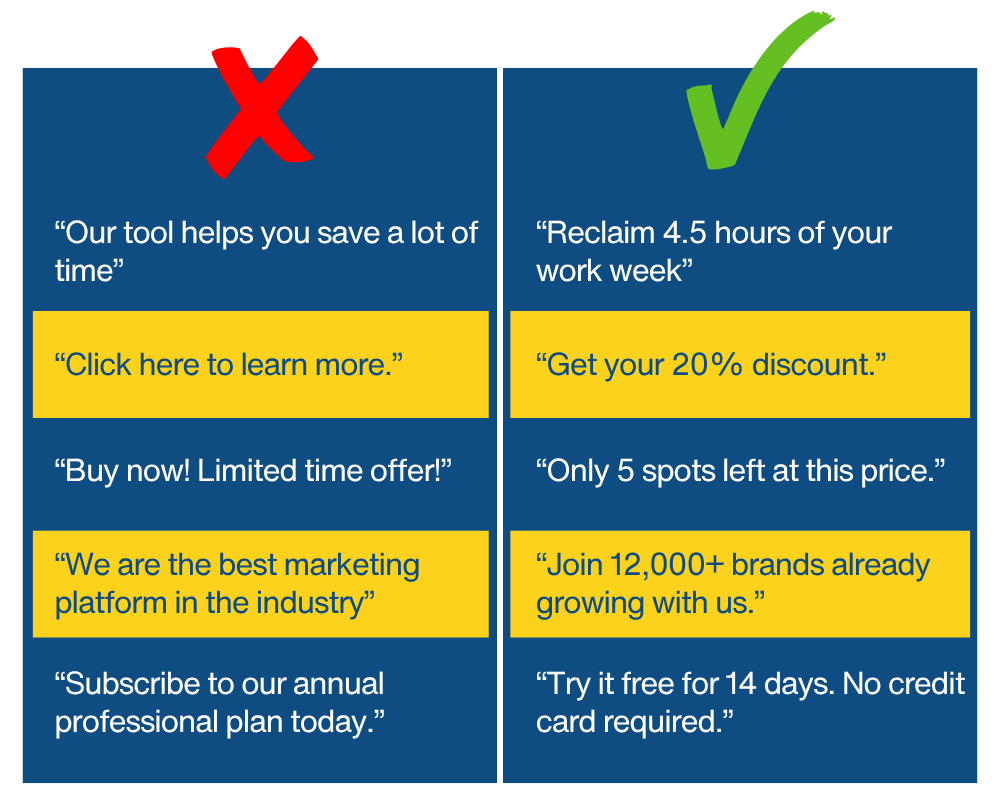
A great email guides the eye. If it looks like work to read, it’s going in the trash. Use this flow to keep the momentum:
- The Subject Line: Its only job is to get the open. Use curiosity or deep empathy.
- The Hook: Don’t talk about your brand. Talk about their 2:00 AM problem.
- The Bridge: Connect their current pain to your specific solution.
- The CTA: Make it benefit-driven. Instead of “Click Here,” try “Get My Free Guide” or “Start Saving Time.”
The “Clever” Trap
As marketers, we often try to be witty or original. But it’s always important to remind ourselves: Clarity trumps cleverness every single time.
People don’t buy because they’re impressed by your puns; they buy because they feel understood. The best emails feel like a conversation with a friend who has the answer to your biggest headache. Ready to audit your email strategy?
Ready to audit your email strategy?
Take your last three campaigns and ask yourself: Am I writing for the spreadsheet, or am I writing for the gut?
If you’re not sure, it might be time to let the psychology do the heavy lifting. Which of these triggers are you going to test in your next campaign?
Frequently Asked Questions
1. Why shouldn't I focus on the logical benefits of my product in an email?
Logic isn’t the primary driver of action; it’s the “legal department” that justifies a decision after it’s been made emotionally. If your email doesn’t first appeal to the Limbic System (emotions) or the Reptilian Brain (instinct/survival), the reader’s rational mind won’t even bother to process your logical arguments.
2. What is the "Three-Brain" problem in marketing?
The “Three-Brain” problem refers to the hierarchy of human decision-making:
-The Reptilian Brain: Filters for safety and simplicity.
-The Limbic System: Processes feelings and emotions.
The Neocortex: Handles complex logic. High-converting copy succeeds by passing the first two “guards” before trying to satisfy the logical Neocortex.
3. How can I make my emails more "scannable" for busy readers?
The brain naturally looks for shortcuts to save energy. To help it, use Mental Triggers like specific numbers (147% instead of “a lot”), social proof, and pain avoidance. Additionally, use a clear structure: a curiosity-driven subject line, a hook that addresses a specific pain point, and a benefit-driven CTA.
4. What is the "Clever Trap," and how do I avoid it?
The “Clever Trap” happens when marketers prioritize puns, wit, or complex wordplay over clear communication. While being witty feels good, clarity trumps cleverness every time. To avoid it, ensure your email feels like a direct conversation with a friend rather than a performance.
5. How do I handle customer objections before they even reply?
Address the “Yeah, but…” moments by anticipating emotional blocks within your copy. If the reader thinks it’s “too much work,” mention a “10-minute setup.” If they doubt it will work for them, include diverse testimonials or “beginner-friendly” language to lower the barrier to entry.