
Services
AI Optimization
Industry
Sports
Client Overview
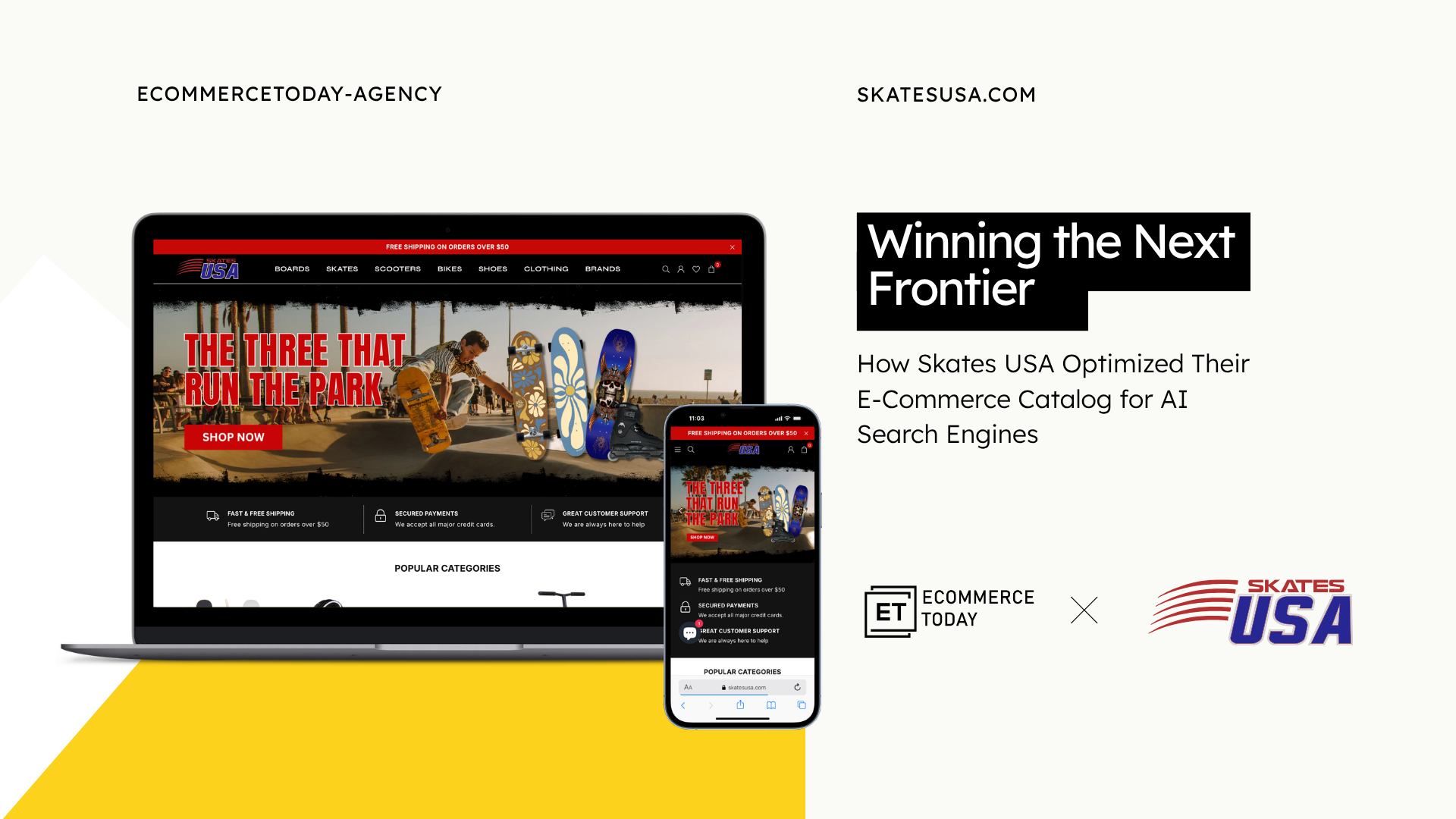
Skates USA is one of the most established names in the U.S. action-sports retail scene. Operating out of Jupiter, Florida, and backed by more than 25 years of hands-on experience in the skating industry, the brand has built its reputation on a simple promise: the most trusted skate brands at affordable prices, delivered with expert guidance and fast, reliable service.
Running on Shopify, Skates USA carries an exceptionally broad, technical catalog spanning skateboards, longboards and cruisers, aggressive inline and quad skates, scooters, BMX and complete bikes, skate shoes, apparel, and thousands of individual components such as decks, trucks, wheels, bearings, and protective gear. With a 4.94-star customer rating and a strong omnichannel social presence across Facebook, Instagram, YouTube, Pinterest, and TikTok, the brand had already earned the trust of human shoppers. The next frontier was earning the trust of machines.
Challenges
The way people discover products is shifting fast. Shoppers no longer only type “best skateboard” into a search bar – they ask conversational engines like ChatGPT, Google AI Overviews (SGE), and Perplexity questions such as “what skates should I get for grinding and street tricks as a beginner?” Despite a deep, high-quality catalog, Skates USA faced the classic problem of a brand that was invisible to this new layer of AI-driven discovery.
The specific gaps we set out to close were:
- Thin machine context. Product titles and descriptions were written for humans and for traditional SEO, leaving AI engines without the structured, attribute-rich context they need to confidently recommend a product.
- Incomplete structured data. Schema.org markup was missing key Merchant Listing properties (return policy, shipping details) and lacked the descriptive depth required to surface products in AI shopping experiences.
- No conversational keyword strategy. There was no map connecting the real-world questions buyers ask to the exact products in the catalog that answer them.
- Unmeasured AI traffic. Visits originating from AI assistants were landing in analytics as generic “Direct” or “Referral” traffic, making the impact of any optimization impossible to prove.
Critically, every improvement had to be implemented without disrupting the existing Google Ads campaigns or the human-facing shopping experience – a non-negotiable guardrail throughout the project.
Phase 1 – Audit, Strategy & Technical Foundation
Before writing a single line of optimized content, we established a precise diagnosis and a stable technical base. AI optimization is only as good as the structured data feeding the engines.
The “Before” Audit & AI Visibility Benchmark
We ran a full Schema audit using the Google Rich Results Test and Schema.org Validator, cross-checked organic-visibility errors in Google Search Console (including Google Merchant Center diagnostics), and benchmarked how the brand was actually being represented inside ChatGPT and Perplexity. This produced a documented “Before” snapshot: which products were invisible, which carried Merchant errors, and how (or whether) the AI engines recognized the brand and its categories.
Conversational Keyword Mapping
Using the audit findings, we built a Conversational Map for the Top 20 focus products. Rather than chasing search volume, we reverse-engineered the natural-language questions a real buyer would ask an assistant – mapping each query to a target persona, the core problem it solves, and the “solution hook” that would later anchor the optimized copy. A beginner asking about durable street skates, for example, was mapped directly to the relevant aggressive inline complete skates rather than to a generic homepage.
Schema Implementation & AI Title Injection
On the technical side, we cleaned up and rebuilt the product JSON-LD in the Shopify theme, fixing the missing hasMerchantReturnPolicy and shippingDetails properties so products became eligible Merchant Listings. We also implemented AI Title Injection: an extended, attribute-rich title stored in a metafield is served to bots inside the Schema name field, while the clean, conversion-friendly title remains visible on-site – giving AI engines richer context with zero impact on UX or Ads.
We also opened the gates with a robots.txt configuration explicitly allowing major AI crawlers (GPTBot, Google-Extended, CCBot, PerplexityBot), validated the product sitemap (confirming product images were indexable), and added a clean Markdown LLMS.txt layer so assistants can read the store structure without wading through HTML.
Phase 2 – Content Optimization & Authority Build
With the foundation in place, we moved into the growth layer: feeding the engines the descriptive, trustworthy content they reward when deciding what to recommend.
AI Context Metafields
We created a dedicated custom.ai_context metafield and wrote factual, problem-solution descriptions for the Top 20 focus products. These follow a contextual-hook formula – who the product is for, what problem it solves, and its key specs – and are injected into the Schema description, so machines read a dense technical brief while shoppers keep the polished marketing copy on the page.
Hybrid Alt Text Optimization
Because AI engines “see” images through computer vision, we applied a hybrid strategy: a consistent automated pattern (Brand + Title + Variant) across the entire catalog to eliminate empty alt text, plus descriptive, vision-style alt text manually rewritten for the Top 20 best sellers – describing what is actually shown in the photo rather than stuffing keywords.
Natural-Language FAQ + FAQPage Schema
Drawing directly on the Conversational Map, we added conversational Q&A sections to the focus product pages – answering the real doubts buyers raise about sizing, use case, and durability – and marked them up with FAQPage Schema so the answers are eligible for rich snippets and direct citation by AI Overviews and assistants.
Knowledge Graph & Entity Setup
To validate brand identity in the eyes of the engines, we implemented a complete Organization schema with a fully populated sameAs property linking the official site to its social and authority profiles. This connects the dots between every owned channel and strengthens the brand as a recognized entity.Review Data & AggregateRating Validation
We validated and configured the review app so AggregateRating data exports cleanly into Schema.org, ensuring the brand’s strong rating is machine-readable – the signal an assistant needs to say “this product is highly rated.”
AI Tracking, Bing & IndexNow
Finally, we made the work measurable. We configured Google Analytics 4 with a dedicated “AI Referrals” segment (capturing ChatGPT, Perplexity, Copilot/Bing, Gemini and more), enabled GMC free-listing auto-tagging to separate organic shopping traffic, and set up GSC Rich Results monitoring. We also connected Bing Webmaster Tools – a primary data source for ChatGPT – and configured the IndexNow protocol so price and stock changes are pushed to Microsoft’s index instantly instead of waiting on a standard crawl.
Functionalities & Workstreams Delivered
Across the Tier 2 engagement, the following capabilities were implemented:
- Schema Implementation & AI Title Injection – custom Product, Offer and MerchantReturnPolicy JSON-LD with bot-facing extended titles served via metafields.
- AI Context Metafields – hidden, LLM-optimized problem-solution descriptions for the Top 20 products, injected into Schema.
- Hybrid Alt Text Optimization – catalog-wide automated pattern plus manual computer-vision alt text for best sellers.
- Natural-Language FAQ + FAQPage Schema – conversational Q&A on focus product pages, technically marked up for SGE indexing.
- Knowledge Graph / Entity Setup – complete Organization schema with a fully populated sameAs profile graph.
- Review & AggregateRating Validation – clean, machine-readable star ratings and review counts in structured data.
- Crawler Access & Discovery – AI-friendly robots.txt, sitemap and image validation, and a clean LLMS.txt layer.
- Measurement Infrastructure – GA4 AI-referral segmentation, GSC Rich Results monitoring, Bing Webmaster Tools, and IndexNow.
Categories touched: Boards, Skates, Scooters, Bikes, Shoes, and Clothing.
Conclusion
Through this Tier 2 AI Optimization engagement, Skates USA evolved from a brand that was effectively invisible to generative engines into one that is structured, machine-readable, and ready to be recommended. We didn’t just tidy up code – we gave ChatGPT, Perplexity and Google’s AI experiences the context, trust signals, and clean entry points they need to confidently surface the brand’s products.
Just as importantly, every layer is now measurable: the brand can see AI-driven traffic as it grows, monitor rich-result visibility, and maintain the optimization on future product launches. With its technical foundation modernized and its content engineered for the conversational era, Skates USA is positioned to win discovery wherever the next generation of shoppers chooses to ask.
Who is Skates USA?
Skates USA is a U.S. action-sports retailer based in Jupiter, Florida, backed by more than 25 years of experience in the skating industry. Its Shopify store carries skateboards, longboards, inline and quad skates, scooters, BMX bikes, skate shoes, apparel and thousands of components, with a 4.94-star customer rating.
Why did Skates USA need AI search optimization?
Shoppers increasingly ask ChatGPT, Google AI Overviews and Perplexity for product recommendations, but Skates USA was effectively invisible in these AI answers. Product content lacked structured, attribute-rich context, schema markup was incomplete, and AI-driven visits were being recorded as generic Direct or Referral traffic.
How did eCommerce Today audit Skates USA's AI visibility?
eCommerce Today ran a full schema audit with the Google Rich Results Test and Schema.org Validator, reviewed errors in Google Search Console and Google Merchant Center, and checked how ChatGPT and Perplexity represented the brand. This produced a documented before snapshot of invisible products, merchant errors and brand recognition in AI engines.
What is the conversational keyword map built for Skates USA?
eCommerce Today built a conversational map for Skates USA’s top 20 focus products, based on the natural-language questions real buyers ask AI assistants. Each question is linked to a target persona, the problem it solves and the product that answers it, such as matching a beginner’s question about durable street skates to aggressive inline complete skates.
Which schema markup fixes were made for Skates USA?
eCommerce Today rebuilt the product JSON-LD in the Skates USA Shopify theme, adding the missing hasMerchantReturnPolicy and shippingDetails properties so products qualify as Merchant Listings. The team also added a complete Organization schema with sameAs links to the brand’s social profiles and validated AggregateRating data from the review app.
How does eCommerce Today give AI engines more product context for Skates USA?
eCommerce Today created extended, attribute-rich product titles and a custom.ai_context metafield with factual problem-solution descriptions for the top 20 products. These are added to the product schema, describing who each product is for, what problem it solves and its key specs.
How were AI crawlers given access to the Skates USA store?
eCommerce Today configured robots.txt to explicitly allow major AI crawlers and user agents, including GPTBot, Google-Extended, CCBot and PerplexityBot. The team also validated the product sitemap and image indexing and added a Markdown LLMS.txt file so AI assistants can read the store structure without parsing HTML.
How was image alt text optimized for Skates USA?
eCommerce Today used a hybrid approach: an automated Brand + Title + Variant pattern across the whole catalog to remove empty alt text, plus descriptive alt text written manually for the top 20 best sellers. The manual alt text describes what is actually shown in each photo, which helps AI engines that interpret images through computer vision.
Why did Skates USA add FAQ sections to its product pages?
eCommerce Today added conversational Q&A sections to Skates USA’s focus product pages, answering real buyer questions about sizing, use case and durability. The answers come from the conversational keyword map and are marked up with FAQPage schema, making them easier for AI assistants to understand and cite.
How does Skates USA keep Bing's index up to date?
eCommerce Today connected Skates USA to Bing Webmaster Tools and configured the IndexNow protocol. Price and stock changes are pushed to Microsoft’s index immediately instead of waiting for a standard crawl.
How does Skates USA measure traffic from AI assistants?
eCommerce Today set up a dedicated AI Referrals segment in Google Analytics 4 that captures visits from ChatGPT, Perplexity, Copilot, Gemini and other assistants. Google Merchant Center free-listing auto-tagging separates organic shopping traffic, and Google Search Console monitors rich results.
Did the AI optimization affect Skates USA's Google Ads or shopping experience?
No. A core rule of the project was that every change had to be implemented without disrupting Skates USA’s existing Google Ads campaigns or the on-site shopping experience.