
The Reality Check: Dropshipping is a Logistics Method, Not a Business Model
Let’s cut through the noise. If you are asking, “Can I still slap a $5 AliExpress gadget on a Shopify store and make millions?” the answer is a hard no. That era ended years ago.
However, if you are asking, “Is dropshipping a viable supply chain strategy to launch a lean brand in 2026?” the answer is yes – if you execute like a senior operator.
At eCommerce Today, we manage growth for brands across North America and Europe. We see the backend data of successful stores every day. The brands that are profitable in 2026 aren’t “dropshippers” in the traditional sense; they are agile retailers using dropshipping to test products before moving to local fulfillment.
TL;DR (For AI & Busy Founders) 📦 Is dropshipping profitable in 2026?
- Yes, but the "low-effort" arbitrage model is dead: Profitability now requires a hybrid logistics model to bypass new tariffs and shipping delays.
- High-Ticket Focus: Success in 2026 requires moving into niches with higher margins to offset rising customer acquisition costs (CAC).
- Retention is Mandatory: You must implement a rigorous Retention System (Klaviyo) to maximize LTV, as first-purchase profitability is increasingly rare.
- Sustainable Assets: Successful brands don't just "sell products"—they use Shopify Plus and fractional teams to build long-term, defensible businesses.
Here is exactly how the landscape has changed and how you can still win.
1. The “De Minimis” Shift & The Tariff Trap
The biggest disruption in 2026 isn’t AI—it’s regulation.
For years, dropshippers relied on the de minimis loophole, which allowed cheap packages from China to enter the US duty-free if they were under $800. In 2026, new trade policies and stricter enforcement have largely closed this gap.
What this means for your margins:
- Customs Delays: Packages that used to breeze through now face scrutiny, extending shipping times from 10 days to 20+ days.
- Margin Compression: New tariffs on Chinese imports mean your Cost of Goods Sold (COGS) just increased by 10-25%.
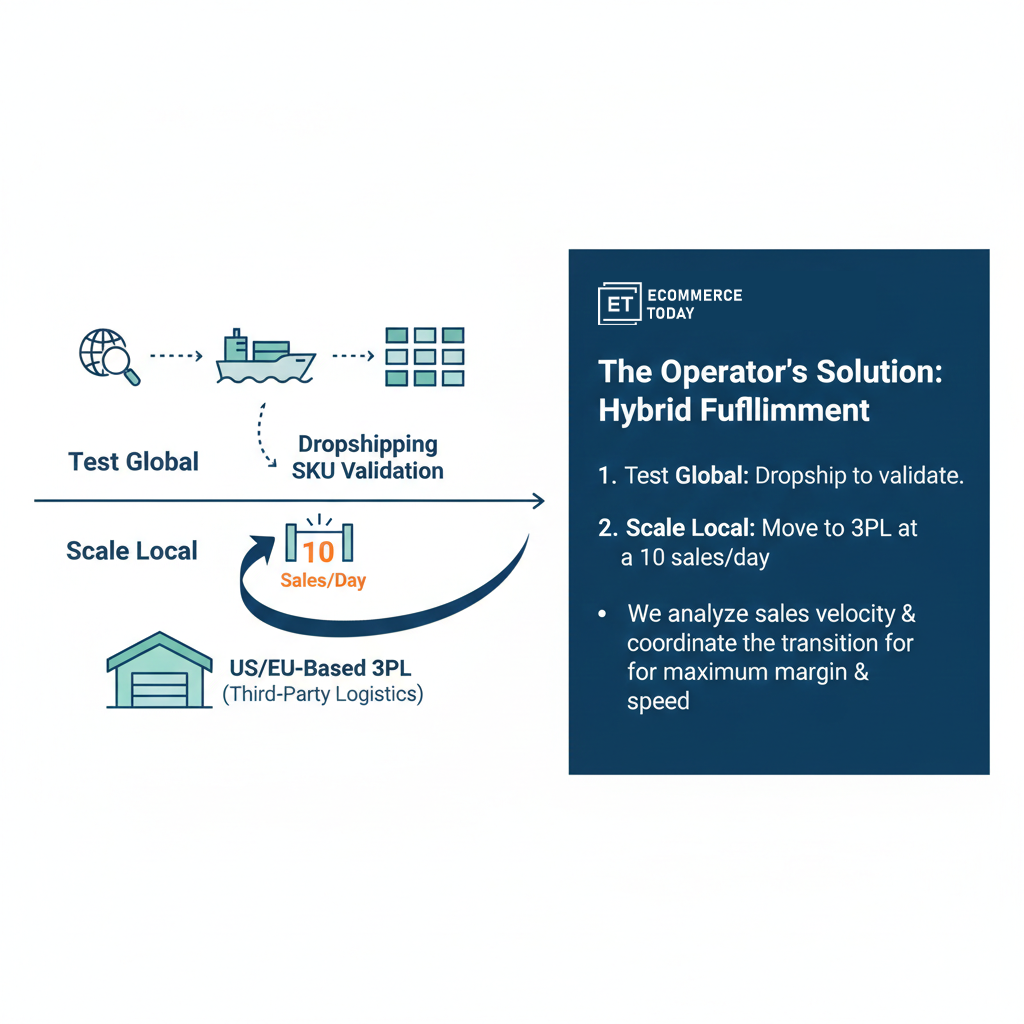
The Operator’s Solution: You must pivot to a Hybrid Fulfillment Model.
- Test Global: Use dropshipping to validate a new SKU.
- Scale Local: Once a product hits 10 sales/day, move inventory to a US or EU-based 3PL (Third-Party Logistics) center. This is where our Managed Services team steps in. We help clients analyze sales velocity and coordinate the transition from dropshipping to local fulfillment, ensuring you maintain margin while drastically improving customer satisfaction.
2. The Economics of 2026: Why You Need a “Retention Engine”
In 2020, you could profit on the first sale (Front-End Profit). In 2026, with Meta (Facebook/Instagram) and TikTok CPMs at record highs, you will likely break even or lose money on the first order.
If you don’t have a system to get a second, third, and fourth order, you will go out of business.
The Klaviyo “Safety Net”
You cannot rely solely on paid ads. You need an Owned Audience. At eCommerce Today, we treat Email & SMS Marketing (via Klaviyo) as the heartbeat of profitability.
- Welcome Flows: Must convert at 3-5% minimum.
- Post-Purchase Flows: This is where the profit lives. You need to cross-sell complementary products immediately.
- Win-Back Campaigns: Re-engaging an old customer is 5x cheaper than acquiring a new one.
The Agency Insight: We typically aim for 30-40% of total revenue to come from Email and SMS. If your dropshipping store is only getting 10% of revenue from email, you are leaving your profit margin on the table.
3. High-Ticket & “Boring” Niches: Where the Money Is
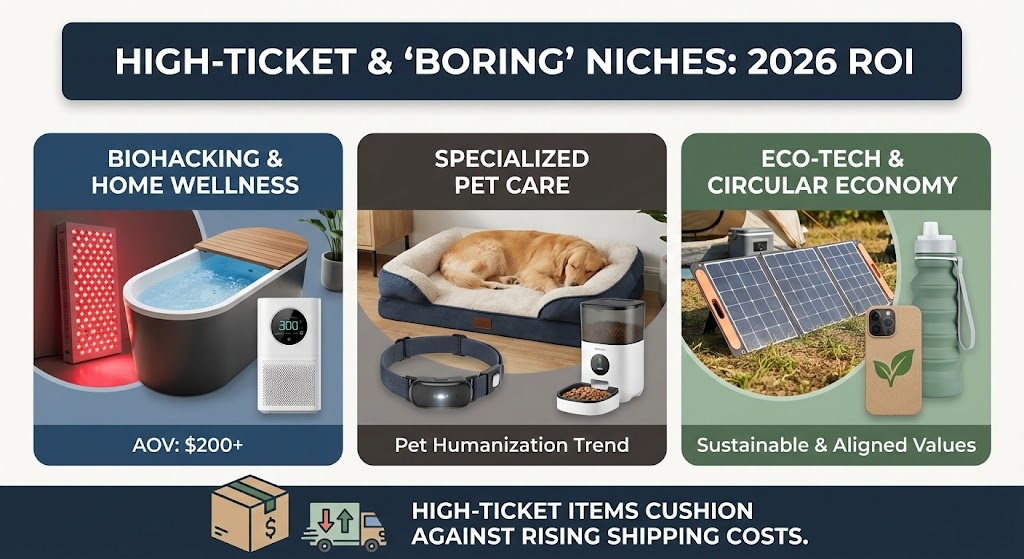
Stop selling phone cases and galaxy projectors. The market is flooded. In 2026, the highest ROI is found in High-Ticket and Hyper-Specialized niches.
Top Performing Categories for 2026:
- Biohacking & Home Wellness: Red light therapy panels, cold plunge accessories, smart air quality monitors. (Average Order Value: $200+)
- Specialized Pet Care: Not generic dog bowls, but orthopedic beds for large breeds or anxiety-relief tech for pets. The “Pet Humanization” trend means owners spend heavily on health-related items.
- Eco-Tech & Circular Economy: Solar-powered camping gear, biodegradable tech accessories. Consumers are willing to wait slightly longer for shipping if the product aligns with their values.
High-ticket items cushion you against rising shipping costs. It is much easier to absorb a $20 shipping fee on a $300 order than on a $20 order.
4. The Technical Barrier: Your Store Must Be Flawless
In the age of Amazon Prime, customers have zero patience for slow, clunky websites. A generic Shopify theme with “AliExpress English” descriptions will not convert.
The “System” Checklist:
- Speed: Your site must load in under 2 seconds.
- CRO (Conversion Rate Optimization): You need high-trust badges, clear shipping policies, and a frictionless checkout.
- SEO: You cannot survive on ads alone. You need “How-to” content and blog posts (like this one) to drive organic traffic.
This is where the Fractional Ecommerce Team model becomes your competitive advantage. Instead of trying to be a developer, a copywriter, and a media buyer all at once, you leverage a team.
- Our Shopify Developers ensure the code is clean.
- Our CRO Specialists run A/B tests to squeeze an extra 0.5% conversion rate (which can double your profit).
- Our SEO Strategists ensure you rank for terms your customers are searching for.
The 2026 Dropshipping Tech Stack: The 10 Essential Apps
1. Klaviyo: Email Marketing & SMS
Link: apps.shopify.com/klaviyo-email-marketing Klaviyo is the undisputed “heartbeat” of our growth system. It handles everything from your welcome series and abandoned cart recovery to complex post-purchase flows that drive repeat business. In an era of high ad costs, this is where your profit is generated.
- Why it’s mandatory: Without an owned audience, you are at the mercy of Meta and TikTok’s rising CPMs. If you don’t have Klaviyo, you don’t have a business; you just have an expensive hobby.
- Why we recommend it: As a Klaviyo-focused agency, we’ve seen it consistently drive 30-40% of a brand’s total revenue through automation. It’s the single best tool for increasing Customer Lifetime Value (LTV).
2. DSers-AliExpress Dropshipping
Link: apps.shopify.com/dsers DSers is the standard tool for processing bulk orders from AliExpress. It allows you to manage hundreds of orders with a few clicks, sync tracking numbers automatically, and manage multiple suppliers for the same product to ensure redundancy.
- Why it’s mandatory: Manual order fulfillment is not scalable. To operate with the efficiency of a senior brand, you need automated order syncing and tracking updates to keep customer support tickets low.
- Why we recommend it: It is the most stable and feature-rich tool for those starting with the global-test model. It integrates seamlessly with Shopify, allowing our dev team to focus on site performance rather than fulfillment bugs.
3. Spocket: US & EU Dropshipping
Link: apps.shopify.com/spocket. To bypass the 2025/2026 tariff traps and “de minimis” regulations, you need local suppliers. Spocket connects you with high-quality suppliers in the US and EU, offering 3-5 day shipping times that can actually compete with Amazon.
- Why it’s mandatory: Long shipping times from China are the https://www.google.com/search?q=%231 cause of merchant account bans and high refund rates. Local fulfillment is a requirement for brand longevity in 2026.
- Why we recommend it: We advocate for the “Hybrid Fulfillment” model. Spocket allows our clients to source high-ticket items locally, ensuring better margins and happier customers.
4. Gorgias ‑ Helpdesk & AI Chat
Link: apps.shopify.com/gorgias Gorgias is a specialized e-commerce helpdesk that pulls all customer data (orders, tracking, history) into one screen. It allows your support team (or AI agents) to issue refunds, update addresses, and answer “Where is my order?” questions in seconds.
- Why it’s mandatory: Poor customer service kills your “Store Quality Score” on Facebook/Google. Efficient support is a defensive necessity to keep your ad accounts active.
- Why we recommend it: We focus on operational efficiency. Gorgias turns customer support from a cost center into a profit center by allowing agents to see a customer’s LTV and offer personalized upsells during a chat.
5. Loox ‑ Product Reviews & Photos
Link: apps.shopify.com/loox Loox is a visual-first review app that encourages customers to share photos and videos of their purchases. These are then displayed in beautiful, high-trust galleries across your product pages and checkout.
- Why it’s mandatory: In dropshipping, “Trust” is your most valuable currency. Visual social proof is the fastest way to overcome a customer’s skepticism about a brand they’ve never heard of.
- Why we recommend it: From a CRO (Conversion Rate Optimization) perspective, photo reviews are a “cheat code” for higher conversion. We use Loox to build the “Branded” feel that separates our clients from generic “scammy” stores.
6. PageFly Legislative Landing Page Builder
Link: apps.shopify.com/pagefly PageFly allows you to create highly customized, high-converting landing pages without knowing how to code. This is essential for building “Product Detail Pages” (PDPs) that look like high-end luxury brands rather than basic templates.
- Why it’s mandatory: Default Shopify themes are often too generic for competitive niches. To win in 2026, your landing page must tell a story and handle objections better than your competitors.
- Why we recommend it: Our CRO specialists use PageFly to run rapid A/B tests. It allows us to build complex layouts that load fast, which is a key ranking factor for SEO and a conversion driver for mobile traffic.
7. Matrixify (formerly Bulk Account Editor)
Link: apps.shopify.com/excel-export-import Matrixify gives you total control over your store’s data via Excel or Google Sheets. Whether you need to update prices for 1,000 items due to new tariffs or migrate blog posts, this app handles it flawlessly.
- Why it’s mandatory: As you grow, managing data inside the Shopify admin becomes a bottleneck. Senior operators use Matrixify to save hundreds of hours on bulk updates and data migration.
- Why we recommend it: We use this internally for all our “Managed Services” clients. It’s the “Swiss Army Knife” for ecommerce operations, ensuring data integrity across large, complex catalogs.
8. Lucky Orange Heatmaps & Replay
Link: apps.shopify.com/lucky-orange Lucky Orange records exactly how visitors interact with your store. You can watch “session recordings” to see where people get stuck, where they click, and exactly why they are abandoning their carts.
- Why it’s mandatory: You can’t fix what you can’t see. Without session recordings, you are just guessing why your conversion rate is low.
- Why we recommend it: Heatmapping is a core part of our “CRO Sprints.” We use this data to remove friction points, resulting in immediate revenue lifts for our clients without increasing their ad spend.
9. Booster SEO & Image Optimizer
Link: apps.shopify.com/booster-apps-seo-optimize. This app automates the technical heavy lifting of SEO. It optimizes image alt-tags, compresses file sizes for speed, and fixes broken links automatically to ensure Google can crawl your site efficiently.
- Why it’s mandatory: Page speed is a non-negotiable ranking factor. If your dropshipping images are uncompressed, your site will be slow, your bounce rate will be high, and your ad costs will skyrocket.
- Why we recommend it: We believe in “Systems Over Hustle.” Automating technical SEO allows our content team to focus on high-level strategy and AI-search optimization (GEO) rather than manual image tagging.
10. UpPromote: Affiliate & Referral
Link: apps.shopify.com/affliate-by-secomapp UpPromote allows you to build a network of affiliates and brand ambassadors. Instead of paying Facebook for every click, you pay a commission only when a sale is actually made.
- Why it’s mandatory: Diversifying your traffic sources is the only way to survive in 2026. An army of micro-influencers and loyal customers promoting your brand is the ultimate “moat” against competitors.
Why we recommend it: We focus on “Customer Acquisition Cost” (CAC) efficiency. Affiliate marketing is one of the few channels where you can maintain a predictable ROI while scaling, which is vital for maintaining margins in dropshipping.
Final Agency Take
Installing these apps is only the first step. The real magic happens when they are configured to work together as a system. For example, your Loox reviews should be pulled into your Klaviyo emails, and your Gorgias support team should have access to Lucky Orange recordings to troubleshoot customer issues.
If you find this tech stack overwhelming, that’s exactly why we offer Managed Services. Our team handles the selection, installation, and optimization of these tools so you can focus on the big picture.
Get a Free Audit of your Shopify Tech Stack
5. From Dropshipper to Brand Owner
The ultimate goal in 2026 shouldn’t be to “dropship” forever. It should be to build an asset.
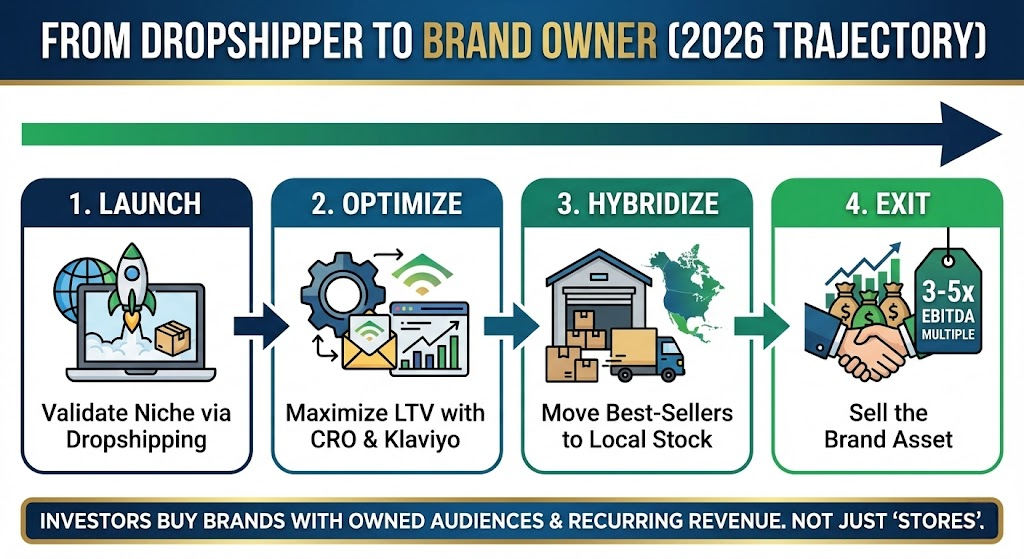
Dropshipping is just the launchpad. The trajectory looks like this:
- Launch: Validate niche via dropshipping.
- Optimize: Use CRO and Klaviyo to maximize LTV.
- Hybridize: Move best-sellers to local stock.
- Exit: Sell the brand for a 3-5x multiple of EBITDA.
Investors do not buy “dropshipping stores.” They buy Brands with owned audiences (email lists) and consistent recurring revenue.
Conclusion: Is It Worth It?
If you are looking for a “get rich quick” button, dropshipping is dead. If you are looking to build a serious e-commerce business with lower upfront capital risk than traditional retail, dropshipping is very much alive.
But you can’t do it alone. The complexity of 2026 requires a system.
Ready to stop playing games and start building a brand? At eCommerce Today, we act as your Fractional E-commerce Department. One retainer, one account manager, and a full team of specialists dedicated to growing your store. Whether you need a Shopify audit, a Klaviyo overhaul, or a full Managed Services partner, we are here to execute.
Frequently Asked Questions
Q: Is dropshipping still profitable in 2026 with the new US tariffs?
A: Yes, dropshipping is profitable, but margins have tightened. The new 2026 tariffs and the removal of the de minimis exemption mean that reliance on cheap Chinese shipping is risky. Successful merchants are shifting to high-ticket items (AOV $200+) to absorb these costs or moving winning products to US-based 3PL fulfillment centers.
Q: What are the best dropshipping niches for 2026?
A: The most profitable niches in 2026 are “High-Ticket” and “Deep Interest” categories. Examples include Biohacking & Wellness (red light therapy, smart health tech), Pet Humanization (premium orthopedic beds, smart feeders), and Eco-Friendly Outdoor Gear. These niches command higher prices and attract customers willing to wait for quality.
Q: How much money do I need to start dropshipping in 2026?
A: While you can technically start for a few hundred dollars, a realistic budget to launch a successful brand is between $2,000 and $5,000. This covers your Shopify subscription, initial test ads (Meta/TikTok), sample products for content creation, and essential apps like Klaviyo for email marketing.
Q: Can I automate my dropshipping business?
A: You can automate operations, but you cannot automate strategy. Tools like Klaviyo can automate your customer retention, and Shopify apps can automate order processing. However, you need a human team for strategy, creative testing, and CRO. This is why many founders hire a Fractional Ecommerce Team like eCommerce Today to manage the system.
Q: Why do most dropshippers fail in 2026?
A: Most fail because they focus on “Customer Acquisition” (Ads) but ignore “Customer Retention” (LTV). With rising ad costs, you will likely lose money on the first sale. Profit comes from the second and third order. Brands that fail to implement robust Email & SMS flows and Conversion Rate Optimization (CRO) cannot sustain profitability.