
A merchandising calendar is not a content calendar. It is not a posting schedule. It is your revenue architecture for the entire year. It tells you when your big pops of revenue are going to happen, what you are going to sell and how, and how you are going to treat your audience before and after every promotional window. Done right, it is the single most powerful lever you can pull to increase profit, grow your list, and build a brand that people actually look forward to hearing from.
This guide breaks down exactly how to build one, what it should contain, and how to execute it at every level, whether you are a one-person shop or running a multi-brand operation.
Why Email and SMS Are the Foundation of Everything
Before you plan a single campaign, you need an honest look at where your revenue is actually coming from. Most ecommerce owners pour budget into paid advertising while systematically under-investing in the channels they already own and control.
When working correctly, email and SMS together should account for 25 to 40% of your store’s total revenue. If your owned channels are sitting below that range, the merchandising calendar is how you close that gap.
Here is why that number matters. When a customer lands on your site from an ad or a search result, their intent to buy is unknown. They might be curious. They might be comparison shopping. They might never come back. But when someone is on your email list, the dynamic shifts completely. They have already opted in. They already know your brand. They are far more likely to buy when you reach them there than through almost any other touchpoint.
SMS raises the stakes further. Conversion rates for ecommerce SMS campaigns typically land between 10 and 22% depending on list size and offer quality. Smaller, more engaged lists often see numbers at the top of that range or beyond. No paid channel comes close to that on a consistent basis. The conclusion is straightforward: building and nurturing your owned audience is the highest-return marketing activity available to your business.
Within your email and SMS revenue, expect a roughly 65 to 35 split between campaigns and automations. Automations, such as abandoned cart sequences, post-purchase flows, and win-back emails, run continuously in the background as your always-on revenue engine. To scale this efficiently, we highly recommend implementing dedicated Klaviyo Automations to ensure your baseline revenue is captured before layering on manual promotions.
Campaigns are what your merchandising calendar governs: the deliberate, manually planned promotions and content you send throughout the year with intention and strategy behind them.
No paid channel will ever match the conversion rate of a well-nurtured email and SMS list. That is not an opinion. It is data.
Build Your List Before You Build Your Calendar
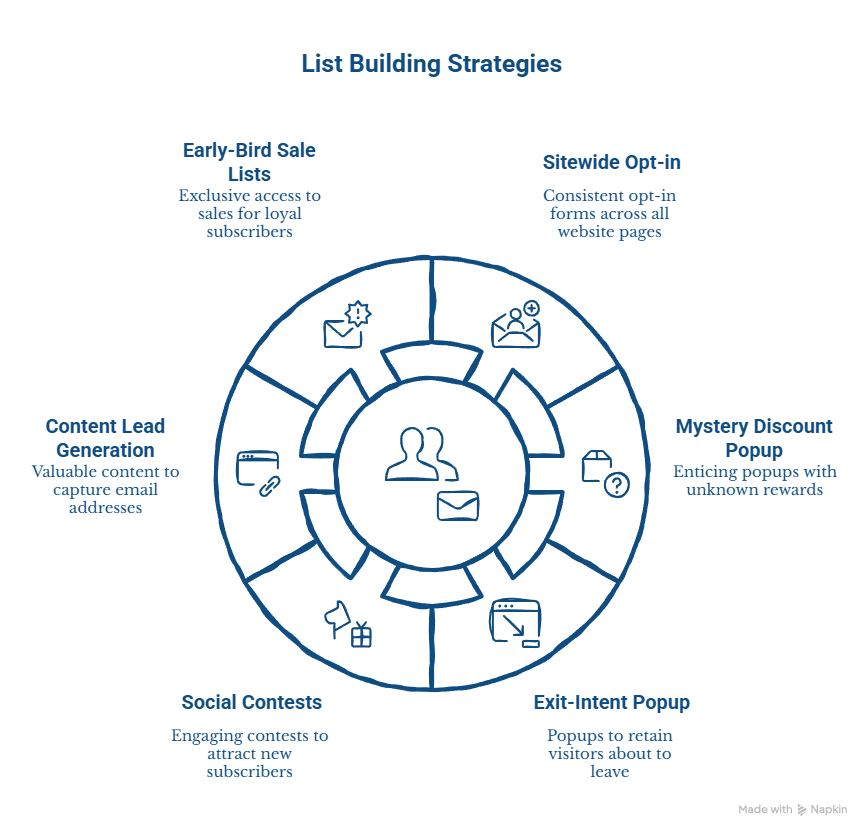
A merchandising calendar only works when there is an audience ready to receive it. List size matters less than most people assume, but consistent growth always matters. Here are the most effective mechanisms for keeping new subscribers coming in.
The sitewide opt-in belongs in your header, your footer, and your mobile navigation at all times without exception. Offer a clear incentive in exchange for an email address and phone number. A discount, early access, or exclusive content all work well. Every landing page and every ad destination should carry this opt-in, not just your homepage.
The mystery discount popup consistently outperforms a standard percentage-off offer. Instead of displaying “Get 10% off,” you present “Claim your mystery discount.” The underlying value is identical, but the framing taps into something deeper. People are wired for anticipation. The unknown reward creates more desire than the known one. If you want to deploy this effectively, learn how to make a great newsletter subscription pop-up for your Shopify store.
The exit-intent pop-up serves visitors who are about to leave without acting. A well-crafted offer presented at the exact moment someone moves to close the tab can recover a meaningful slice of traffic that would otherwise disappear permanently.
Social contests and giveaways remain one of the most underused list-building tools in ecommerce despite being highly effective and relatively low-cost. A giveaway promoted through paid ads, organic posts, and your existing email list can generate a significant number of new, qualified subscribers in a short window. Running two to four of these per year keeps list growth healthy and audience engagement high.
Content lead generation is a strategy most ecommerce brands have never tried, which makes it a genuine competitive advantage for those who do. Set aside roughly 3 to 7% of your advertising budget specifically for campaigns that drive traffic not to a product page, but to a content landing page gated behind an email opt-in. The content should be genuinely valuable and directly connected to your product category: a buying guide, a quiz, a how-to resource. Not everyone is ready to purchase the first time they encounter your brand. Many of them will, however, exchange their contact details for something that helps them.
Early-bird sale lists are worth building before every major promotional event. In the weeks before a significant sale, invite your audience to sign up for early access. This rewards your most loyal subscribers, creates a warm high-intent segment ready to buy the moment your sale opens, and gives you a measurable pre-sale benchmark for forecasting revenue.
The Three-Phase Promotion Framework
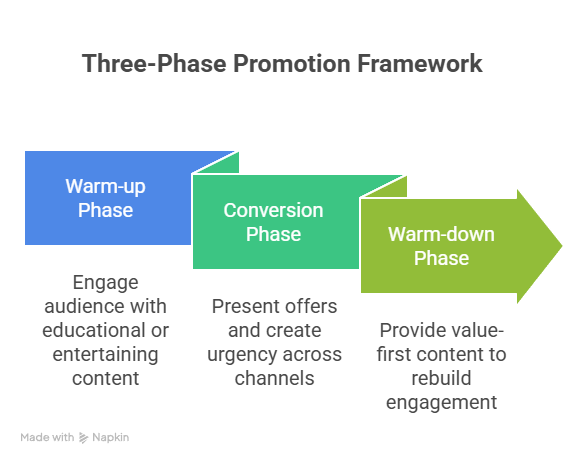
Every promotion you run, whether it lasts one day or ten, should follow the same three-phase structure. Skipping any phase is where brands start to see fatigue, declining open rates, and audiences that feel like they are only ever being sold to.
Phase one is the warm-up. This is the content and relationship work that happens before you ever present an offer. You lead with education, entertainment, or a story. Audiences that feel engaged and valued before a sale convert at a meaningfully higher rate than audiences that receive a discount code out of nowhere. This is why understanding ramp-up campaigns in email marketing is a crucial prerequisite for massive promotional success.
Phase two is the conversion. This is the active promotional window. You are presenting offers, creating deadline-driven urgency, and communicating with frequency across email, SMS, and all other active channels. This is not the time for restraint. Brands that send too little during this phase consistently underperform the revenue their list is capable of generating.
Phase three is the warm-down. Once your promotion closes, you do not roll directly into another one. You spend time sending value-first content: practical tips, customer stories, educational material, entertainment. This phase recovers the goodwill of subscribers who did not purchase and rebuilds the engagement that makes the next promotional window effective.
Brands that skip the warm-up and the warm-down do not burn their lists overnight. They erode them gradually until one day the open rates are low, the revenue per campaign is disappointing, and no one can quite explain when it went wrong.
The Annual Merchandising Calendar Structure
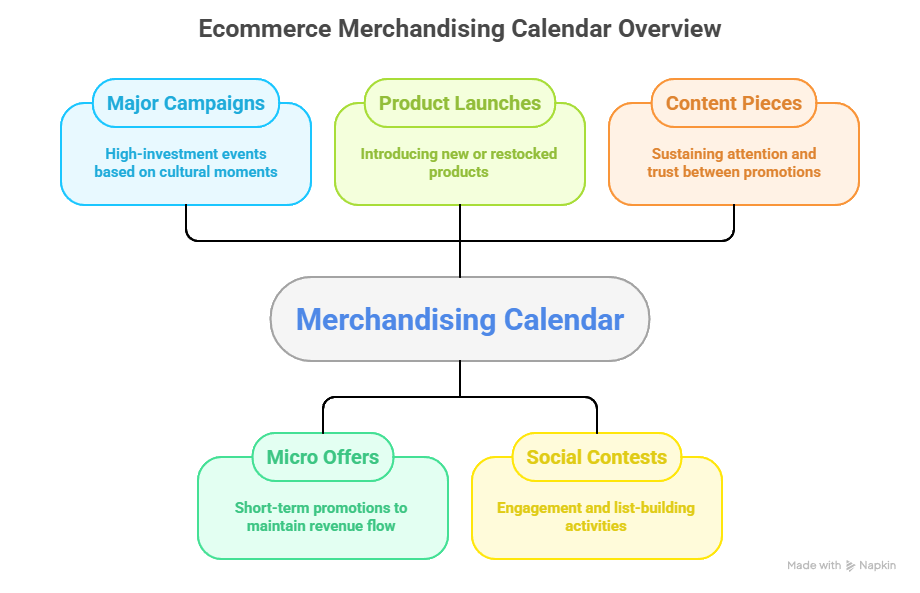
A well-structured merchandising calendar for an ecommerce brand contains several distinct layers, each serving a different function within your overall revenue plan.
A few main campaigns, between 3 and 5 major campaigns per year, are your highest-investment promotional events. These run anywhere from three to nine days and are built around culturally relevant moments: Valentine’s Day, Mother’s Day, Memorial Day, the Fourth of July, back-to-school season, autumn, or any other occasion that resonates with your specific customer base. Major campaigns are supported by paid advertising, dedicated sale pages, and a full email and SMS communication sequence that builds toward a strong close.
Micro offers sit between your major campaigns and keep revenue flowing consistently throughout the year. These are one to three-day events built around a specific, compelling offer with a hard deadline. At minimum, run one per month. The brands that treat micro offers seriously and execute them with the same discipline as major campaigns often find they generate a disproportionately high share of annual revenue relative to the effort required.
Product launches per year keep your catalog from going stale and give you fresh angles for both acquisition and retention marketing. Here is one of the most overlooked insights in ecommerce: a product does not need to be newly manufactured to qualify for a launch. When a product sells out and returns to stock, treat its comeback as a full launch event. Build anticipation, send a narrative sequence about the product’s story and results, and send traffic to a dedicated page.
Social contests or giveaways function simultaneously as list builders and engagement drivers. Running one roughly every quarter maintains a healthy rhythm without oversaturating your audience.
Pieces of content fill the space between your promotional events. That range sounds large, but at its minimum it is less than one piece per week. This is the content that sustains attention, builds trust, and keeps your audience engaged during the periods when you are not actively selling. We will detail exactly what this content looks like in an upcoming section.
What Goes Inside a Major Campaign
The email and SMS cadence within a major campaign is what separates a revenue event from a missed opportunity.
For a five to nine-day event, a solid structure is two communications per day across the opening days, a deliberate pause over the weekend if the timing permits, and a hard close with three emails and two SMS messages on the final day. Ad spend increases on peak days, specifically the opening day and the closing day of the event. These are the moments when the highest number of people are ready to act.
A reliable three-day cadence works as follows: two emails and one SMS on day one, two emails on day two, and two emails plus one SMS on day three. This structure is repeatable, manageable for most teams, and consistently effective across categories.
A single-day micro offer operates on a simple triple send: one email in the morning, one SMS in the afternoon, one email in the evening. Three touches across one day is enough to reach the majority of your active audience without overwhelming anyone.
One distinction worth internalizing early: micro offers do not need paid advertising support. Reserve your ad budget for major campaigns. Micro offers are a direct test of the health and responsiveness of your owned list, which is itself a reason to invest in that list continuously.
What Micro Offers Actually Look Like
A micro offer is not a sitewide discount sent to your whole list on a slow Tuesday. That approach trains customers to expect discounts at random intervals and to wait rather than buy at full price. Over time it degrades both your brand perception and your margins.
A well-executed micro offer is specific, structured around a particular product or bundle, tied to a deadline the customer can feel, and wrapped in a reason that justifies the timing.
The bundle discount is among the highest-converting offer structures available. The customer must purchase two or more specific products together to access the discount. This raises average order value and allows you to move inventory intentionally rather than reactively.
BOGO and free gift with purchase remain the most compelling offer formats in ecommerce. When something is framed as free, it triggers a response that percentage discounts simply do not. A modified version of this, where the second item is 30 to 50% off rather than fully free, lets you preserve margin while still delivering the psychological impact of a highly attractive deal.
The single item with a hard deadline is among the simplest micro offer formats and often among the most effective. An email that reads “Today only, $10 off this one product” sent as plain text with no images frequently outperforms polished HTML campaigns because it reads like a personal message rather than a broadcast. The perceived intimacy drives action.
The product relaunch requires no new inventory, no new packaging, and no product development budget. When a product returns to stock after a period of unavailability, treat the restock as a launch event. Use the sequence to tell or retell the product’s story, share customer results, and build desire before the product is available again.
Every micro offer and every major campaign should direct traffic to a dedicated sale page, not a standard product detail page. The sale page is a conversion environment designed specifically around the offer: it explains the deal, displays the bundle or discount visually, builds urgency with a countdown, and surfaces social proof. It does a job that a product detail page was never designed to do.
Merchandising Tactics That Move Real Volume
How you structure your offer matters as much as when you send it. These are the tactics that consistently produce the highest revenue per campaign across categories.
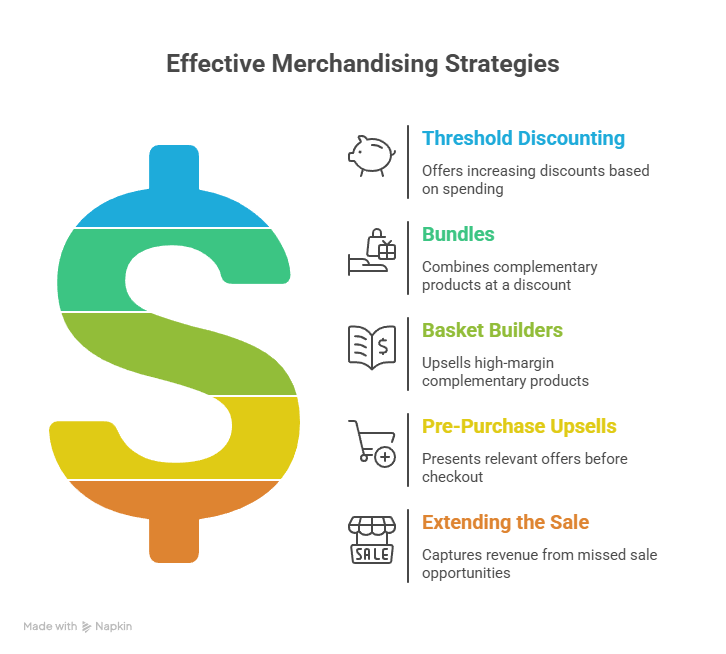
Threshold discounting is one of the most effective broad merchandising formats available. The principle is simple: the more a customer spends, the larger the discount they unlock. A structure might look like this: spend $60 and receive 15% off, spend $90 and receive 20% off, spend $120 and receive 25% off plus a free gift. This format works because customers are motivated to add more to their cart in order to reach the next tier. Average order value lifts measurably and consistently when threshold discounting is in place.
Bundles at the top of your offer page are non-negotiable. When you pre-build complementary product combinations and display them at a discount, and then stack your campaign discount on top, the compounding savings become genuinely compelling. A bundle already carrying a 5 to 8% discount that then receives an additional 12 to 15% sale discount delivers total savings that convert at a significantly higher rate than individual product promotions.
Basket builders are the high-margin complementary products that belong in your upsell flow at every stage of the purchase journey. Identify the products in your catalog that pair naturally with your best sellers and carry your highest margins. Bundle them together. Surface them on the product page, in the cart, and post-purchase. The goal is to increase the average transaction value of every order without increasing your customer acquisition cost.
Pre-purchase upsells presented at the moment a customer clicks Add to Cart are one of the highest-return infrastructure investments a Shopify store can make. The key insight from data across thousands of stores is that 80% of upsell revenue is generated without any discount attached. You do not always need to offer a lower price to get the upsell. What you need is a relevant, well-timed offer. Presenting between two and five options in the upsell modal consistently outperforms a single offer because choice creates agency rather than pressure.
Extending the sale is a tactic that generates real revenue with minimal effort. After your official close date, a message telling customers the sale has been extended by 48 hours due to demand consistently captures a meaningful amount of revenue from people who missed the window or needed one more nud
Content, AI, and Modern Brand Building
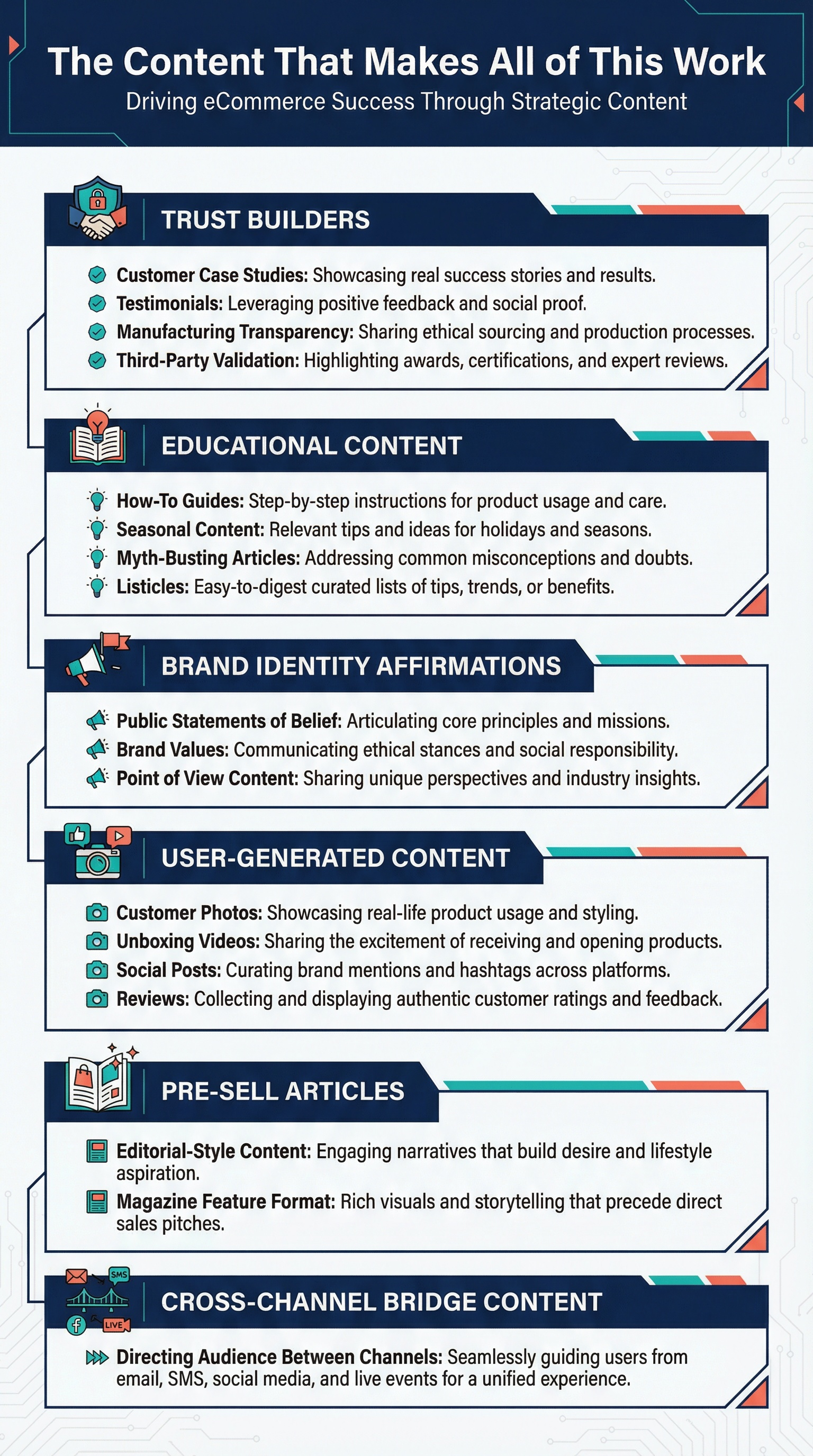
Promotional campaigns do not exist in a vacuum. Trust builders, educational content, listicles, and brand identity affirmations are vital. Listicles perform well across email and search because they are inherently scannable, highly shareable, and easy to optimize for specific long-tail keywords.
The content volume described in this guide sounds intimidating until you understand what AI tools are genuinely capable of doing today. Build a custom AI knowledge base trained on your brand’s existing material: every email ever sent, every product description written, and every ad created.
Trust builders exist to close the credibility gap between a new visitor and a confident buyer. The most effective formats include customer case studies, detailed before-and-after testimonials, transparency around how your products are made, sourcing or ingredient stories, and any third-party validation such as press coverage, certifications, or clinical testing. The singular goal is to give a skeptical customer every reason they need to feel confident purchasing from you.
Educational and engaging content keeps your list warm between promotional periods. This includes how-to guides connected to your product category, content tied to timely seasons or cultural moments, curated material from external sources presented with your brand’s perspective, myth-busting pieces that challenge assumptions your customer holds, and listicles. Listicles in particular perform well across email and search because they are inherently scannable, highly shareable, and easy to optimize for specific long-tail keywords.
Listicles are articles structured as a numbered or sequenced list. The word combines “list” and “article.” Each item in the list gets its own heading, a short explanation, and sometimes an image. The format is inherently easy to scan, meaning a reader can get value from it in 60 seconds or spend 10 minutes going deep. Both are valid and both drive engagement.
Why Listicles Work So Well for Ecommerce
The format does three jobs simultaneously that most content formats cannot do alone.
They work in email because a subject line like “7 Mistakes Killing Your Skin Routine” or “5 Reasons Your Hair Color Fades Too Fast” creates immediate curiosity. The reader knows exactly what they are getting and how long it will take. Open rates and click rates on listicle emails consistently outperform standard promotional emails.
They work in search because Google rewards content that directly answers specific questions. A listicle titled “10 Best Gifts for Women Over 50 Who Have Everything” targets a long-tail keyword phrase that a product page could never rank for. The article attracts organic traffic, warms the reader up, and links naturally to your products.
They work as pre-sell content because they build desire without feeling like an ad. A reader arrives looking for information and leaves wanting to buy. That is the ideal conversion journey.
Brand identity affirmations are a more advanced content type that many ecommerce brands overlook entirely. These are clear public statements of what your brand believes, not what it sells. The goal is to express a point of view that your ideal customer already holds or aspires to hold. When a customer encounters content that articulates something they believe, they do not just engage with it: they feel understood by the brand that created it. That emotional response is the foundation of loyalty.
User-generated content is simultaneously your most credible asset and your most cost-effective content source. Customer photos, unboxing videos, written testimonials, and social posts featuring your products carry a weight that brand-produced content simply cannot match. Create systematic processes for soliciting UGC: follow-up emails after purchase, a dedicated hashtag, incentives for submission. Feature this content in your emails and ads. What your customers say about your products will always outperform anything you say about them yourself.
Pre-sell articles and listicles occupy the space between editorial content and conversion content. A well-written pre-sell article informs, entertains, and builds desire for a product without leading with a call to purchase. It reads like a magazine feature. It feels like advice rather than advertising. And at the right moment in the reader’s journey, it moves them from curiosity to readiness to buy. Every product in your catalog should have at least one.
Cross-channel bridge content actively directs your audience from one owned channel to another. An email that encourages subscribers to follow your Instagram. An SMS that promotes an upcoming Facebook live. A live event that invites viewers to join your text list for exclusive access. Each channel you own becomes more valuable when it actively feeds the others.
How to Use AI to Create All of This Content
The content volume described in this guide sounds intimidating until you understand what AI tools are genuinely capable of doing for brand-specific content production today.
The most effective approach begins with building a custom AI knowledge base trained on your brand’s existing material: every email ever sent, every product description written, every customer question answered, every ad created, every blog post published. Tools like ChatGPT’s custom GPT feature allow you to upload this material and instruct the AI on your brand’s tone, values, preferred formats, and communication style. You can also reference external brands whose voice you admire as reference points.
Once this is in place, your content production workflow changes fundamentally. You are no longer writing from a blank page. You are briefing, reviewing, and refining. A full month of email content that might previously have taken days to produce can now be drafted in an afternoon. A listicle brief that once required a freelance writer can be turned around in minutes. Your role shifts from creator to editor and strategist, which is where your time produces the most value anyway.
For visual content, AI image generation tools have advanced rapidly and are now genuinely useful for producing lifestyle imagery, product mockups, and on-brand creative assets. Paid creators and ambassadors remain the gold standard for authentic, human-centered visual content. AI handles the volume and fills the gaps between professional productions.
The Email Anatomy That Drives Clicks
Every campaign email you send should be structured to account for the different ways people engage with their inbox. Some people click images instinctively. Others look for buttons. Others read every word and click a text link buried in the third paragraph. Your email should be built for all of them simultaneously.
A branded header with your tagline anchors every email in your brand identity. Do not assume subscribers remember who you are or why they signed up. Your tagline, placed at the top alongside your logo, does that work in one line.
An image with an embedded link should appear early and be fully clickable. For many subscribers, this is the first and only thing they interact with.
A button call to action follows your primary copy block. Make it direct and specific. “Shop the Sale,” “Claim Your Free Gift,” and “See the Bundle” convert better than generic phrasing. The button should be large enough to tap comfortably on mobile.
Body copy with a headline and a supporting subheadline gives the reader enough context to decide whether to keep going. It does not need to be long. It needs to be clear.
Text links within the body copy serve the readers who move through email methodically. They are often the highest-intent clickers. Do not leave them without a path forward.
A content carousel pinned to the bottom of every email featuring your three highest-performing pieces of content serves as a secondary engagement layer. Subscribers who are not interested in the primary content of that particular email will often click something in the carousel. It keeps engagement metrics healthy and surfaces valuable content to people who may have missed it when it was first sent.
A PS line is consistently among the most-read elements of any email. When you are in an active promotional period and sending a content-first email, use the PS to remind the reader that a sale is live. One sentence. One link. It is disproportionately effective for the three seconds it takes to add.
A reminder paragraph in the footer is the most underused retention tool in ecommerce email. Before your unsubscribe link, include a short paragraph reminding subscribers why they are on the list and what they receive as a result. Something concise and genuine: “As a subscriber, you get early access to our sales, exclusive offers, and content we do not publish anywhere else. You can update your preferences at any time, or unsubscribe below.” Brands that add this consistently report a meaningful drop in unsubscribe rates.
Running a Multi-Channel Sale Event
When you execute a major campaign, your promotional message needs to exist everywhere your customers encounter your brand. A sale that lives only in your email is a sale that leaves significant revenue behind.
On Google Shopping and paid search, set up a promotional extension within your active campaigns that surfaces your discount directly in the search result. Link it to your dedicated sale page. When the promotion closes, switch it off. This is a short setup task that produces immediate returns.
On organic social, post about the sale. Post about the specific offer. Share the customer stories and social proof that support the campaign narrative. Your social audience and your email list overlap but are not the same group of people. Both deserve to know.
On paid social, take your strongest performing ad from the past year and add a discount overlay badge. “18% Off This Weekend” on a proven creative is often all the refresh you need. You do not have to produce new assets for every campaign. Your best ad, updated with a badge, is usually the right move.
On Amazon, if your products are listed there, reflect your promotional pricing during the campaign window. A customer who sees one price in your email and a different price on Amazon loses trust in both.
On the Shopify Shop app, make sure your promotions are visible. This platform is growing steadily as a consumer-facing shopping destination and takes minimal effort to keep current.
Post-purchase automations should remain active throughout every campaign, surfacing relevant upsell and cross-sell opportunities to every customer who converts during the event window.
Why Execution Requires a Fractional Team (Not Just a Solo Founder)
The strategies outlined above are highly profitable, but they are incredibly difficult for a solo founder or a thin in-house team to execute flawlessly. A true revenue calendar requires a developer to spin up dedicated sales landing pages, a CRO specialist to optimize the threshold discounts, an email marketer to segment the Klaviyo flows, and a media buyer to align the ad spend.
By utilizing a fractional team like eCommerce Today, you get senior-level operators managing the entire ecosystem. You eliminate the technical debt and bottlenecks of trying to do it all yourself, ensuring that every major campaign and micro offer launches on time and maximizes your margins.
The Most Important Mindset Shift: Product vs. Offer
This is the distinction that separates brands generating strong consistent revenue from those that produce good products and wonder why growth feels harder than it should be.
Your product is not your offer. Your offer is the entire context in which your product is presented.
The offer includes the risk reversal. A money-back guarantee, clearly stated and genuinely honored, removes the primary psychological barrier standing between a first-time visitor and a purchase. The longer and more generous the guarantee, the lower the perceived risk, and the higher the conversion rate.
The offer includes the incentive. There needs to be a reason to act today rather than tomorrow. A deadline. A limited quantity. A bonus that disappears when the window closes. A price that returns to normal at midnight. Urgency is not manipulation: it is the context that gives customers permission to stop deliberating and decide.
The offer is the value stack. What does the customer receive in addition to the product? A free gift with purchase, a downloadable guide, a loyalty reward, a bonus sample, a satisfaction guarantee, access to a community? Every element you add to the offer increases the perceived value of the transaction without increasing your product cost.
Most ecommerce brands sell products. The best ecommerce brands sell offers. That single shift in perspective, applied consistently across every campaign in your merchandising calendar, is what produces the revenue results that feel elusive when you are only competing on product quality and price.
Where to Start
If you have never built a merchandising calendar before, the most important first step is not choosing a template or mapping out a spreadsheet. It is making a decision.
Decide that you are going to communicate with your audience with intention and consistency. Decide that you will promote to them at minimum every four to six weeks, regardless of how large your list is today and regardless of whether you feel fully ready.
The brands that spend months waiting until conditions are ideal, until the list is bigger, until the product lineup is more complete, are the same brands that look back a year later and recognize the compounding cost of that hesitation.
Start with three major campaigns planned across the next six months. Anchor them to moments that are relevant to your specific customer. Build one micro offer per month around a focused deal, a real deadline, and a clear page designed to convert. Send one piece of value-first content per week.
That is a fraction of the full framework described in this guide. And executed consistently, it will produce results that make the rest of the framework feel not like extra work, but like the obvious next step.
If at any point the calendar feels overwhelming, the cadence feels unclear, or you are not sure how to translate the strategy into actual campaigns for your specific brand, that is exactly what we are here for.
The team at Ecommerce Today works with brands at every stage of this process, from building the first calendar from scratch to auditing and optimizing what is already in place.
Reach out at contact@ecommerce-today.com and tell us where you are starting from. We will take it from there.
What is a marketing calendar and why does an ecommerce brand need one?
A marketing calendar is a planned schedule of all your promotional campaigns, micro offers, product launches, content, and live events across the year. Without one, most brands end up reacting to holidays at the last minute, promoting inconsistently, and leaving significant revenue on the table between sale events. The calendar turns revenue from something unpredictable into something you can plan, forecast, and build on year after year.
How many promotional campaigns should an ecommerce brand run per year?
A realistic and effective annual calendar includes 3 to 7 major campaigns, which are multi-day sale events supported by email, SMS, and paid advertising, plus 5 to 12 micro offers running in the months between them. Major campaigns are anchored to culturally relevant moments like Valentine’s Day, Mother’s Day, or Black Friday. Micro offers are shorter, more specific, and run entirely on owned channels without ad spend.
How often should I email my list without burning them out?
More often than you think. The average person receives hundreds of emails per day and sees a small fraction of them. Most brands are under-communicating, not over-communicating. The key is balance: for every promotional email you send, make sure you are also sending value-first content that educates, entertains, or builds trust. Brands that mix content with promotion consistently see higher engagement and lower unsubscribe rates than brands that only send when they have something to sell.
What is a micro offer and how is it different from a regular sale?
A micro offer is a one to three-day, highly specific promotional event built around a single product, bundle, or incentive with a hard deadline. It is not a sitewide discount blasted to your entire list. It is a focused deal with a reason to exist, a limited window, and a dedicated page to land on. Micro offers run on email and SMS only, require no paid advertising, and are one of the highest-return activities in a well-built merchandising calendar.
Should I discount if I run a premium or high-end brand?
Yes, strategically and selectively. The concern that discounting damages a premium brand is valid at high frequency and extreme depth, but running 3 to 7 campaigns and 5 to 12 micro offers per year with varied offer formats does not make a brand look cheap. It makes it look active and generous. The risk is not in promoting. The risk is in offering sitewide deep discounts as your only promotional format. Threshold discounting, free gifts with purchase, and bundle deals all create compelling reasons to buy without the brand perception risk of a permanent price reduction.
How does SMS fit into the merchandising calendar?
SMS is the highest-converting channel in ecommerce and should be used deliberately rather than constantly. For major campaigns, send SMS on day one, once or twice in the middle of the event, and once or twice on the final day. For micro offers, one SMS is usually sufficient. For content weeks, send one SMS per week featuring the best-performing piece of content. SMS should always feel like a direct, personal message. Keep it short, make it relevant, and always include a clear link.
How does paid advertising connect to the marketing calendar?
Paid advertising supports your major campaigns only. When a major campaign is live, double your ad spend on peak days, set up Google promotional extensions that surface your discount in search results, take your best-performing existing ad and add a discount badge overlay, and ensure your promotional pricing is reflected on every channel including the Shopify Shop app. Micro offers do not use paid advertising. Allocate 3 to 7% of your annual ad budget specifically to lead generation campaigns that build your email and SMS list rather than driving direct purchase.