
As of February 25, 2026, Shopify has officially solved one of the most persistent friction points for European and British merchants: Native VAT Number Validation at Checkout.
At eCommerce Today, we’ve spent years helping brands navigate the complexities of international B2B sales. Until yesterday, handling VAT exemptions was a mess of “hacks,” expensive third-party apps, and manual corrections. Today, the game has changed.
📱 TL;DR: The Quick Summary
- What: Shopify Tax now validates EU/UK VAT numbers natively at checkout.
- The Benefit: Automatically applies the "Reverse Charge" (0% VAT) for B2B orders.
- Eligibility: Merchants using Shopify Tax in the EU/UK, shipping from an EU location.
- The Big Win: No more manual refunds for VAT or clunky third-party validation apps.
The “Old Way”: Why B2B on Shopify was a Headache
Before this update, merchants had to jump through hoops to handle B2B tax exemptions. If you’ve been in the trenches, you likely relied on one of these tricks:
The “Company Name” Hack: Merchants would ask customers to put their VAT number in the “Company” field. The problem? Shopify didn’t validate it. You had to check the number post-purchase, often resulting in messy refunds and accounting issues.
Cart-Level Validation Apps: Using third-party apps to validate VAT before checkout. This often added an extra step to the journey, slowing down the site and hurting conversion rates.
The “Plus-Only” Barrier: Advanced tax logic often required Shopify Plus and custom scripts, leaving growing mid-market brands in the cold.
What’s New: Seamless, Automated Reverse Charge
Merchants using Shopify Tax can now enable a native VAT field that manages the entire lifecycle of a B2B transaction.
How the system works:
-
Real-Time Validation: When a customer enters their VAT number, Shopify verifies it instantly against official databases.
-
Instant Exemption: If valid, the VAT is removed from the total before the customer pays.
-
Compliant Documentation: The system generates a VAT invoice that automatically includes the required legal phrase: “Reverse Charge Mechanism: Recipient responsible for VAT.”
How to Enable Native VAT Validation
Setting this up takes less than 5 minutes, but you need to know exactly where to look.
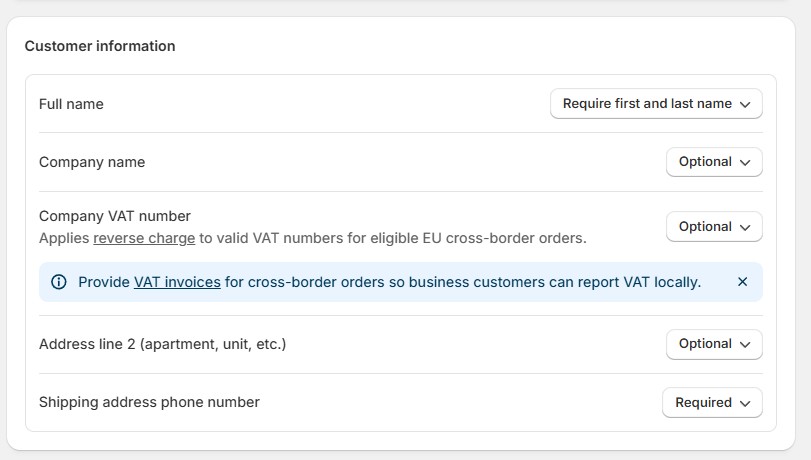
1. Configure the Checkout Field Navigate to your Shopify Admin, go to Settings > Checkout, and scroll down to the Customer Information section. You will see the option for Company VAT number. Here, you can choose to set the field as Optional or Don’t include.
Important Technical Note: Unlike the address or phone number fields, the VAT number cannot be enforced (set to Mandatory). It must remain optional to ensure that D2C (B2C) customers can still complete their purchases without a business ID.
2. Activate Shopify Tax Invoicing To be fully compliant, your store must issue a valid invoice. Go to Settings > Taxes and Duties, select European Union or United Kingdom, and in the VAT Invoices section, select “Generate and display invoices when orders are placed.”
How the System Works: Under the Hood
When a customer enters their VAT number, Shopify performs a real-time check against the official VIES (for EU) or HMRC (for UK) databases.
-
Logic: The exemption is triggered based on the fulfillment location country. For example, if you ship from a warehouse in France to a business in Ireland, the system detects a cross-border EU-to-EU transaction and removes the VAT.
-
Legal Compliance: The generated invoice will automatically include the mandatory phrase: “Reverse Charge Mechanism: Recipient responsible for VAT.”
-
Persistence: Validated VAT numbers are saved to the customer profile, making repeat B2B purchases seamless.
Frequently Asked Questions
Does this work for UK to EU shipments?
No. The exemption applies to EU-to-EU (cross-border) and EU-to-UK shipments. UK-to-EU and UK-to-UK shipments do not qualify for the automatic reverse charge through this specific tool.
Will it save the VAT number for returning customers?
Yes. Once validated, the VAT number is saved to the customer’s profile, making future B2B purchases even faster.
Is it 100% fraud-proof?
Shopify validates the format and existence of the number. However, it doesn’t guarantee the person using it is the rightful owner. For very high-value orders, we recommend a manual “sanity check” via the VIES service (https://europa.eu/youreurope/business/taxation/vat/check-vat-number-vies/index_en.htm)
What if the validation fails?
If the service is down or the number is invalid, the tax remains applied. Shopify also includes rate-limiting to prevent “brute-force” validation attempts by bad actors.
At eCommerce Today, we don’t just look at features; we look at Systems. This update is a massive win for Operating Efficiency. By moving VAT validation natively into the checkout, you reduce your “app stack” costs, decrease manual customer support tickets, and provide a professional “Enterprise-grade” experience to your B2B buyers.
Ready to modernize your Shopify B2B setup? Our “one retainer, full team” model is designed to handle these technical migrations while you focus on the big picture.
Book a discovery call with our team and let’s turn your Shopify store into a global growth engine.