

The “Magento Fatigue” is Real
The “Magento Fatigue” is Real
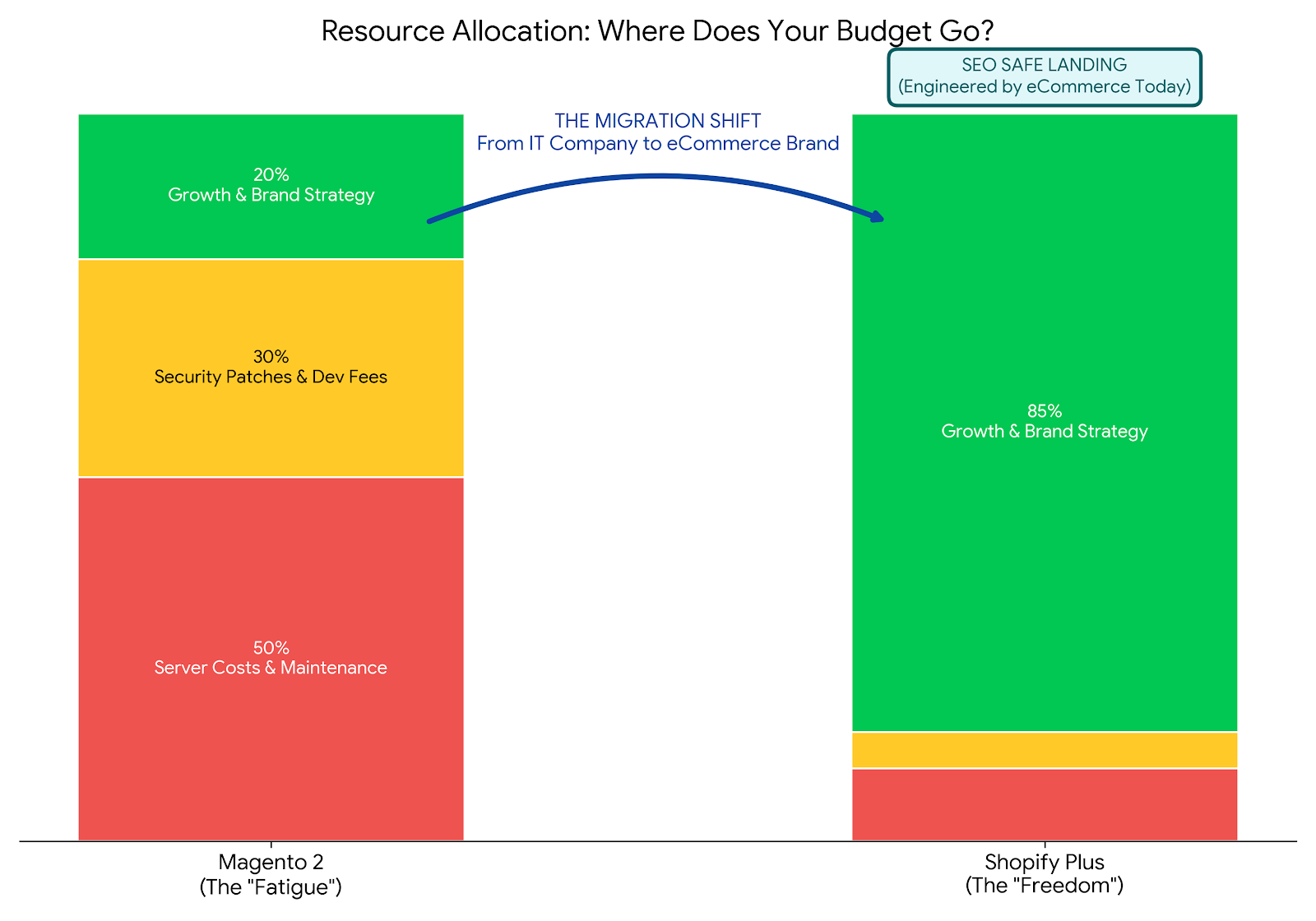
If you are running on Magento 2 (Adobe Commerce) in 2026, you know the pain. It starts with a security patch that breaks your checkout on a Friday night. It continues with server costs that seem to double every year. And it ends with a developer who charges you $150/hour just to keep the lights on, leaving no budget for actual growth features.
Most enterprise brands move to Shopify Plus for one simple reason: They want to stop being an “IT Company” and start being a “Retail Brand.”
But the fear of moving is valid. We hear it in every discovery call: “If I move, will my Google rankings tank? We spent 10 years building our SEO authority. We can’t lose it overnight.”
At eCommerce Today, we have migrated dozens of enterprise stores from Magento to Shopify. We don’t just “import products”; we engineer a safe landing. A migration is not just a platform switch; it is a transfer of digital assets.
Here is the truth about the 3 biggest migration risks and the roadmap we use to mitigate them.
🚀 TL;DR: The Migration Roadmap (Risk Mitigation)
- The TCO Reality: If your Magento maintenance costs are cannibalizing your growth budget, a shift to Shopify Plus can reduce Total Cost of Ownership (TCO) by up to 40%.
- SEO Safety Net: The biggest fear of migration is data and traffic loss; our strategy centers on strict 301 Redirect Mapping and data integrity to protect your organic rankings.
- The Strategic Pivot: Move away from "passive myth-busting" and toward a proactive "Migration Roadmap" that treats the platform switch as a massive Customer Activation Event.
- Growth Systems: Beyond the move, we integrate Shopify B2B and advanced lifecycle marketing to transform your store from a legacy burden into a modern revenue engine.
- Action: Audit your current Magento overhead and request a "Risk-Free Migration Blueprint" to transition from technical debt to scalable growth.
1. The SEO Trap: “It’s Just a New URL”
In the eyes of a developer, a URL change is a minor configuration. In the eyes of Google, a URL change—if not handled correctly—is a deletion of your business.
The Structural Difference:
- Magento URL: site.com/blue-shirt-html (or often unstructured categories like site.com/mens/shirts/blue)
- Shopify URL: site.com/products/blue-shirt
Shopify has a rigid URL structure. You cannot change the /products/ or /collections/ prefixes. If you launch your new Shopify site without explicitly telling Google where the old page went, Google assumes the old page is gone. You will see a spike in “404 Not Found” errors, and your rankings will plummet.
The Fix: The 301 Redirect Matrix We don’t rely on automated apps for this. We build a manual 301 Redirect Map.
- Crawl: We use SEO tools to crawl every single URL on your current Magento site that has received traffic in the last 12 months.
- Map: We match every legacy URL to its closest new Shopify equivalent.
- Wildcards: For large catalogs (10,000+ SKUs), we use “Pattern Matching” redirects to ensure even obscure pages find a home.
The Result: When Google crawls the new site, it sees the 301 signal, which effectively says: “This business didn’t close; it just moved to a better address. Transfer all the ‘Link Juice’ and authority to the new page.” Because Shopify is significantly faster than Magento (improving Core Web Vitals), we often see rankings improve post-migration.
2. Data Migration: “I’ll Lose My Customer Passwords”
This is the most common technical anxiety. “My customers have accounts. If they try to log in and it doesn’t work, they will think we are broken.”
The Reality: Magento hashes (encrypts) passwords differently than Shopify. You cannot simply “copy-paste” the encrypted strings. For security reasons, Shopify cannot read Magento’s encryption.
The “Senior Operator” Solution: We turn this technical hurdle into a Marketing Win.
Option A: Shopify Plus Multipass (Enterprise) If you are on Shopify Plus, we can sometimes use “Multipass” to bridge the login experience, though it requires significant custom development.
Option B: The “Activation Campaign” (Recommended) Instead of silently migrating passwords, we migrate the customer data (Name, Email, Order History) and then use Klaviyo to launch a “Welcome to the New Era” campaign.
- The Email: “We’ve upgraded our store to serve you better. Activate your new account today and get 100 Bonus Loyalty Points (or 10% off).”
- The Psychology: You are asking them to reset their password, but you are framing it as a reward. This typically wakes up “dormant” customers who haven’t shopped in 6 months.
What About Order History? We migrate historical orders so they appear in the customer’s dashboard. B2B buyers specifically need to see past invoices to reorder easily. We ensure this data maps correctly so the “Reorder” button works on Day 1.
3. The B2B Myth: “Shopify Can’t Handle Wholesale”
In 2020, this myth was true. If you had complex B2B needs (Net 30 terms, tiered pricing), you were stuck on Magento or BigCommerce. In 2026, this is false.
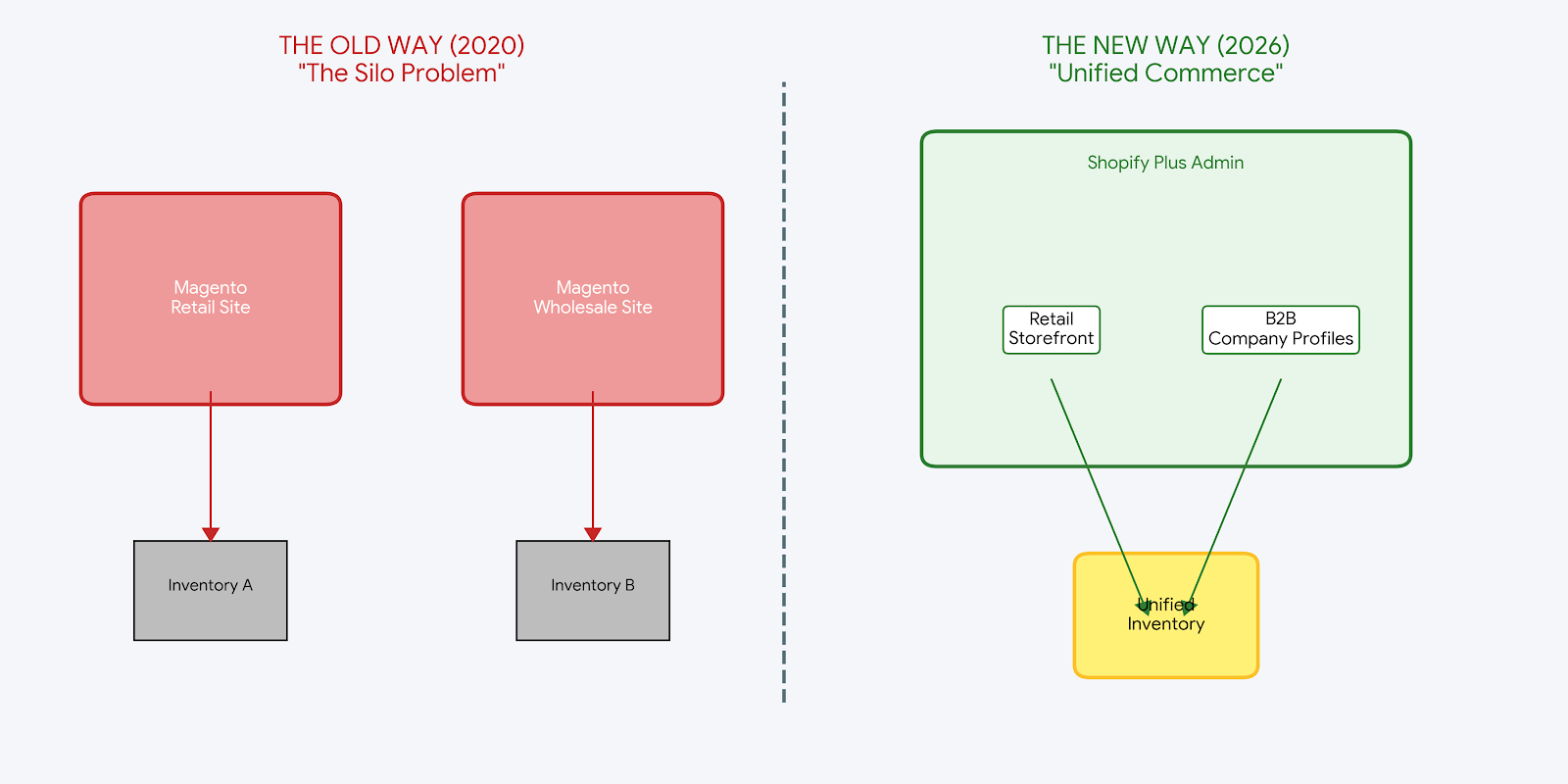
The Old Way (Magento): You often needed a completely separate “Wholesale” store view, or a heavy extension that conflicted with your checkout.
The New Way (Shopify Plus B2B): Shopify has released native B2B on Plus. We set this up directly in the admin.
- Company Profiles: We treat your B2B clients as “Companies” with multiple locations and buyers.
- Price Lists: Buyer A sees “Tier 1 Pricing.” Buyer B sees “Tier 2 Pricing.” Retail customers see “MSRP.” All on the same URL.
- Net Terms: Approved clients can checkout with “Net 30” or “Invoice” while retail customers must pay via Credit Card.
The Benefit: You stop managing two inventories and two tech stacks. Your retail and wholesale businesses live under one roof, sharing the same analytics and the same growth team.
4. The “Feature Parity” Audit: Extensions vs. Apps
Magento is famous for its “Custom Extensions.” You might have paid a developer $10,000 to build a custom “Product Finder” three years ago. A major fear is: “Shopify doesn’t have my custom feature.”
The Mindset Shift: In Magento, the default answer was “Build it custom.” In Shopify, the default answer is “Is there an App for that?”
During our audit, we map your Magento extensions to Shopify’s ecosystem:
- Magento Search Extension -> Replaced by Searchspring or Boost AI.
- Magento Helpdesk -> Replaced by Gorgias.
- Magento Reward Points -> Replaced by Smile.io or Yotpo.
The Risk of “Over-Engineering”: Sometimes, clients ask us to replicate a Magento feature exactly. We push back. Often, that feature was built 5 years ago and is clunky. We use the migration to simplify. Instead of porting over bad code, we implement best-in-class apps that are maintained by someone else. This drastically lowers your monthly maintenance bill.
5. The Financial Argument: Total Cost of Ownership (TCO)
Why do CFOs love the move to Shopify? Because Magento is a “Capital Expenditure” (CapEx) nightmare.
The Magento Cost Structure:
- Hosting (AWS/dedicated): $1,000 – $3,000 / month.
- Security Patches & Upgrades: $10,000 – $20,000 / year (mandatory or you get hacked).
- Dev Retainer (just to keep it running): $2,000 / month.
- Total: $50k – $80k per year just to maintain the status quo.
The Shopify Plus Cost Structure:
- Hosting: Included ($0).
- Security Patches: Included ($0).
- License Fee: ~$2,300 / month (variable).
- Apps: ~$500 / month.
- Total: ~$35k per year.
The Difference: The money you save on hosting and “keeping the lights on” can now be shifted to a Managed Services Retainer with eCommerce Today. Instead of paying a dev to update a server, you pay a Strategist to improve your conversion rate. That is how you grow.
Why You Need a “Fractional Team” for Migration
A migration is not a one-person job. If you hire a solo freelancer, you are gambling with your business.
- The Developer migrates the data and ensures the checkout works.
- The SEO Strategist maps the 301 redirects and monitors 404s on launch day.
- The Email Marketer ensures your domain reputation doesn’t tank (deliverability issues) when you switch platforms.
- The Designer ensures the new theme isn’t just a clone, but a UX upgrade.
If you hire a solo freelancer, they might be great at code but terrible at SEO. That is how you lose 40% of your revenue.
eCommerce Today provides the full Fractional Ecommerce Team—Dev, SEO, Email, and Strategy—under one Project Manager. We have a “Go-Live Checklist” with 150+ points to ensure nothing falls through the cracks.
We don’t just migrate you; we position you for the next 5 years of growth.
Frequently Asked Questions
Q: Will I lose SEO traffic if I migrate from Magento to Shopify?
A: Not if done correctly. The risk comes from broken links. By implementing a strict 301 Redirect Strategy that maps every old Magento URL to the new Shopify URL, we preserve your domain authority and rankings.
Q: Can I migrate customer passwords from Magento to Shopify?
A: No, because the encryption methods differ. However, you can use Shopify Multipass (for Plus users) or send a bulk “Activate Account” email via Klaviyo to seamlessly transition customers to the new platform.
Q: Is Shopify Plus cheaper than Magento Enterprise?
A: Generally, yes. While Shopify Plus has a platform fee, it eliminates the high costs of hosting, security patches, and server maintenance associated with Magento. The Total Cost of Ownership (TCO) is usually 30-50% lower on Shopify.
Q: How long does a Magento to Shopify migration take?
A: A standard data migration takes 4-8 weeks. However, a full replatforming project with custom design, ERP integration, and SEO testing typically takes 3 to 4 months to ensure a flawless launch.
Q: Can Shopify handle complex B2B pricing like Magento?
A: Yes. The new Shopify B2B features allow for Company Profiles, unique Price Lists, Payment Terms (Net 30), and easy reordering, matching most native Magento B2B functionalities.
Q: What happens to my order history during migration?
A: We migrate all historical order data into Shopify. Customers will be able to see their past orders in their new account dashboard, ensuring continuity for customer support and returns.