

Your customers browse, add one product to their cart, and check out. Your average order value stays flat, and simple percentage discounts do not fix the problem. A Build Your Own Bundle changes that pattern. Instead of discounting one product, you invite shoppers to choose three, four, or five items from a curated set and reward them with a better price for completing the bundle.
This guide walks through how to design a Build Your Own Bundle that actually raises AOV, starting with how to choose the right product pool, then how to set up conditions and pricing that drive conversions. It also includes five ready-to-copy bundle strategies and a best-practices checklist to uplift bundle performance once your setup is live.
🛍️ TL;DR: The Custom Bundling Blueprint
- Beyond Flat Discounts: Traditional flat discounts often hurt margins without shifting buyer behavior. A "Build Your Own Bundle" (BYOB) strategy drives AOV higher by rewarding shoppers only when they add more items to their cart.
- Strategic Product Pools: The composition of your product pool determines your AOV ceiling. Group items intelligently based on routines, gifting occasions, or best-seller pairings to prevent browsing fatigue and keep completion rates between 15–25%.
- Tiered Pricing Power: While fixed pricing simplifies checkout, tiered discounts (e.g., Save 10% on 2 items, 15% on 3, 20% on 4) serve as the strongest psychological trigger, giving customers a concrete reason to buy just "one more."
- Frictionless Mobile UX: With over half of Shopify traffic originating on mobile, your bundle builder must utilize sticky summaries, clear tap targets, and progress bars in the cart drawer to ensure high completion rates on smaller screens.
- Action: Run focused A/B tests on bundle size thresholds and discount depths for 1–2 weeks, monitoring your average bundle order value and margin per order to find your store's sweet spot.
Key Takeaways
- The product pool determines the AOV ceiling. There are 6 ways for you to bundle products.
- Tiered discounts pull AOV higher than flat discounts because it gives customers a built-in reason to add one more item. A single flat rate has no such trigger.
- Bundle discounts of 10-20% are the sweet spot
- Placement and visibility matter as much as the offer. Use offer widgets on product pages, progress bars in the cart drawer, and a dedicated bundle page to keep the offer in front of buyers.
- Mobile experience and A/B testing are the two most overlooked levers. A bundle that works on desktop but fails on mobile loses more than half its potential. A bundle launched without testing leaves AOV gains on the table.
What Is a Build Your Own Bundle and Why Does It Increase AOV?
A Build Your Own Bundle is a promotion format where customers select a set number of products from a curated collection and receive a discount or special price for completing the bundle. Unlike a fixed bundle where you decide exactly which products are included, a Build Your Own Bundle lets the customer control the combination.
The result depends entirely on how you set up the offer. The next two sections walk through the two decisions that determine whether your bundle actually increases AOV: which products go into the pool, and how you structure the conditions and pricing around it.
6 Smart Ways to Group Products for Your “Build Your Own Bundle”
The product pool is the foundation of a successful Build Your Own Bundle strategy. It determines what customers can choose, how they perceive the value of the bundle, and whether the offer actually increases AOV instead of simply offering discounts.
A strong product pool should not be built by adding random products together. It needs a clear anchor: the main product type, customer need, or buying occasion that gives the bundle a purpose. Below are six practical ways to optimize your product pool, tailored to your store type, campaign goal, and inventory strategy.
1. Same-Category Product Pool
Build the pool from a single product category and let customers choose multiple items within it, such as 4 lipstick colors, 3 candle scents, or 5 protein bar flavors.
Why it works: The appeal is variety within a familiar product type. Customers do not need to evaluate different kinds of products. They simply pick the variations they want, which shortens decision time and lifts completion rate.
How to set it up: Keep individual prices within a tight range (15-20% of each other) so any combination produces a similar cart value. A wide price spread tempts customers to fill the bundle with only the cheapest options, which weakens the AOV gain.
Best for: Cosmetics, candles, food and beverage, coffee, tea, snacks, and supplements with multiple flavors or variations.
2. Best Seller + Complementary Add-Ons
Start with one of your winning products as the anchor, then let customers choose 2–3 complementary items to pair with it.
Why it works: Unlike a same-category pool, this structure begins with a hero product that customers commit to first. From there, they customize the rest of the bundle with items that naturally enhance the anchor. This guided approach boosts AOV by steering buyers toward useful pairings instead of letting them stop at the flagship product alone.
How to set it up: Curate an add-on pool of products that genuinely enhance the anchor’s experience rather than random items. Customers should immediately recognize that the extras belong with the hero product, reinforcing the benefit of the bundle.
Best for: Stores with strong hero products in skincare, supplements, electronics, accessories, or specialty food.
3. Best Sellers + Slower-Moving Items
Another way to take advantage of your hero product is to pair it with the slower-moving items that need more exposure.
Why it works: Best sellers bring built-in trust while customers already feel safer choosing them. When slower-moving products are placed next to these proven products, they have a better chance of being discovered without making the offer feel like a clearance sale.
A good starting ratio is 60-70% best sellers and 30-40% slower-moving items. If the pool contains too many weak products, customers may feel the bundle is built around unwanted stock instead of real value.
Best for: Fashion, beauty, accessories, home goods, and stores with many product variants.
4. Routine-Based or Complete Solution Pool
Group products that naturally work together as a routine or solve a complete use case.
Why it works: This method often drives a higher AOV because it shifts the customer’s mindset from buying standalone items to completing a full routine for the best results. It also removes the guesswork: customers don’t have to figure out which products pair well together, since the bundle guides them toward the ideal combination.
How to set it up: Structure the bundle to follow the natural use sequence of your products. Your product group should feel intuitive and helpful, rather than forced upselling.
Instead of offering only one pool, you should break the bundle into multiple clear stages, each with a benefit-driven description. This way, customers immediately understand the role of every product, feel motivated to explore more, and see the bundle as a curated path to better results.
Best for: skincare, haircare, supplements, wellness, oral care, and pet care.
5. Gift Box or Occasion-Based Pool
This is one of the most popular “Build Your Own Bundle” strategies. It curates products around a specific gifting theme, such as Christmas, Valentine’s Day, Mother’s Day, birthdays, or any special occasion. Within this strategy, the items don’t need to be from the same category, but they should feel cohesive as a finished gift box.
Why this works: Gift buyers behave differently from self-purchasers. They’re less price-sensitive, prioritize emotional impact, and are motivated by the recipient’s delight rather than personal savings. Unlike fixed bundles that risk the friction of “what if they don’t like it?”, a well-curated gift pool allows buyers to flexibly choose the product while keeping the offer margins under control. This method works best during seasonal peaks but can run year-round for stores with consistent gift-buying audiences.
How to set it up: Focus on mid-to-premium products rather than everyday basics. Add at least one small “bonus” element, such as a handwritten card, travel-size item, or customized packaging, to make the bundle feel generous and thoughtful.
Best for: candles, beauty care, chocolate, jewelry, and stationery during seasonal campaigns.
6. Volume or Replenishment Pool
Build the pool around consumable products that customers buy regularly, then encourage them to consolidate multiple single-unit purchases into one larger order.
Why it works: The AOV lift here comes from changing buying frequency, not buying behavior. Customers who normally reorder one coffee bag every two weeks now buy four bags in one transaction. When paired with a subscription option, this locks in the higher order value across multiple cycles instead of just one purchase.
How to set it up: This method works best for replenishable products where customers already buy from you repeatedly. Use a per-unit discount rather than a fixed bundle price so the savings feel concrete at the item level. For stores with subscription capability, add an extra 5-10% on top of the bundle discount to incentivize recurring orders.
Best for: coffee, tea, supplements, snacks, protein bars, beauty refills, pet food, and soaps.
Pricing Methods: How to Calculate and Choose Bundle Prices Effectively
Choosing the right pricing method is one of the most important decisions when setting up your bundle builder. The way you calculate and present your bundle price can dramatically impact perceived value, conversion rates, and ultimately your AOV.
Below are the four pricing models that work for Build Your Own Bundles, when each one performs best, and how to set them up to uplift your AOV.
1. Fixed Bundle Price
A fixed bundle price means the entire bundle costs one set amount, regardless of which products the customer selects from the pool. For example: “Build your bundle of any 3 products for $75.”
This is one of the simplest pricing methods because customers know exactly what they will pay before they start building the bundle. It works especially well when the bundle feels like a complete set, such as a routine, gift box, starter kit, or curated product package.
Best for: routine bundles, gift bundles, starter kits, self-care boxes, and product pools where item prices are similar.
Tips to maximize AOV:
- Price the bundle 15–20% below the total price of buying each item separately. This creates strong perceived value while still giving you room to protect margin.
- Use clean, attractive price points such as $79, $99, or $129. These prices are easier to process than uneven amounts like $76 or $103.
- If you offer multiple fixed bundle sizes, use a value badge to guide customers toward the higher tier. For example, “Bundle of 3 for $75” and “Bundle of 5 for $115” can be paired with a “Best Value” badge on the larger bundle.
- To protect profit, exclude very low-margin products from the pool or set a minimum item value. This prevents customers from choosing only the most expensive combinations while paying the same fixed price.
2. Percentage Discount
A percentage discount gives customers a defined percentage off once they meet the bundle condition. For example: “Pick any 4 items and save 15%.”
This method is flexible and easy to test. It works well when products in the pool have different prices because the discount adjusts naturally based on what customers choose. Unlike a fixed bundle price, it does not create a big value gap between low-priced and high-priced combinations.
Best for: same-category pools, slow-moving inventory bundles, mixed-price product pools, and stores testing their first Build Your Own Bundle offer.
Tips to maximize AOV:
- Keep the discount between 10% and 20% for most bundle campaigns. Below 10% may feel too small to motivate a larger cart, while going above 20% can reduce the margin gain that higher AOV is supposed to create.
- Start with a lower discount, such as 10%, then measure bundle completion rate, AOV, and margin per order for 1–2 weeks before increasing the discount.
- Show both the percentage and the actual savings amount. For example: “Save 15% – that’s $18 off.” This helps customers understand the value without doing the calculation themselves.
- Use this method when product prices vary widely. A fixed bundle price may create inconsistent value across different product combinations, while a percentage discount stays proportional.
3. Fixed Amount Discount
A fixed amount discount takes a specific dollar amount off the bundle once the customer reaches the required condition. For example: “Pick any 3 items and get $15 off.”
This pricing method feels concrete because customers can immediately see how much they save. It is especially useful for lower-priced products, where a dollar amount may feel more meaningful than a small percentage.
Best for: same-category bundles, lower-priced product categories, and stores where customers respond better to dollar savings than percentage savings.
Tips to maximize AOV:
- Set the discount amount to around 10–15% of the expected bundle value. If most customers build bundles around $80, a $10–$12 discount can feel valuable without cutting too deeply into profit.
- Use round discount amounts such as $10, $15, or $20. These are easier to understand and usually feel more attractive than uneven savings amounts.
- Apply the discount only after the minimum item count is reached. This ensures customers must build a larger cart before receiving the offer.
- Keep product prices within a relatively tight range. A flat $15 discount may feel generous on a $60 bundle but less exciting on a $150 bundle, so this method works best when the products in the pool have similar price points.
4. Tiered Discount
A tiered discount increases the discount as customers add more items to the bundle. For example: Buy 2, get 10% off, Buy 3, get 15% off, and Buy 4, get 20% off.
This method is often the strongest pricing tool for increasing AOV because it gives customers a clear reason to keep adding items. Each extra product unlocks a better deal, which encourages customers to move beyond the minimum requirement.
Best for: Routine bundles, subscription bundles, and any store where the goal is to push customers from 2 items toward 4 or more. Tiered discounts are the strongest pricing tool for moving AOV upward.
Tips to maximize AOV:
- Create 3 to 4 clear tiers. Two tiers can feel too limited to create momentum, while five or more can become confusing and reduce urgency.
- Keep the tier jumps meaningful but not extreme. A structure like 10% → 15% → 20% gives customers a reason to upgrade without forcing you into a deep discount.
- Cap the top-tier discount at around 20–25% to protect your margin, even if customers fill the maximum bundle size.
- Pair tiered discounts with a progress bar on your cart drawer, such as “Add 1 more item to unlock 20% off.” This creates real-time motivation while customers are building the bundle.
Use the quick guide below to identify which pricing method best fits your business:
- Fixed Bundle Price → Use when you want the offer to feel simple, complete, and easy to understand. Best for gift boxes, starter kits, and routine bundles.
- Percentage Discount → Ideal when product prices vary, and you need a flexible model that’s easy to test and adjust.
- Fixed Amount Discount → Works best when you want savings to feel clear and concrete, especially for lower-priced or same-category products.
Tiered Discount → Perfect when your main goal is to encourage customers to add more items. This is often the strongest option for boosting AOV, since each extra item unlocks a better deal.
Real-world Build Your Own Bundle Strategies You Can Copy
Everything we have covered so far has been theory and framework. This section moves from concepts to practice with two real-world Build Your Own Bundle strategies you can copy and adapt for your store.
1. TYYNI’s Smart Earplug Bundles: Tiered Discounts That Motivate Larger Carts
TYYNI, a Finland-based earplug brand, runs a Build Your Own Bundle offer that lets customers mix products designed for different use cases, with tiered discounts that reward larger baskets.
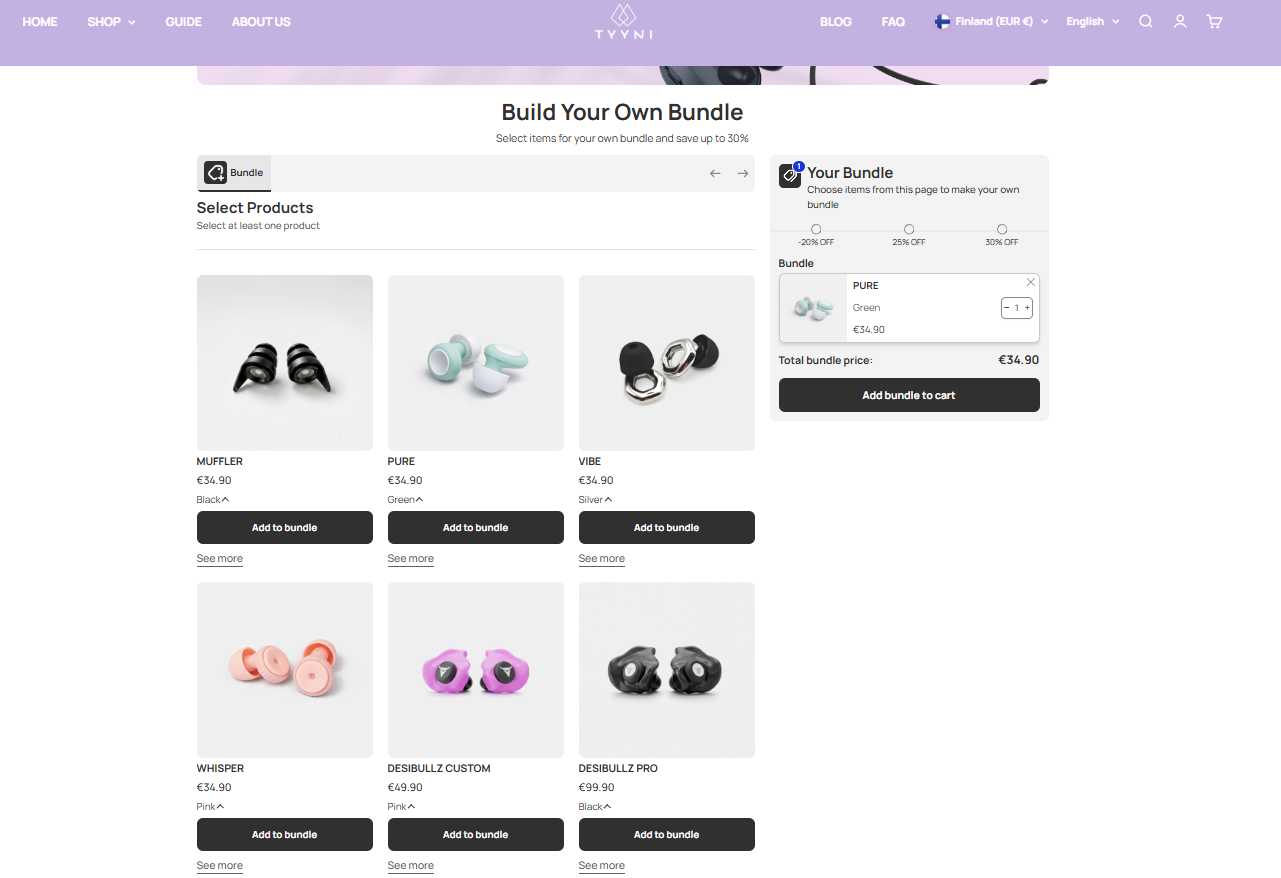
Key details from their setup:
- Use-case-driven pool: Instead of grouping earplugs randomly, TYYNI organizes them by specific use cases customers care about: earplugs for riding under a helmet, earplugs for deep sleep, and earplugs for sports activities. This positions the bundle as a complete solution across different parts of a customer’s day, not as a random mix.
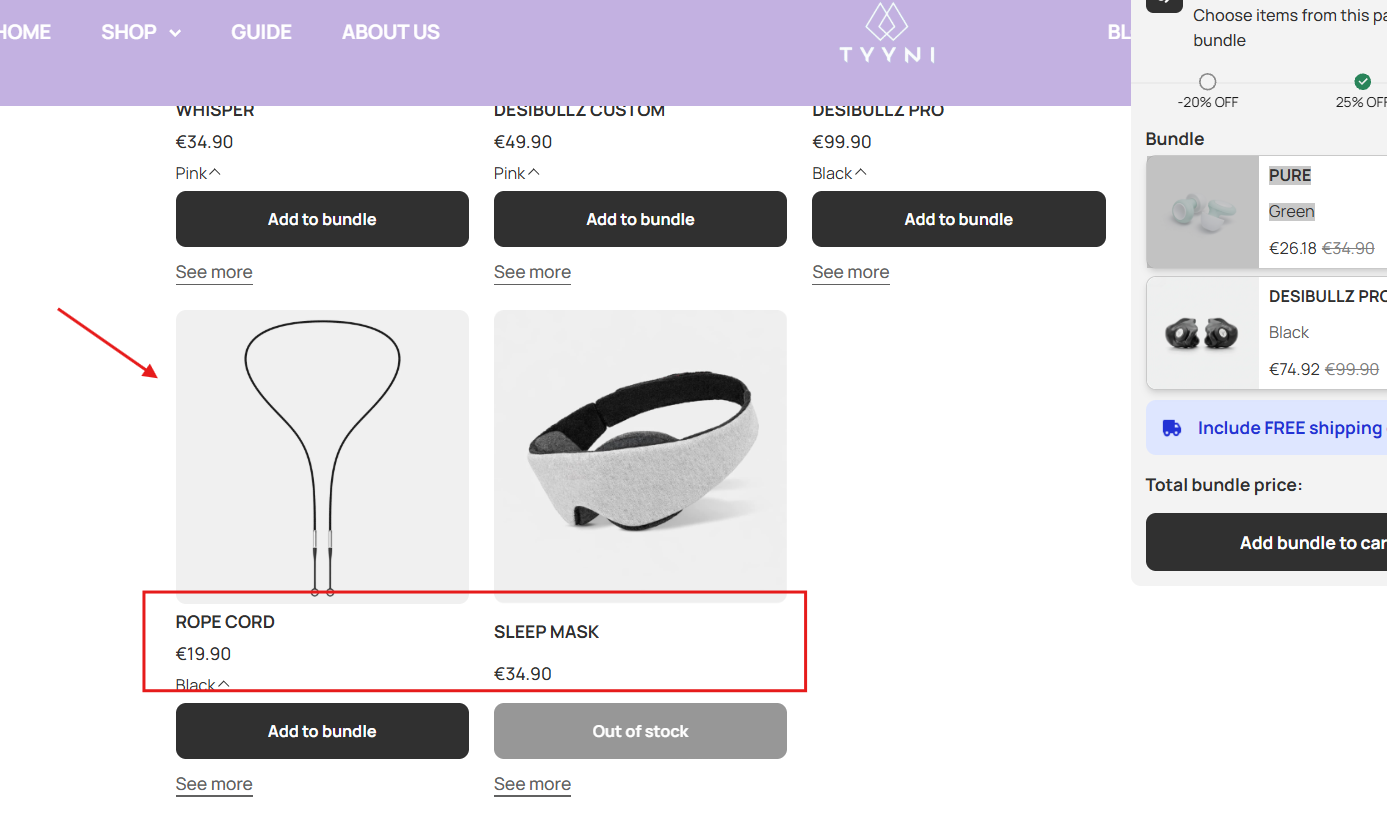
- Accessories as add-ons: The bundle also includes useful accessories, like a neck cord that keeps earplugs secure during outdoor activities. These small add-ons make it easier for customers to reach the next discount tier, while still providing real value.
- Three-tier discount structure. The bundle uses tiered pricing: 20% off for 2 items, 25% off for 3, and 30% off for 4. The jump between tiers is quite small, which motivates customers to add more to their cart without a heavy financial barrier while helping the brand increase AOV significantly.
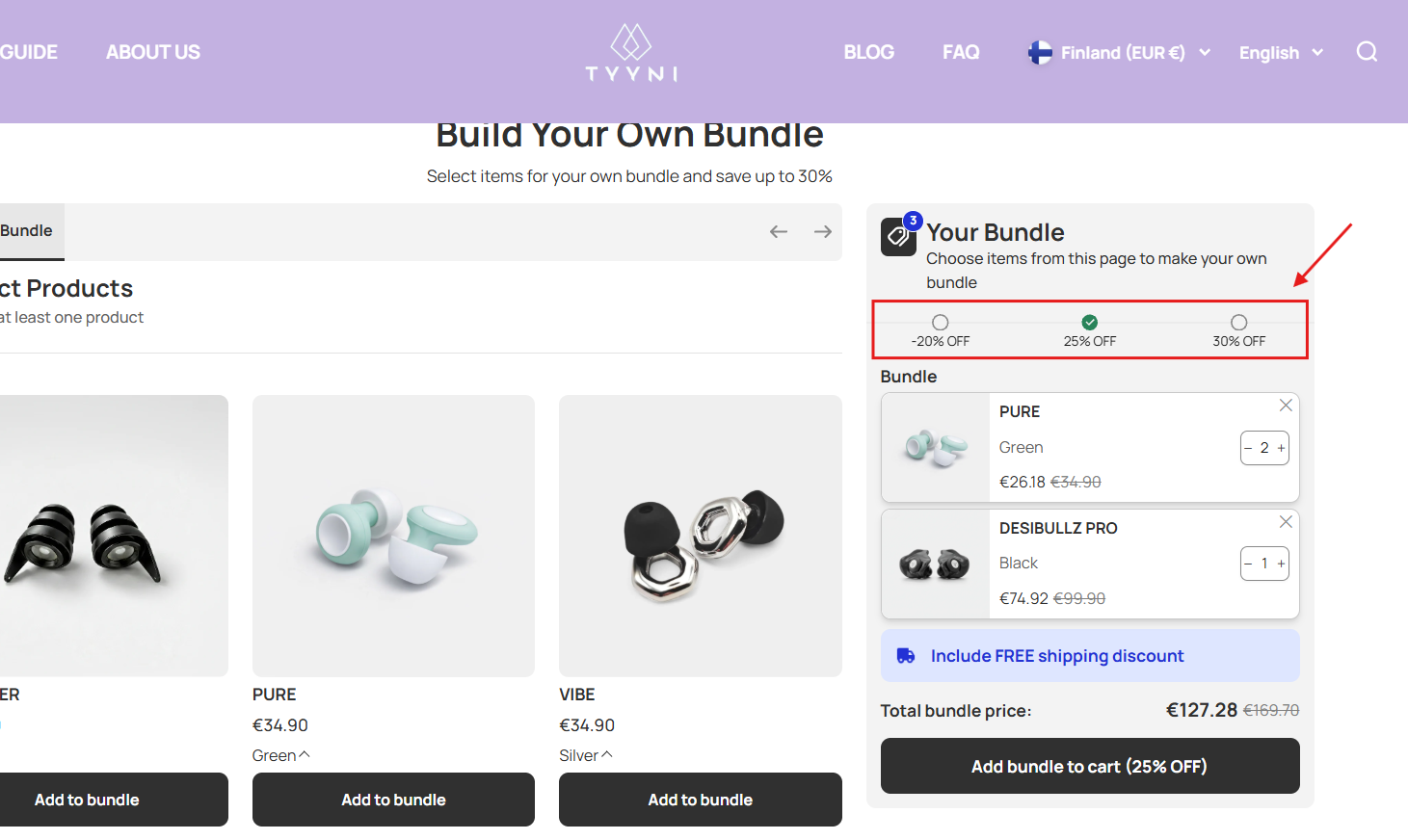
Set up at a glance
- Organize items by specific customer needs so the bundle feels intentional and genuinely beneficial, not like a clearance or random pool.
- Include low-cost accessories as “easy adds” that help customers meet the offer condition effortlessly while still adding real value to the use case.
- Use a clear discount ladder with small, reasonable steps between tiers, paired with meaningful percentage jumps. This motivates shoppers to add more without creating a heavy financial barrier.
2. Slumbrl Builds a Routine Bundle for a Complete Sleep Experience
Slumbrl, a bedding brand, lets shoppers design their own sleep setup through a routine-based bundle. The offer combines essential product groups with a tiered discount framework, encouraging customers to build a complete comfort experience while maximizing per-order value.
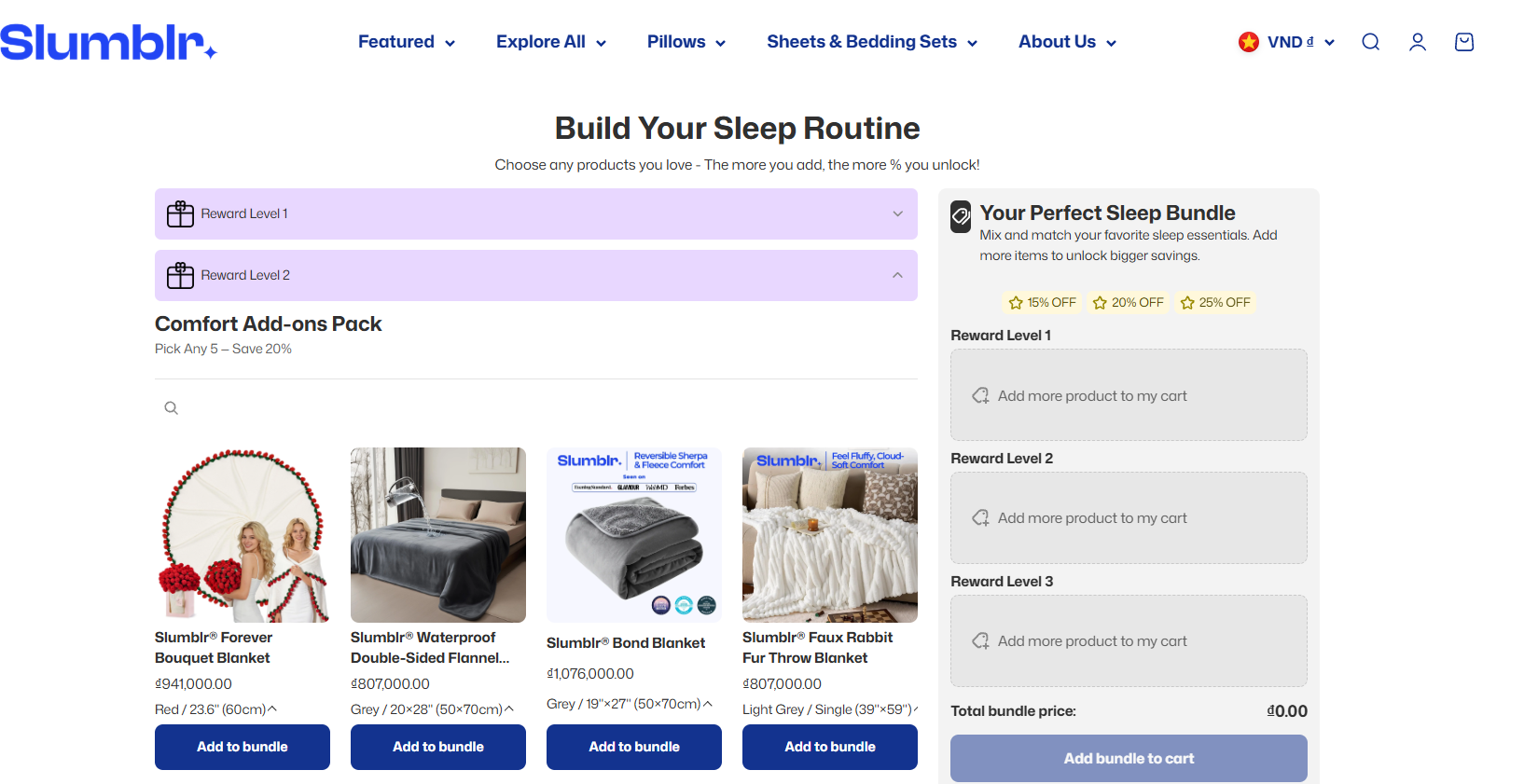
Key details from their setup:
- Routine-based product grouping: Slumbrl organizes items into a complete comfort setup featuring different pillow types (reading pillow, face-down comfort pillow, U-shape contour pillow), with blankets and plushies grouped as accessories. This creates a cohesive sleep routine rather than a random product mix, and the structure mirrors how customers actually use bedding products together.
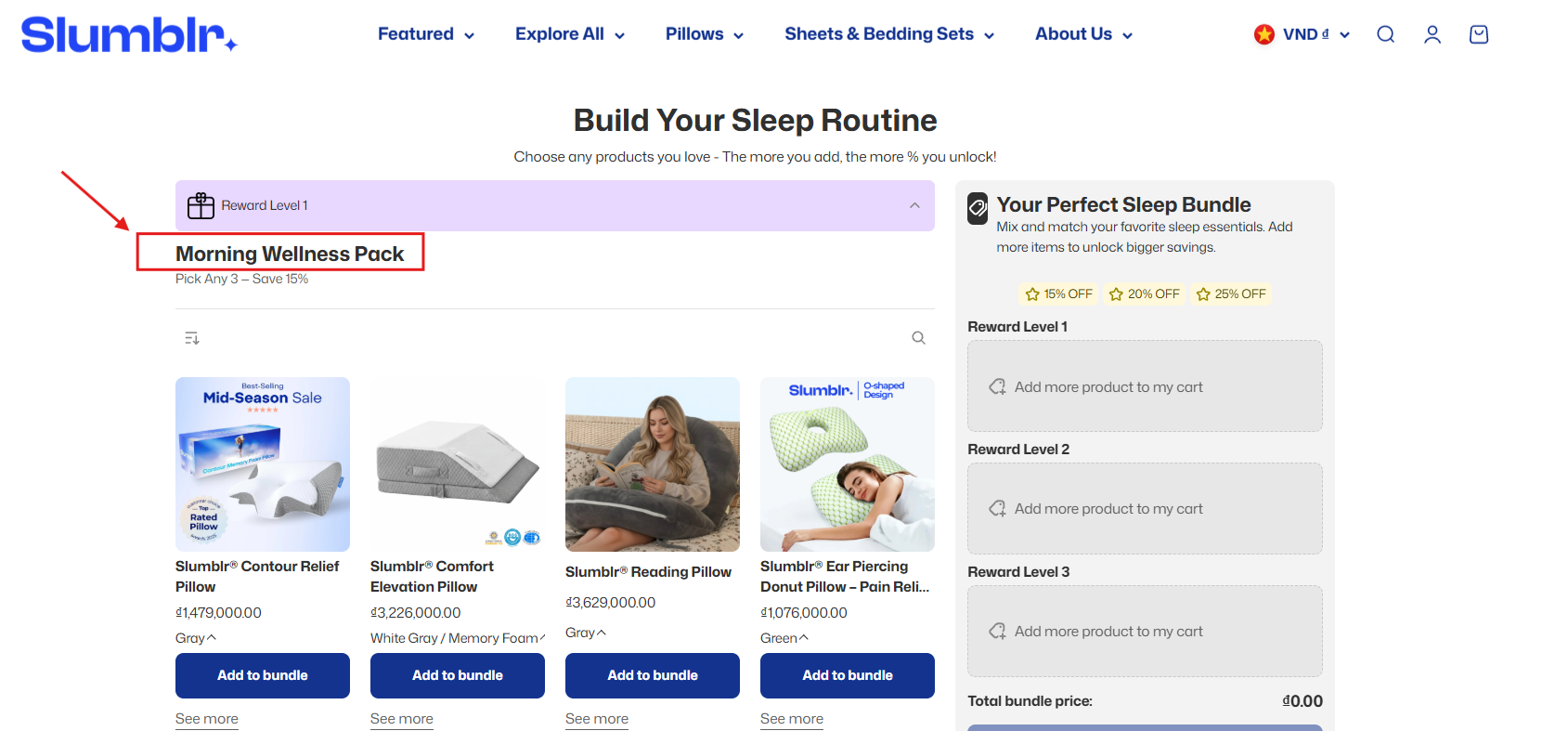
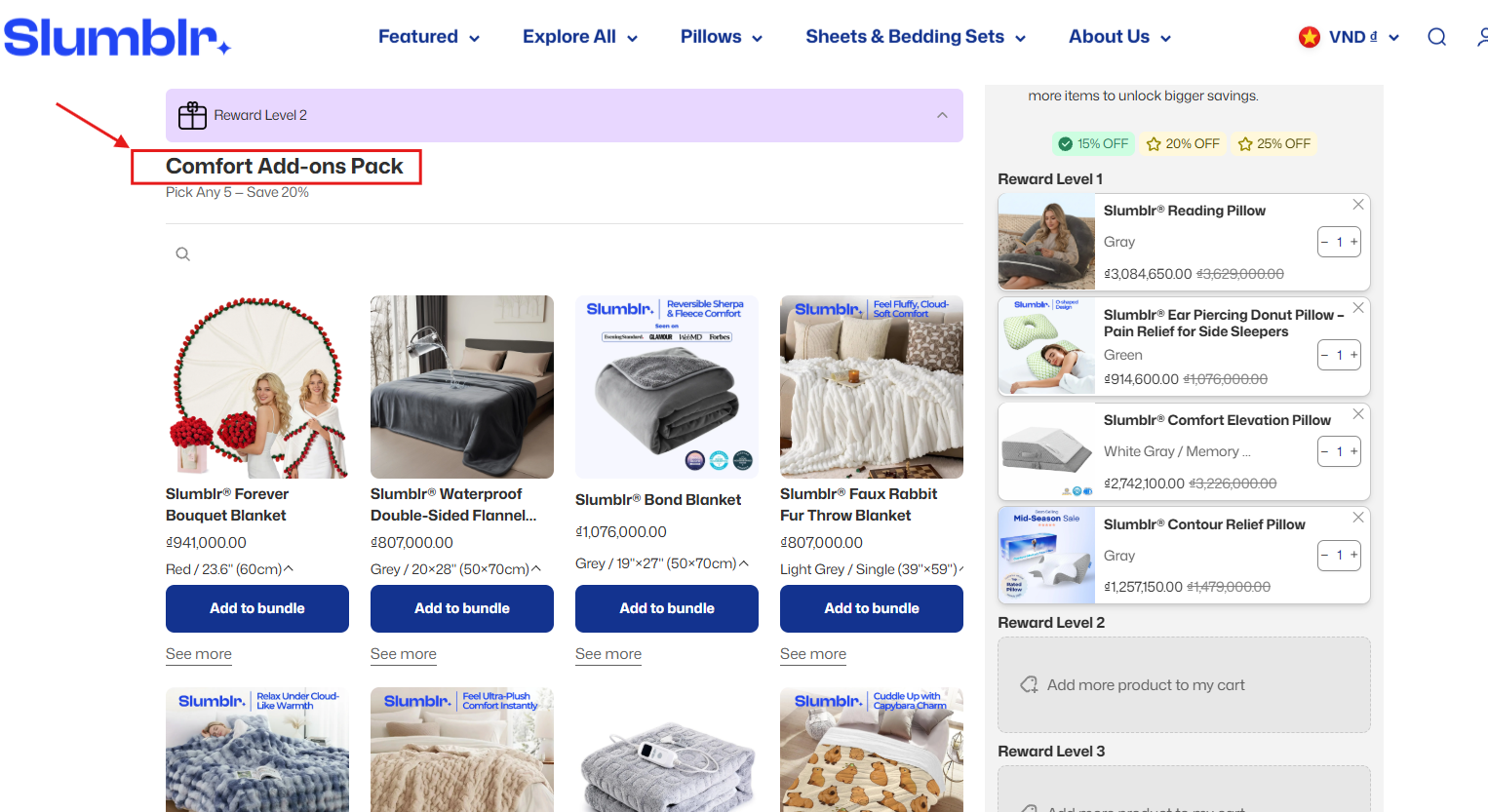
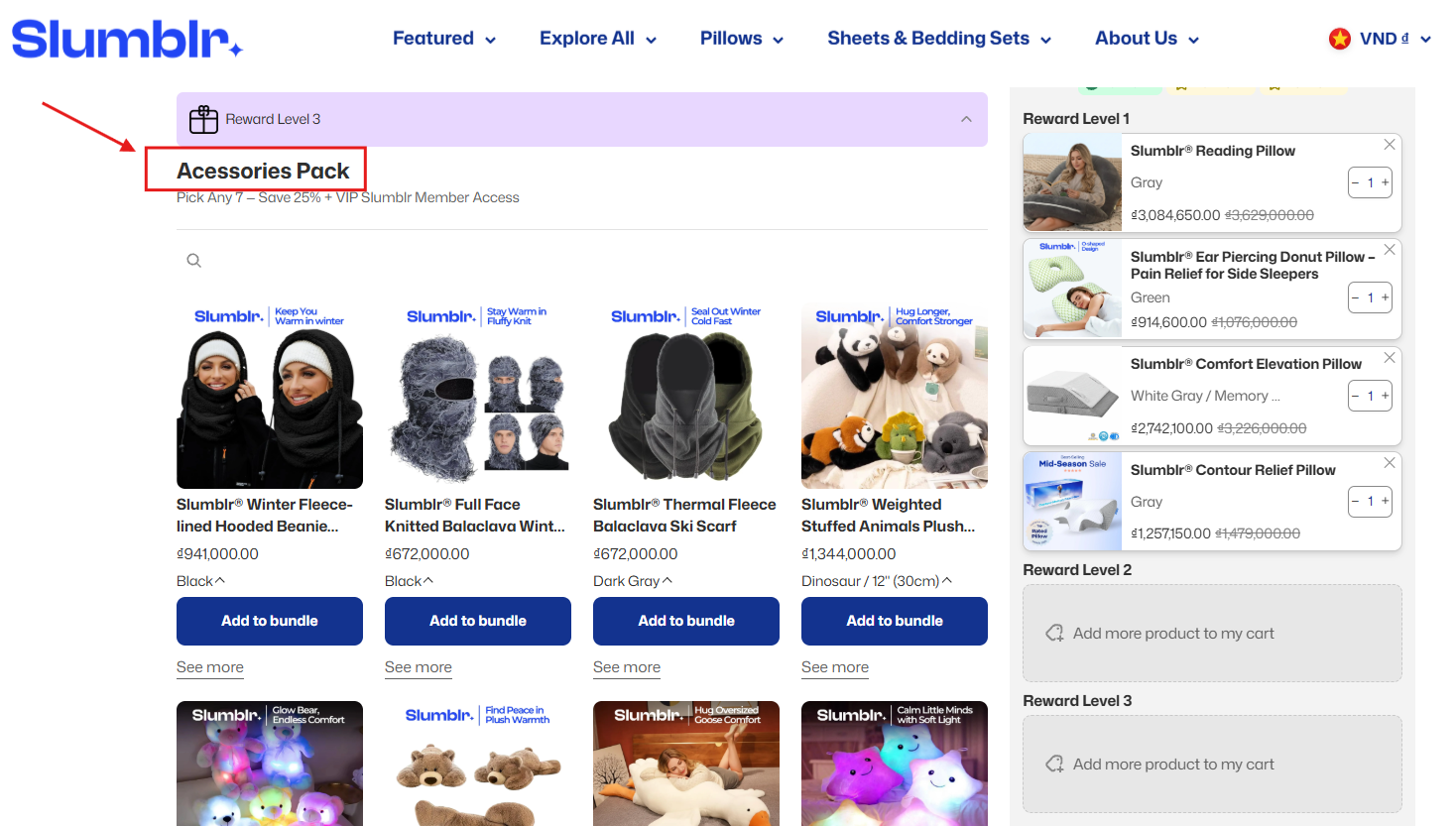
- Tiered discounts that match bulk-buying behavior. Customers unlock 15% off at 3 items, 20% off at 5 items, and 25% off at 7 items. Bedding shoppers often buy in combos or stock up for guest rooms and household refreshes, so the larger bundle sizes feel natural. The clear value compared to single-item purchases shifts the customer mindset to “Why not stock up on essentials I’ll need later at this price?”
Set up at a glance:
- Bundle items from different product categories that complete a specific routine or use case, not a random mix of SKUs.
- Use tiered discounts with larger bundle sizes (5, 7+ items) when your product category supports bulk or household buying behavior, such as bedding, food, or supplements.
- Keep the percentage jumps between tiers reasonable (5 percentage points per tier in Slumbrl’s case) so each step feels achievable without creating a sudden price barrier.
Tips to Enhance Your Bundle Builder Offer for Maximizing AOV Results
Even the best product selection and offer conditions won’t matter if shoppers overlook them. To make sure your Build Your Own Bundle drives strong AOV results, here are 4 simple tips to enhance its appeal and performance.
Write a Catchy Offer Title That Drives Action
Your bundle title is the first thing customers notice. Lead with the outcome, such as a routine, box, or gift, rather than directly pointing out mechanics. Weak titles focus on how the bundle works. Strong titles highlight what the customer is creating, how many items they can choose, and why the bundle delivers more value than the sum of its parts.
👉 Use this simple formula: Action verb + what the customer is building + number of items
Place Your Bundle Offer on High-Traffic Pages
The right placement determines whether the bundle feels like a natural next step or an afterthought. Here is how each location and tool works best:
|
Placement |
Tool |
Best use case |
|
Product page |
Announcement line |
Place a clear announcement about your BYOB offer on the related product page, giving customers a direct link to start building their box |
|
Cart drawer |
Announcement bar |
Reminds customers when they are close to unlocking the bundle discount |
|
Product page or cart drawer |
Progress bar |
Shows exactly how close customers are to completing the bundle or reaching the next pricing tier |
|
Store navigation or SEO |
Dedicated bundle page |
Gives the offer a permanent home and helps attract organic traffic from shoppers searching for custom gift sets or variety packs |
Optimize the Mobile Experience
Most Shopify stores receive more than half of their traffic from mobile devices, which means the bundle builder must work just as smoothly on a phone as it does on a desktop. A bundle flow that requires excessive scrolling, tiny tap targets, or awkward horizontal swiping will lose completions before customers finish their selection.
A mobile-optimized bundle experience should keep three elements visible and accessible at all times: the bundle progress (how many items selected and how close to the next tier), the running total and savings, and the “Add to bundle” button on each product card. Customers should never have to scroll back to the top of the page to check what they have selected or how much they are saving.
A few practical fixes that improve mobile performance:
- Use a sticky bundle summary that stays pinned to the bottom of the screen as customers scroll
- Make product images large enough to evaluate without zooming
- Replace hover states with clear tap targets and ensure buttons are at least 44 pixels tall
- Test the full flow on a phone (selection, preview, cart, checkout) before launch, not just on the desktop preview
A/B Test Your Bundle Setup Before Scaling
A Build Your Own Bundle has multiple variables that can affect AOV, including pool composition, bundle size, discount depth, tier structure, and offer messaging. The only reliable way to know which combination produces the highest AOV for your store is to test variants against each other and let the data decide.
The most useful elements to A/B test are:
- Pricing model. Test a tiered discount against a flat percentage discount to see which one pushes customers to add more items
- Bundle size threshold. Test “Pick any 3” against “Pick any 4” to find the size that balances completion rate with AOV
- Discount depth. Test 10% off against 15% off to identify where the discount stops adding completions and starts eating margin
- Offer title and subtitle. Test outcome-driven titles (“Build Your Morning Routine”) against deal-driven titles (“Save 20% on Any 3 Products”) to see which framing converts better
- Tier increments. Test small jumps (5% per tier) against larger jumps (10% per tier) to find what motivates customers to climb to the next level
Run each test for at least 1-2 weeks. Measure bundle completion rate, average bundle order value, and margin per bundle order side by side. The winning variant is the one that lifts AOV while keeping the margin healthy.
Measuring Whether Your Bundle Is Actually Increasing AOV
A bundle that boosts order volume but erodes margins hasn’t solved your AOV challenge. Track these three key metrics before drawing conclusions:
|
Metric |
What it tells you and where to find it |
|
Bundle completion rate |
The percentage of customers who start the bundle selection flow and add the completed bundle to their cart. Find this in your bundle app’s analytics dashboard. A healthy rate for most bundle types is 15-25%. Below 10% usually means friction in the selection flow or an unclear offer. |
|
Average bundle order value vs. store AOV |
Compare the average value of orders containing a completed bundle against your overall store AOV. If bundle orders are not running at least 30-40% above your store AOV, revisit your product pool and pricing structure. |
|
Margin per bundle order |
Revenue from the bundle order minus product cost, discount, and any fulfilment premium (e.g., gift wrapping). If AOV rises but the margin stays flat or falls, your discount is too deep. Calculate this in a simple spreadsheet using Shopify’s order export. |
Conclusion
A Build Your Own Bundle works for AOV growth because it gives customers a reason to add more items before the discount applies. The cart grows first, then the savings kick in. That structure is what separates a real AOV strategy from a generic promotion.
The decisions that determine whether your bundle moves AOV are clear: which products go into the pool, how the pricing and tiers are structured, and how visible the offer is across your storefront. Get these three right for your specific catalog and customer behavior, and the bundle becomes one of the most reliable ways to increase order value without training customers to wait for discounts.
If you need a flexible platform that supports tiered discounts, multiple pool patterns, and built-in visibility tools like progress bars and offer widgets from one place, BOGOS: Free Gift Bundle Upsell can help you launch, test, and optimize your bundles as your store grows.
Frequently Asked Questions
1. What is the ideal number of items for a Build Your Own Bundle?
Three to five for most stores. Three fit routine bundles where customers think in steps. Four to five fits multipacks and gift boxes, where variety is the appeal.
2. Which pricing model works best for AOV growth?
Tiered discounts perform strongest because each tier gives customers a built-in reason to add more items.
3. How many products should I include in the bundle pool?
Between 8 and 15. Fewer feels restrictive. More creates browsing fatigue. If your catalog is larger, split it into separate bundles by category or use filters within the bundle page.
4. How do I know if my bundle is actually increasing AOV?
Compare bundle order value against your store-wide AOV. Also track bundle completion rate and margin per order. If AOV rises but the margin stays flat, the discount is too steep. If the completion rate is low, the friction is likely in the product pool size or the selection flow.