

For years, e-commerce optimization followed a familiar playbook: tweak your copy, run an A/B test on your primary call-to-action, and make your checkout buttons larger and brighter. But as we cross into the second half of 2026, the era of surface-level conversion rate optimization (CRO) hacks is officially dead.
Shopify is currently executing its most aggressive architectural shift in a decade, forcing high-volume merchants to completely rethink how transactions occur on their storefronts. This isn’t a subtle aesthetic refresh—it is a mandatory, structural migration away from legacy, app-dependent checkout environments toward a native, high-performance ecosystem powered by Checkout Extensibility.
The clock is ticking louder than ever. The most critical technical milestone of this transition is looming directly ahead: the legacy Address Blocker system will be completely shut down on August 31, 2026.
⚡ TL;DR: The Shopify Checkout Revolution
- The August 31 Sunset: Legacy address-blocking apps and deprecated checkout scripts will cease to function on August 31, 2026. Failing to migrate to Shopify's native Checkout Rules will break validations, disrupt warehouse logistics, and spike cart abandonment.
- The Science of Velocity: The native checkout redesign focuses on mobile scanning patterns. Pulling express payment methods (like Shop Pay and Apple Pay) to the top and compressing scroll depth reduces mobile transaction times to under 10 seconds.
- Server-Side Security: Unlike legacy client-side validation apps that are prone to latency and script-blocking, the new native validation engine executes server-side directly within Shopify’s core. This guarantees instant, unbypassable PO Box, military address, and wildcard postal code rules.
- Native B2B Global Scaling: Cross-border compliance is simplified via Shopify Tax. The platform now natively unhides, validates, and zeroes out UK and EU VAT liabilities directly in the checkout flow when a valid B2B tax ID is supplied.
- The CRO-SEO Connection: Driving organic search traffic is meaningless if your checkout leaks. Broken address rules lead to high order cancellation rates, frustrated support channels, and negative external reviews, which signal search engines to degrade your organic rankings.
- Action: Stop relying on legacy apps. Audit your existing scripts, build your native server-side validation configurations, and complete your checkout migration before the looming August deadline.
Merchants still relying on deprecated checkout scripts, outdated validation apps, or unmigrated address blocks face an immediate operational crisis. If your store hasn’t transitioned to native Checkout Rules before the cutoff, your backend logistics will suffer from broken validations, unfulfillable shipments, and sudden spikes in abandoned carts.
From an SEO and customer acquisition standpoint, this is a code-red scenario. Millions of dollars spent driving high-intent organic traffic to your store will be entirely wasted if the bottom of your funnel breaks during the final steps of the buyer’s journey.
1. Deconstructing the Native Checkout Redesign: The Science of Velocity
To understand why Shopify is deprecating its old infrastructure, we have to look at the anatomy of the native checkout redesign. The new framework is completely engineered around mobile-first user psychology, processing speed, and the reduction of cognitive friction.
Mobile-First Scanning Patterns
On mobile screens, users do not read text sequentially; they scan it. Legacy checkouts often overwhelmed users with multi-step pages, dense form fields, and nested drop-down menus that caused severe “input fatigue.”

The native redesign replaces this with a highly compressed, single-page or optimized multi-step layout. Form fields are strictly consolidated, and the visual hierarchy is tuned to standard mobile thumb placement zones, keeping the primary interaction buttons within easy physical reach.
The Power of Express Payment Prominence
Every second added to the checkout process slashes conversion rates. The new layout architecture resolves this by pulling express payment methods (such as Shop Pay, Apple Pay, Google Pay, and PayPal) to the absolute top of the viewable canvas.
By prioritizing these accelerated checkout options, users can authenticate, verify their shipping details, and complete their purchase via biometric scanning in under ten seconds. This design choice bypasses manual data entry entirely, removing the primary friction point where mobile users historically drop off.

Drastic Reduction in Scroll Depth
In the old Shopify checkout framework, a customer had to scroll through distinct, vertically stacked sections for contact information, shipping methods, and billing details. The native overhaul introduces a smart, responsive layout that minimizes scroll depth. On mobile interfaces, a persistent, floating order summary ensures that shoppers always know exactly what they are spending without needing to scroll away from the active input field.
2. Technical Deep Dive: The Checkout Blocks Evolution & The August Sunset
While the front-end layout focuses on maximizing speed, the backend must maintain strict compliance and data accuracy. For years, high-volume merchants used third-party tools or custom app blocks, most notably the “Address Blocker” component within legacy checkout apps, to prevent customers from entering invalid shipping addresses.
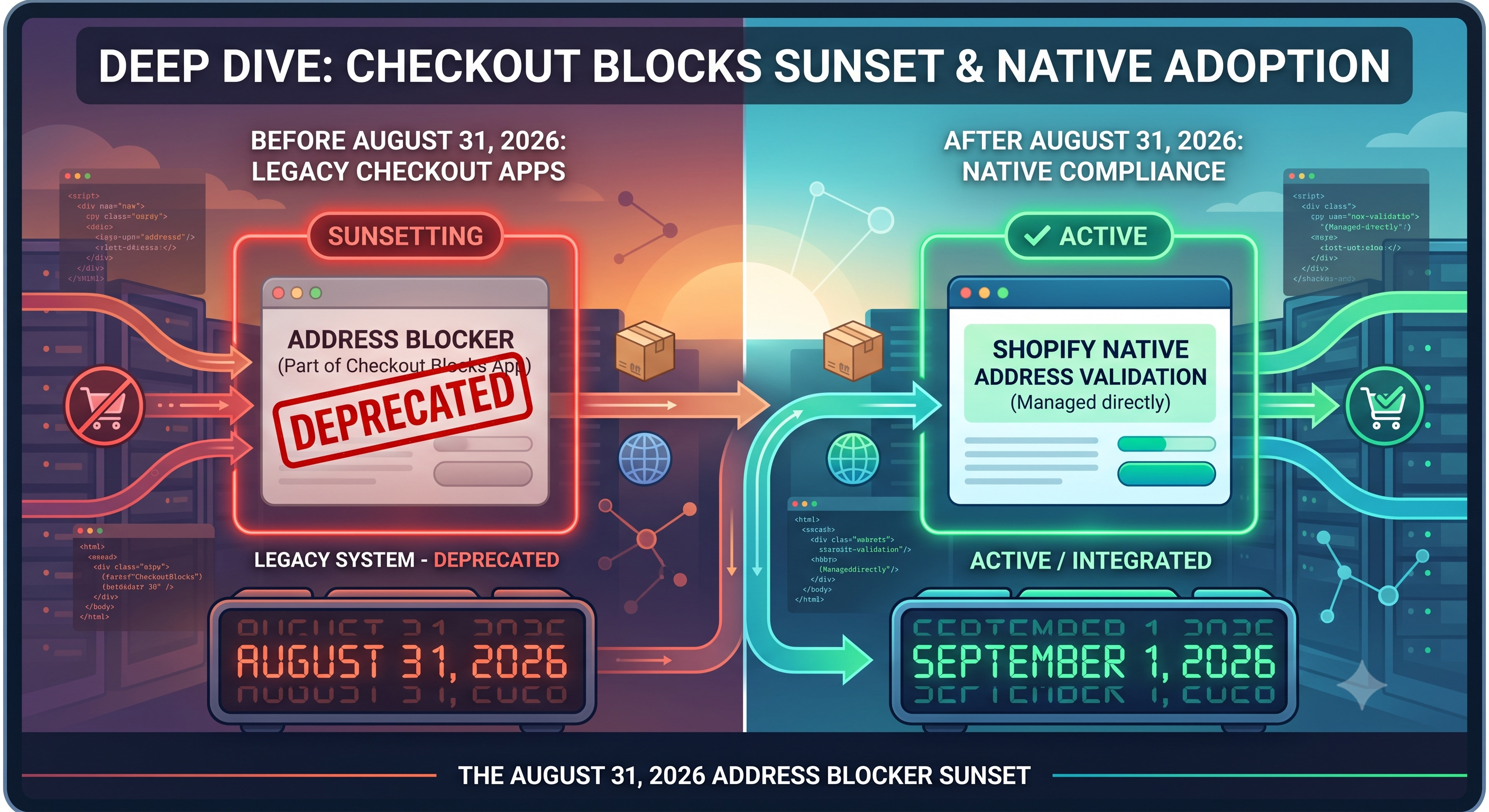
On August 31, 2026, that legacy architecture will cease to exist. Shopify is permanently retiring these older app-block frameworks and replacing them with a native Address Format Validation engine, configured directly within the core platform settings under Checkout Rules.
[Legacy Validation: Client-Side App Script] ──► Slow, easy to bypass, prone to theme conflicts
VS.
[Native Validation: Core Server-Side Rules] ──► Instant, secure, executed at the platform level
Why Immediate Migration is Mandatory
The legacy Address Blocker operated primarily via client-side JavaScript extensions. When a customer typed an address, the app script intercepted the action, verified the data against its external database, and updated the user interface. This process introduced latency, caused conflicts with other scripts, and could occasionally be bypassed if a user had a slow internet connection or a browser that blocked third-party scripts.
The new native system operates server-side, directly within Shopify’s core checkout engine (Settings > Checkout > Checkout rules). Because these validations are hardcoded into the platform’s native pipeline, they execute instantly with zero performance drag, ensuring that invalid data is caught before the checkout can proceed.
Harnessing the Native Validation Engine
The new native setup allows developers and merchants to build highly customized, airtight logic to match their specific supply chain and fulfillment realities:
- PO Box and Military Restrictions: Instantly block shipments to PO Boxes, APO, FPO, or DPO addresses if your primary carrier cannot service them.
- Postal Code Pattern Matching: Enforce precise regular expressions (Regex) or wildcard filters (e.g., restricting specific remote postal zones or matching unique international code structures).
- Character and Field Restraints: Set maximum and minimum length parameters across address lines to prevent formatting issues on physical warehouse labels.
- Inline Real-Time Warnings: Instead of popping up a disruptive error modal after a customer clicks “Complete Order,” the native engine flags layout errors inline as the user types, allowing for immediate correction.
Comparing the Architectures
|
Validation Capability |
Legacy Address Blocker Apps |
Native Checkout Rules (2026 Standard) |
|
Execution Speed |
Dependent on external script load |
Latency-free (Server-side) |
|
Bypass Vulnerability |
High (Can be bypassed via script failure) |
Zero (Locked at platform core level) |
|
Configuration Area |
Third-party app dashboards |
Native Shopify Admin Settings |
|
Regex & Custom Logic |
Limited to app preset features |
Fully extensible wildcard and string matching |
3. Global Scaling: Natively Integrating EU/UK VAT ID Validation
Cross-border e-commerce brands face additional compliance hurdles when selling into international markets. In the United Kingdom and European Union, managing B2B tax exemptions and B2C sales tax requires real-time accuracy to avoid heavy back-tax penalties and shipping delays at customs.

The native checkout redesign addresses this by embedding automated VAT ID validation directly through Shopify Tax.
When an international customer selects an EU member state or the UK as their delivery destination, the checkout interface dynamically adapts. It unhides an authenticated, region-specific tax identification field that communicates via API directly with official verification systems, such as the EU’s VIES system or the UK’s HMRC database.
If a business customer enters a valid, active VAT number, Shopify Tax instantly zeroes out the tax liability for qualified cross-border B2B sales. If the ID is invalid, the checkout surfaces an explicit error, preventing tax fraud and ensuring your accounting data remains perfectly clean.
4. The SEO Connection: Why a Broken Checkout Destroys Organic ROI
Many marketers view checkout migration as a pure development issue, but it is deeply intertwined with your organic search and digital marketing performance.
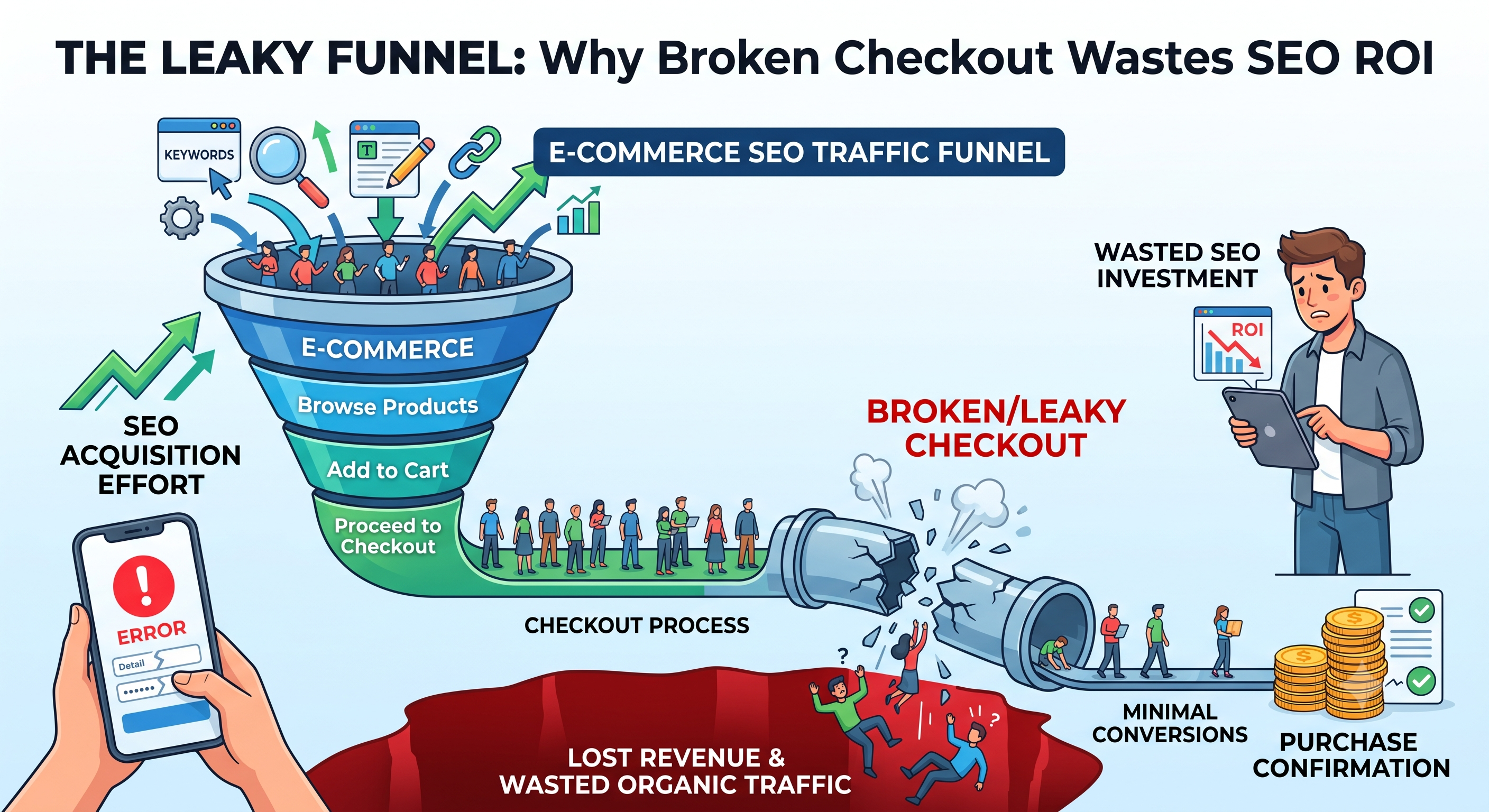
From an SEO specialist’s perspective, securing top-of-funnel rankings and driving traffic is completely meaningless if your site suffers from a leaky checkout funnel. Here is how a delayed or poorly managed checkout migration directly damages your broader SEO and business health:
- Sudden Shifts in Conversion Velocity: If you miss the August 31, 2026 deadline and your address filtering fails, your store will begin processing invalid orders. This leads to a wave of unfulfillable shipments, high cancellation rates, and a massive strain on your customer support team—ultimately hurting your bottom-line revenue metrics.
- Spike in Cart Abandonment: If your legacy apps break or become misconfigured due to automatic platform updates, users will run into generic, unresolvable errors during checkout, driving them straight to your competitors.
- Negative Search Engine Signals: A broken checkout experience results in frustrated customers, leading to negative reviews on external platforms (like Trustpilot or Google Reviews) and poor brand mentions across the web. Search engines track user satisfaction and brand sentiment; a sustained drop in customer happiness can gradually degrade your organic rankings.
5. Monetize the Shift: Let Us Secure Your Checkout Pipeline
The transition away from legacy apps and the impending shutdown of the old Address Blocker framework doesn’t have to be a headache. When executed correctly, migrating to Shopify’s native checkout architecture is a massive revenue opportunity that secures your tracking accuracy, protects your ad spending, and turns more visitors into buyers.
Do not wait until August 31 to discover that your checkout validation apps have stopped working. Let our expert development team handle the heavy lifting to ensure a seamless, high-performance upgrade.
Our Specialized Checkout Packages:
- Urgency Migration Service (Legacy Blocker to Checkout Rules): We will audit your store’s existing address blocking configurations, write and test custom native validation rules, and completely transition your backend before the August 31 deadline with zero storefront downtime.
- Custom Checkout & Customer Account Branding: We design and deploy beautifully customized, single-page checkout screens that perfectly match your brand’s unique identity—built entirely on the native, high-speed Checkout Extensibility framework.
- International Compliance & Tax Engineering: Full integration of Shopify Tax and real-time VAT ID validation systems to ensure your cross-border business remains fully compliant with EU and UK tax laws.
The clock is ticking on legacy checkout apps. Contact our development team today to schedule your migration and lock in an optimized, compliant checkout funnel.
Frequently Asked Questions
1. What exactly is happening to Shopify checkout on August 31, 2026?
Shopify is permanently shutting down its legacy checkout architecture, specifically deprecating old client-side checkout scripts, outdated validation apps, and the legacy Address Blocker system. High-volume merchants must transition to Shopify’s native Checkout Extensibility and Checkout Rules before this hard cutoff to prevent their checkout funnels from breaking.
2. Why is Shopify replacing third-party validation apps with native rules?
The transition is driven by speed and security:
The Old Way: Legacy apps relied on client-side JavaScript, which injected latency, caused theme conflicts, and could easily be bypassed if a browser blocked third-party scripts.
The New Way: Native Checkout Rules operate server-side directly within Shopify’s core engine. This means validation happens instantly with zero performance drag and zero vulnerability to bypass hacks.
3. What kind of custom logic can I build with the new native validation engine?
The native Checkout Rules allow merchants to configure airtight, supply-chain-specific logic directly in the Shopify Admin, including:
Shipping Restrictions: Instantly block delivery to PO Boxes, APO, FPO, or DPO addresses.
Pattern Matching: Use Regular Expressions (Regex) or wildcards to filter out restricted international postal zones.
Formatting Limits: Enforce minimum or maximum character counts to prevent shipping label printing errors at your warehouse.
Inline Errors: Flag layout and entry errors in real time as the user types, rather than throwing a disruptive error modal after they click “Complete Order.”
4. How does the new checkout handle international tax compliance for the EU and UK?
Cross-border scaling is now natively integrated through Shopify Tax. When a customer selects a UK or EU delivery destination, the checkout dynamically displays an authenticated, region-specific tax identification field. The platform communicates via API with official databases (like the EU’s VIES or the UK’s HMRC) to validate VAT numbers in real time, automatically zeroing out tax liabilities for qualified B2B transactions.
5. I thought checkout was a development issue—how does it affect my store's SEO?
Driving high-intent organic traffic to your store is a waste of capital if your checkout funnel leaks at the finish line. If you miss the migration deadline and your checkout breaks:
Cart abandonment will spike, throwing off your baseline conversion data.
System errors and unfulfillable orders will lead to a flood of customer support issues.
Frustrated users will leave negative brand sentiment signals online (such as poor Google and Trustpilot reviews). Search engines track customer satisfaction and brand health, meaning a wave of bad reviews can gradually degrade your organic search rankings.