
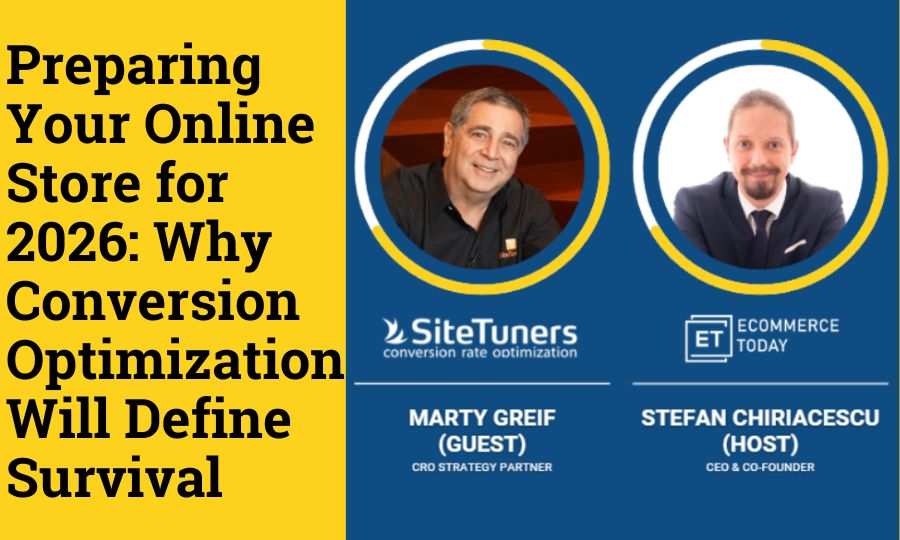
During the latest Ecommerce Today webinar, Ștefan Chiriacescu opened the discussion by framing a reality many brands prefer to postpone: the cost of traffic is rising steadily, Artificial Intelligence is reshaping how purchases are made, and the competitive edge will shift from who attracts more visitors to who converts them more efficiently. In conversation with Marty Greif, President at SiteTuners and renowned international keynote speaker, he explored what e-commerce businesses must internalize now if they want to remain relevant by 2026.
Ștefan emphasized that while AI assistants will soon handle routine orders automatically, emotionally driven purchases and high-consideration products will still rely heavily on website experience. That makes on-site performance exponentially more important. When acquisition costs increase and automation absorbs repetitive demand, inefficiency becomes a structural risk rather than a temporary weakness.
As Marty explained, AI will effectively become the most consistent sales force in history; always learning, never distracted, capable of analyzing patterns and behavioral signals faster than any human team. In that environment, mediocre persuasion will not survive. What used to be a growth lever becomes survival infrastructure.
Visitors Are Not Interested in You
One of Marty’s most direct statements during the webinar was also the most psychologically accurate: online visitors are inherently self-focused. They do not land on a website to appreciate a brand’s story, achievements, or internal milestones; they arrive because they want a solution, reassurance, or clarity.
He shared an example in which rewriting an “About Us” page from company-centered messaging to visitor-centered reassurance generated a 31% increase in conversion rate. The shift was not about adding persuasive tricks but about reframing language from “who we are” to “why this matters to you.”
Ștefan reinforced this point by noting that brands that continue to communicate primarily about themselves are unintentionally increasing friction. Customer-centric positioning is not branding theory; it is conversion psychology applied correctly.
The Three Questions Every Website Must Answer Immediately
Marty outlined three rapid evaluations that occur subconsciously when a visitor lands on a page, and he stressed that failing even one of them can collapse the session.
The first is clarity: “Am I in the right place?” If a user clicks on an ad for a solitaire diamond engagement ring and lands on a generic homepage instead of a precise product page, cognitive friction appears instantly. According to Marty, the brain is wired to avoid unnecessary effort, and every extra decision point reduces conversion probability. Ștefan added that message alignment between ads and landing pages is one of the fastest ways to lower acquisition costs without increasing spend.
The second evaluation is emotional: “How do I feel about this site?” Marty explained that trust is processed visually before it is rationalized intellectually. Modern layout, strong social proof, visible security signals, and accessible contact information all reduce subconscious doubt. Ștefan observed that post-pandemic consumers are more cautious with unfamiliar brands, which makes visible trust elements, such as a phone number in the header or physical store locations, disproportionately valuable.
The third question is behavioral: “What am I supposed to do next?” Marty argued that websites often fail not because of poor products, but because of overwhelming structure. When too many options are presented simultaneously, the brain experiences cognitive overload. He recommends limiting primary visual categories and guiding users with structured progression rather than forcing them to navigate complexity alone.
Design Habits That Quietly Reduce Conversions
Both speakers addressed common design elements that appear modern but often harm performance. Marty was explicit about rotating banners and homepage sliders, explaining that sudden movement is processed by the brain as a potential threat, fragmenting attention and lowering focus on primary calls to action. While they may look dynamic, tests frequently show measurable decreases in conversion rates.
On the subject of pop-ups, Marty argued that if immediate interruptions are responsible for most sales, the base site persuasion is likely weak. Ștefan added nuance from a marketing automation perspective, clarifying that pop-ups are not inherently negative, but their timing and contextual placement determine whether they assist or damage conversion flow. For example, interrupting a user before they have viewed product imagery often creates resistance rather than engagement.
They also discussed the common practice of placing “Bestsellers” prominently at the top of the homepage. Marty challenged this approach by suggesting that pushing top-selling products before understanding visitor intent prioritizes the brand’s agenda over the user’s needs. Conversion optimization is often about removing friction and sequencing persuasion correctly, not about adding more elements.
Analytics Before Aesthetics
When working with new clients, Marty’s first step is rarely visual redesign; it is analytical alignment. Reviewing traffic sources, auditing analytics configuration, and ensuring that ad messaging matches landing page experience frequently produces profitability improvements without touching design. According to Ștefan, many brands underestimate how much acquisition inefficiency is caused by misaligned messaging rather than poor layout.
Execution discipline was another major theme. Marty warned against implementing multiple changes simultaneously, as this destroys the ability to isolate causality. Ștefan highlighted a related mistake: comparing inconsistent time periods, which leads to misleading conclusions. During major redesigns, Marty recommended measuring early performance primarily through new visitors, since returning customers often resist change temporarily and can distort short-term data.
What 2026 Will Reward
As the session concluded, Ștefan summarized the broader strategic direction: growth in 2026 will be defined by efficiency rather than scale alone. Traffic volume without on-site performance will no longer be enough. Long-term planning, controlled experimentation, and disciplined A/B testing will outperform reactive optimization.
Marty reinforced that the brands that win will treat CRO not as a campaign tactic but as a permanent operational capability embedded into decision-making. Establishing benchmarks, aligning acquisition intent with landing clarity, strengthening psychological reassurance, and iterating systematically will compound advantages over time.
In an environment shaped by AI acceleration and rising acquisition costs, the question will no longer be how much traffic you can buy, but how intelligently you convert the traffic you already have.
For more in-depth, watch the 1-hour webinar here.